
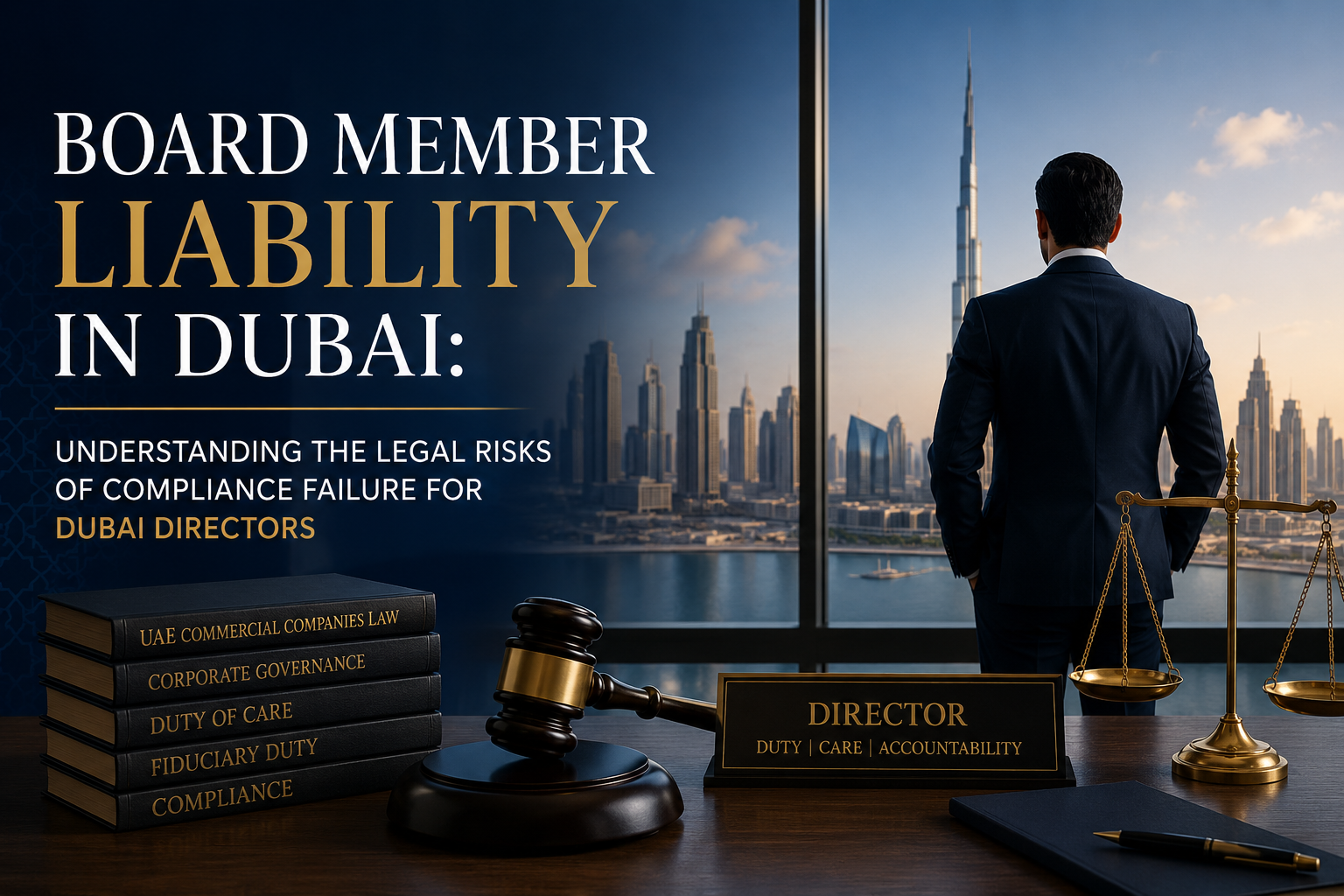
Board Member Liability in Dubai: Understanding the Legal Risks of Compliance Failure for Dubai Directors
Introduction
Being a company director in Dubai has always carried prestige. It signals leadership, authority, and commercial credibility. But in 2024 and beyond, it carries something else too: significant personal risk.
Under Dubai commercial law, the corporate veil that once offered comfortable protection to directors and board members has been steadily pierced by courts willing to hold individuals personally accountable for what happens inside their companies. The introduction of Federal Decree-Law No. 51 of 2023 on bankruptcy in Dubai, enforced since May 2024, has made this shift impossible to ignore.
In November 2024, the Dubai Court of Cassation ordered directors and shareholders to pay AED 850 million in personal damages, the largest such judgment in UAE history. In January 2025, a former CEO was ordered to pay AED 152 million personally. These are not cautionary tales. They are real judgments being enforced against real individuals.
The legal framework every Directors must understand
Director liability in the UAE does not stem from a single law. It is built across several overlapping pieces of legislation, and understanding how they interact is the starting point for any director serious about protecting themselves.
The UAE companies law, Federal Decree-Law No. 32 of 2021 on Commercial Companies, is the primary framework. It establishes core duties of care, loyalty, and good faith for both LLC managers and joint stock company directors. It holds directors personally accountable for fraud, misuse of authority, and gross negligence causing harm to the company, shareholders, or third parties.
Alongside it sits the updated Bankruptcy Law, the Anti-Money Laundering Law, the Labour Law, and the UAE Penal Code. Each creates its own layer of liability. In practice, a single governance failure can trigger civil, criminal, and administrative penalties simultaneously, across more than one of these laws at the same time.
For directors of companies in free zones, the position is not simpler. While DIFC and ADGM operate under separate frameworks, onshore free zone directors remain subject to UAE federal law including corporate tax, AML obligations, and the Bankruptcy Law.
Who can actually be held liable: It goes further than you think
One of the most important and most misunderstood aspects of UAE director liability is how broadly the law defines who qualifies as a director in the first place.
Formal appointment to a board is not required. Under the Bankruptcy Law and the Commercial Companies Law, liability extends to anyone who effectively manages the company or influences its decisions. This includes:
- Shadow directors who instruct formal directors while staying in the background
- Controlling shareholders who make operational decisions without holding a title
- Family business leaders who drive decisions informally
- Private equity representatives who control board composition
- Corporate service providers exercising operational control over a UAE entity
A common question directors ask is whether shareholders are liable for company debts in the same way directors are. The answer, under UAE law, is increasingly yes, if those shareholders exercise actual management control. The November 2024 Hadef Partners case made this explicit, holding shareholders personally liable as de facto managers despite having resigned from formal roles more than ten years earlier.
The lesson is stark. You cannot resign your way out of liability if you continue to exercise real influence over company decisions.
Civil and criminal penalties: What directors actually face
Many directors assume that the worst outcome of a compliance failure is a company fine. The reality under UAE law is considerably more personal.
On the civil side, directors can be ordered to personally compensate losses caused by negligence or misconduct. Recent judgments demonstrate the scale: AED 850 million in the Hadef case, AED 450 million in the Marka case, and AED 152 million against the Drake and Scull CEO. Understanding what is the punishment for a civil case in the UAE is therefore not an academic question for Dubai directors. It is a question of personal financial survival.
On the criminal side, the Bankruptcy Law provides for up to five years imprisonment and fines of up to AED 1 million for fraudulent conduct including asset concealment, falsifying accounts, and admitting fictitious debts. The UAE Penal Code adds further exposure for embezzlement and breach of trust, with penalties reaching ten years imprisonment in serious cases.
Administrative penalties operate alongside criminal and civil proceedings, not instead of them. Regulatory bodies can impose fines independently, freeze assets, and issue travel bans without waiting for court outcomes. For expatriate directors, the consequences extend further still, with deportation and permanent exclusion from the UAE a real possibility following conviction.
AML compliance: The liability risk most directors underestimate
Of all the compliance obligations facing Dubai directors, AML compliance is the one most frequently underestimated. The Anti-Money Laundering Law imposes non-delegable personal responsibility on directors. If a company facilitates money laundering or fails to implement adequate AML programmes, the director cannot simply point to a compliance officer and walk away.
Personal criminal liability under UAE AML law includes imprisonment and fines ranging from AED 50,000 to AED 300,000, with more serious cases attracting heavier penalties. Directors are responsible for appointing compliance officers, ensuring proper customer due diligence, monitoring suspicious transactions, and filing Suspicious Transaction Reports with the Financial Intelligence Unit.
For companies in financial services, real estate, precious metals, and professional services, these obligations are even more stringent. A director who fails to take AML seriously is not just exposing the company. They are exposing themselves.
Three cases that redefined what personal liability means in Dubai
Understanding how UAE courts apply director liability provisions in practice is essential. Three cases from recent years demonstrate just how seriously the courts take this area.
The AED 850 million judgment from November 2024 is the most significant. The Dubai Court of Cassation held shareholders liable as de facto managers despite having formally resigned over a decade earlier. The court found that six years of improper financial record-keeping constituted gross negligence. Civil and criminal proceedings were pursued simultaneously.
The Drake and Scull case from January 2025 resulted in the former CEO being ordered to pay AED 152 million personally. The court found that specific management decisions made during the period leading to financial distress breached fiduciary duties and contributed to creditor losses. Executive decisions made before insolvency are subject to exactly the same judicial scrutiny as decisions made during it.
The Marka case from 2021 saw directors held liable for AED 450 million when company assets fell below 20% of total debts. While the new Bankruptcy Law now requires proof of causation rather than applying automatic liability, the financial exposure involved in these cases remains extraordinary.
Two defenses that can genuinely protect you
The law does provide meaningful protection for directors who plan ahead. Two statutory defenses under Article 246 of the Bankruptcy Law are available, but both require contemporaneous written evidence to work.
The first is the written objection defense. Any director who formally records their objection to a harmful decision in board minutes or via written communication at the time it is made is explicitly protected under the law. The objection must be specific, explaining why the decision violates fiduciary duties or harms creditors. A vague verbal disagreement will not suffice.
The second is the reasonable precautionary measures of defense. Directors who can demonstrate they sought independent professional advice, obtained proper valuations for material transactions, documented board decisions thoroughly, and actively worked to minimise creditor losses can avoid personal liability even when the company ultimately fails.
Both defenses rest on one foundation: documentation. The burden of proof falls on the director, not the court. Build your evidence now, not when proceedings have already begun.
Directors and Officers insurance: Useful but not a complete answer
Given the scale of recent judgments, directors and officers insurance has become a serious consideration for any board member of a substantial UAE company. A good D&O policy covers legal defense costs and certain civil settlement amounts arising from claims under the Bankruptcy Law and Commercial Companies Law.
However, director and officer liability insurance has important limitations that directors must understand clearly. It does not cover criminal fines, deliberate wrongdoing, fraudulent conduct, or personal profit obtained through misconduct. Given that recent UAE judgments have reached AED 850 million, no insurance policy should be treated as a substitute for proper governance.
D&O coverage is a useful layer of financial protection. It is not a safety net that allows directors to be careless.
A practical compliance checklist for Directors
The best protection against personal liability is a culture of proactive compliance, built before any sign of financial distress appears. Here is what every director should have in place:
- Detailed board minutes documenting all significant decisions, information reviewed, and any dissenting votes
- Written objections formally recorded whenever a director disagrees with a proposed decision
- Independent legal and financial advice sought and documented for complex or high-risk transactions
- Accurate, up-to-date financial records maintained at all times and readily accessible
- AML compliance programmes implemented with a properly appointed compliance officer
- Ultimate Beneficial Owner register maintained and updated within 15 days of any change
- Corporate tax returns filed correctly and on time with proper transfer pricing documentation
- Immediate engagement of restructuring advisors at the first sign of financial distress
None of these steps are extraordinary. They are the building blocks of sound governance, and in a legal environment as demanding as Dubai's, they are also the building blocks of personal protection.
How Filing Buddy supports Directors
Navigating the personal liability landscape as a director in Dubai is not something that should be done alone. The legal frameworks are complex, the consequences of getting it wrong are severe, and the pace of regulatory change means that what was compliant last year may not be compliant today.
At Filing Buddy, we work with companies and their directors across Dubai and the UAE on compliance consulting that goes beyond tick-box exercises. From corporate tax filings and AML programme reviews to governance documentation and board advisory support, our team helps directors build the kind of compliance record that protects them when it matters most.
If you are a director of a Dubai company and you are not fully confident in your compliance position, the right time to act is now, before financial distress arrives, not after.
Speak to Filing Buddy's compliance experts in Dubai today and take the first step toward protecting yourself, your business, and your reputation.
Contact Us
An expert will call you within 24 hours. No payment required to get started.
 The Ultimate Guide to the UAE Corporate Tax 9-Month Rule (August Deadlines Explained)
5 minutes read
The Ultimate Guide to the UAE Corporate Tax 9-Month Rule (August Deadlines Explained)
5 minutes read
.png) UAE VAT Return Filing: Step-by-Step Guide | Filing Buddy
5 minutes read
UAE VAT Return Filing: Step-by-Step Guide | Filing Buddy
5 minutes read
 Top CA Firms in Dubai for SME Tax Registration (2026 Guide)
5 minutes read
Top CA Firms in Dubai for SME Tax Registration (2026 Guide)
5 minutes read
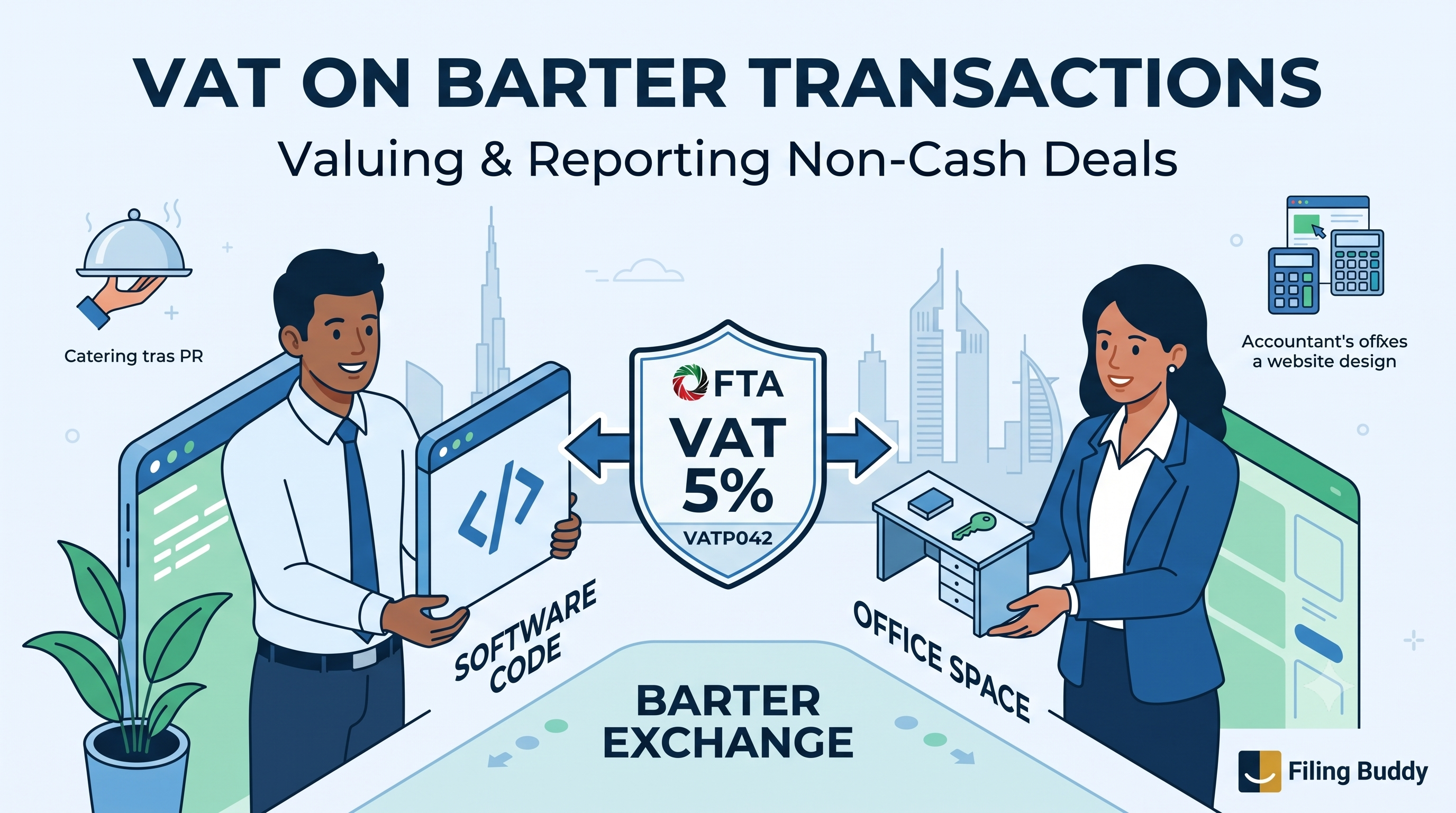 VAT on Barter Transactions UAE: How to Legally Value and Report Non-Cash Deals in Dubai
3 min
VAT on Barter Transactions UAE: How to Legally Value and Report Non-Cash Deals in Dubai
3 min
Have a question about this?
Our team can walk you through what applies to your business and what to do next.
Talk to our teamRelated posts
.png)
Decoding FTA Guidelines: Aggregated Financial Statements & Audit Compliance for UAE Corporate Tax Groups
Understand AFS rules and audit compliance for UAE Tax Groups under FTA guidelines. Learn key conditions, disclosures, and deadlines with expert Filing Buddy support.
. 5 min read.png)
UAE Free Zone Corporate Tax Updates
Unlock 0% UAE Free Zone tax benefits. Discover 2025 updates on qualifying activities and pricing rules—act now to stay compliant and avoid penalties.
. 3 min read.png)
UAE E-Invoicing – Complete Guide (2026)
Comprehensive guide to UAE eInvoicing (2026): understand DCTCE 5-corner model, XML invoices, FTA compliance, implementation timeline, and how businesses can prepare.
. 5 min readEverything right at your mail.
Request a Call Back
Leave your details and our team will call you.
Chat with us on WhatsApp
Hi there! 👋 Connect with our team on WhatsApp.
Hello FilingBuddy, I would like to know more about your services.
Chat Now