
Co-Founder Prenup: The Critical Shareholders Agreement Guide

The air in the National Company Law Tribunal (NCLT) hallway is usually stale, smelling faintly of damp files and desperation. For "Rohan", a Bengaluru-based fintech founder, it smells like regret. Three years ago, he and his college roommate launched a payments startup with a handshake and a 50:50 equity split. No vesting schedule. No exit clauses. Just "vibes" and a shared vision.
Today, that roommate has moved to Goa, stopped answering Slack messages, and refuses to sign off on a critical Series A term sheet unless he gets a massive secondary exit. Rohan is stuck. The investors have walked away, citing "cap table instability." The startup, once valued at $15 million, is effectively dead. Rohan isn’t fighting a competitor; he’s fighting a ghost on his own cap table.
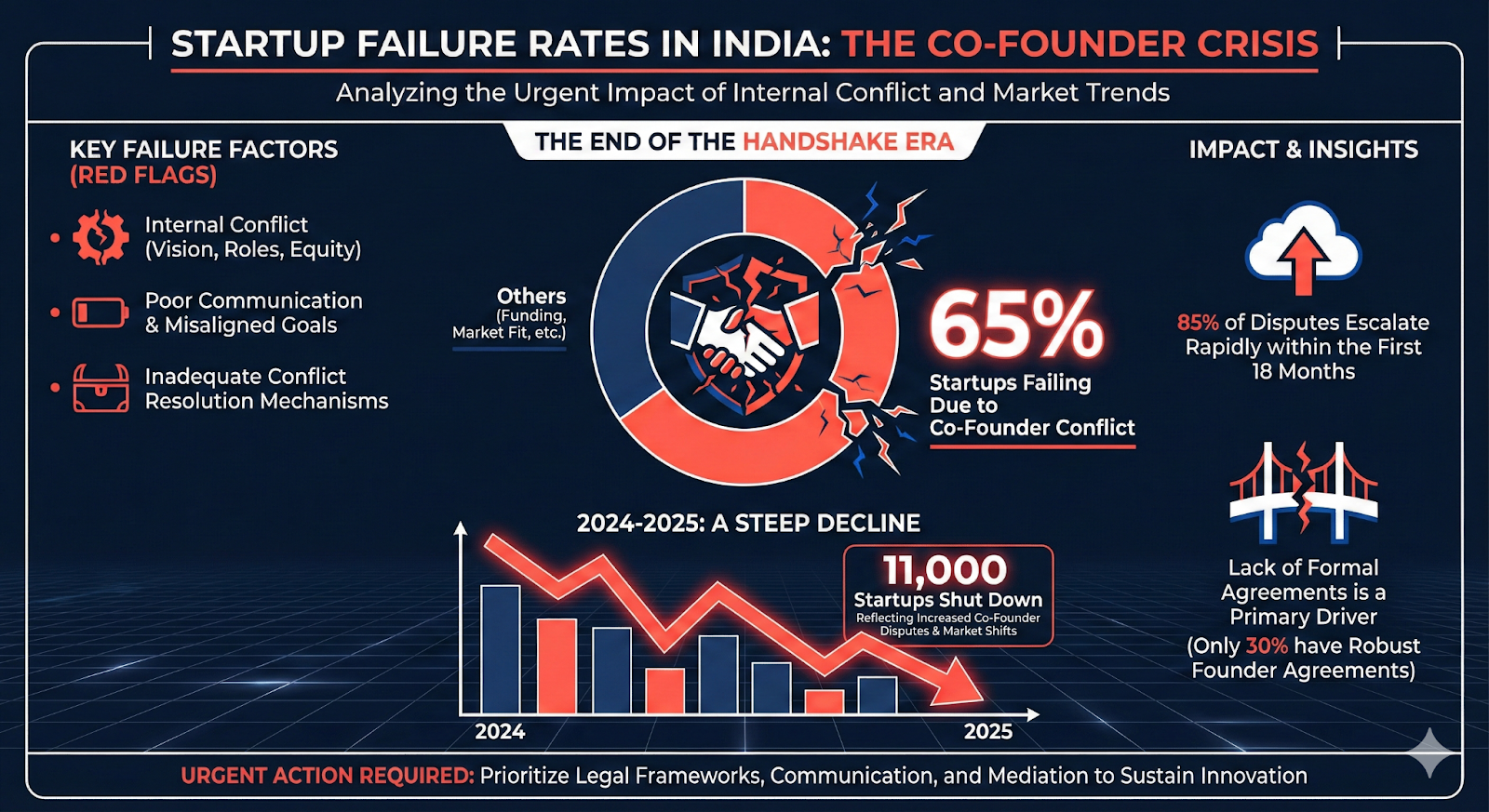
This scene is playing out with alarming frequency across India’s startup ecosystem in 2026. As the liquidity-fueled exuberance of the past half-decade fades, it has laid bare the cracks in foundational governance. The "Co-Founder Prenup" formally known as the Shareholders’ Agreement (SHA) is no longer just legal paperwork. In an era where 65% of high-potential startups fail due to co-founder conflict, it is a survival mechanism.
The End of the Handshake Era
Why is this happening now? For years, the Indian startup narrative was dominated by growth at all costs. Governance was a boring afterthought. But the "funding winter" and subsequent market correction of 2024-2025 changed the calculus. With over 11,000 startups shutting down in 2025 alone a 30% jump from the previous year the margin for error has vanished.
Investors in 2026 are not just betting on total addressable markets (TAM); they are underwriting governance. They have seen too many "deadlocks" situations where 50:50 founders disagree, paralyzing the company. They have watched cap tables become uninvestable because a dormant co-founder holds 30% of the equity.
"The handshake era is dead," says a partner at a top Mumbai law firm specializing in VC deals. "In 2021, founders dictated terms. In 2026, if you don't have a clean SHA with clear vesting and bad leaver provisions, you aren't getting past the first due diligence meeting."
The BharatPe Hangover
If there is a "Patient Zero" for the current obsession with founder agreements, it is BharatPe. The public fallout between co-founder Ashneer Grover and the board wasn't just a drama for Twitter; it was a wake-up call for the entire ecosystem.
The dispute highlighted the critical importance of "clawback" clauses and the definition of "cause." When Grover was ousted, the battle wasn't just over his role, but over his shares. The complex legal tussle that followed involving arbitration, NCLT hearings, and criminal complaints demonstrated how messy exits can get when the "divorce" terms aren't airtight.
"Founders often think, 'We are friends, we don't need this,'" notes a Delhi-based venture capitalist. "But Ashneer and the BharatPe board showed us that when billions of dollars are at stake, friendship is the first casualty. The SHA is the only thing that protects the company from the individual."
The Mechanics of the Prenup: Vesting and Control
So, what exactly goes into this "prenup"? In 2026, three specific clauses are non-negotiable for serious founders.
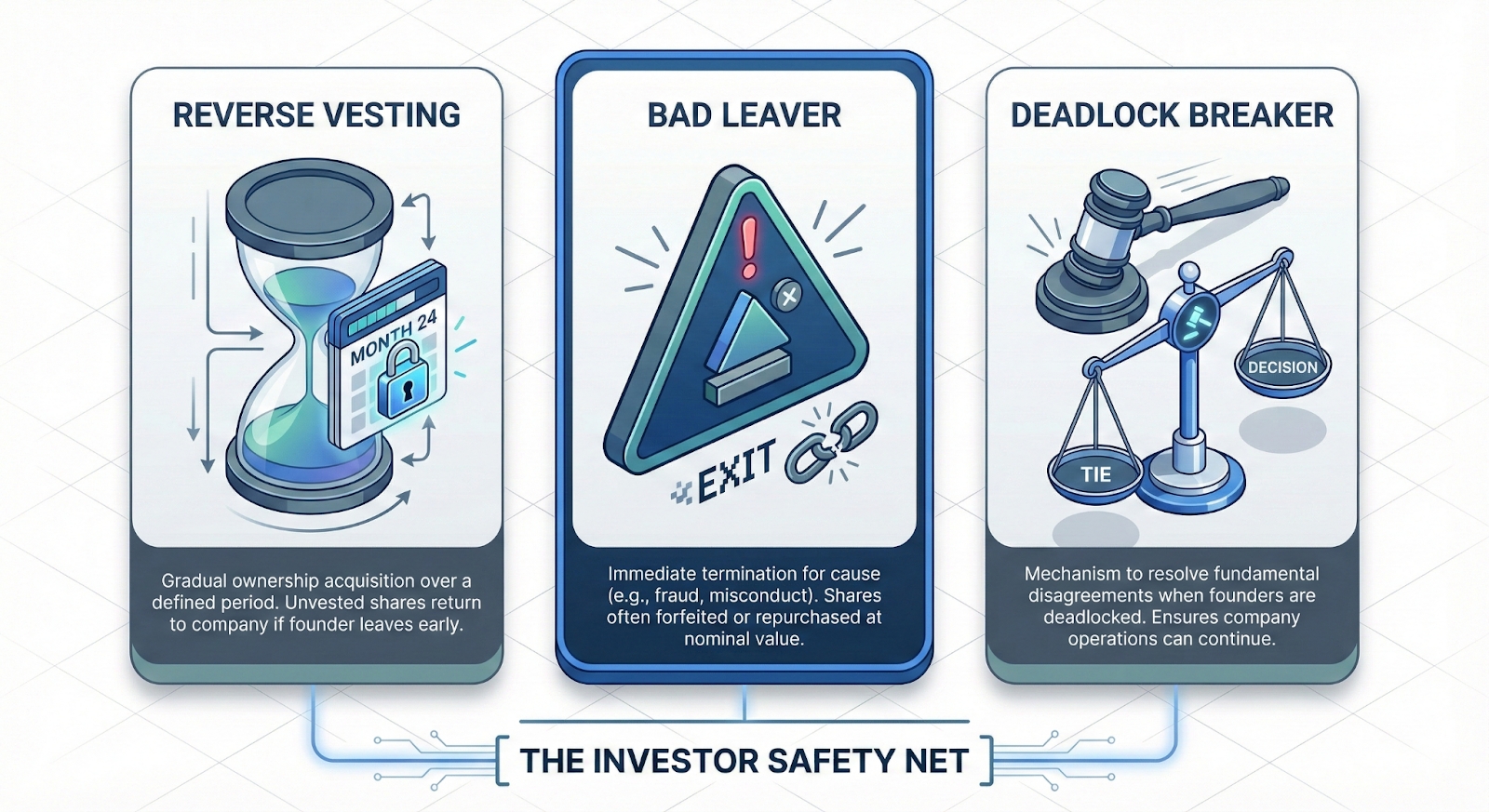
1. Reverse Vesting (The Golden Handcuffs)
Imagine you give your co-founder 40% of the company upfront. They quit in six months. They still own 40% of your hard work forever. This is the nightmare scenario.
To prevent this, modern SHAs use "Reverse Vesting." The founder technically owns the shares, but the company has the right to buy them back at nominal value if the founder leaves before a certain period (typically 4 years).
- The 2026 Standard: A 4-year vesting schedule with a 1-year cliff. If a founder leaves before 12 months, they walk away with nothing. "It aligns incentives," says a legal expert from Treelife. "You earn your equity by staying, not just by starting."
2. The "Bad Leaver" Clause
This is the most contentious part of any negotiation. If a founder is fired for "cause" (fraud, criminal misconduct, or material breach of contract), they are deemed a "Bad Leaver."
- The Consequence: They lose their unvested shares, and often, even their vested shares can be bought back by the company at a steep discount (e.g., face value instead of fair market value). In the post-BharatPe world, investors are demanding extremely tight definitions of "cause" to protect the company from rogue founders.
3. The Deadlock Breaker
Deepinder Goyal of Zomato has famously advised against 50:50 splits, suggesting that "veto power should lie with one person" to ensure speed. But for partners who insist on equality, the SHA must include a deadlock-breaking mechanism.
- The Solution: This could be a "Russian Roulette" clause (one partner names a price, the other must either buy or sell at that price) or the casting vote of an independent board member. Without this, a disagreement over a pivot or a hire can freeze the company’s bank accounts.
The Legal Reality: The AoA Trap
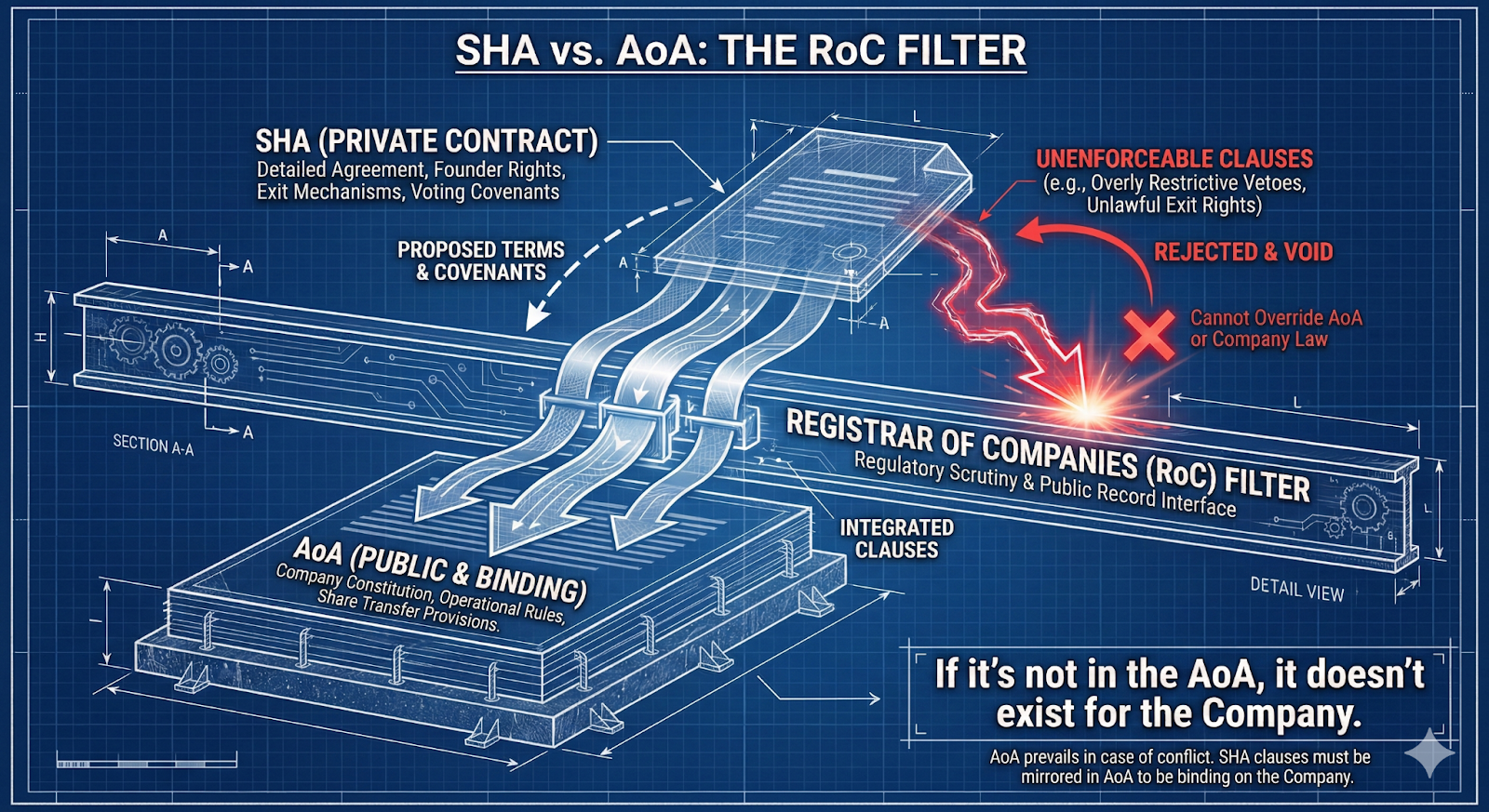
Here is the technical nuance that catches many founders off guard: A Shareholders' Agreement is a private contract, but for it to be fully enforceable against the company under Indian law, its key terms must be incorporated into the company’s Articles of Association (AoA).
This stems from the Supreme Court's landmark V.B. Rangaraj ruling, which established that restrictions on share transfers (like the Right of First Refusal or Tag-Along rights) are unenforceable if they exist only in the SHA and not the AoA.
"We see this all the time," says a corporate litigator. "Founders sign a brilliant 50-page SHA, but they never update the AoA with the Registrar of Companies (RoC). When a dispute hits the NCLT, the opposing counsel argues the SHA is not binding on the company. It’s a rookie mistake that costs millions."
The Investor’s Ultimatum
For early-stage startups, the SHA is often the difference between being funded or forgotten. Data from 2025 shows a sharp bifurcation in funding: "Clean" companies are raising capital; "messy" ones are shutting down. In the seed stage, where dilution typically hits 15-25% , investors are meticulously scrutinizing the founder agreements.
"If I see a cap table where an ex-founder holds 15% equity with no role in the business, I’m passing," admits a partner at a prominent micro-VC fund. "That’s 'dead equity.' It de-motivates the remaining team and makes it mathematically impossible to create a meaningful ESOP pool for future hires."
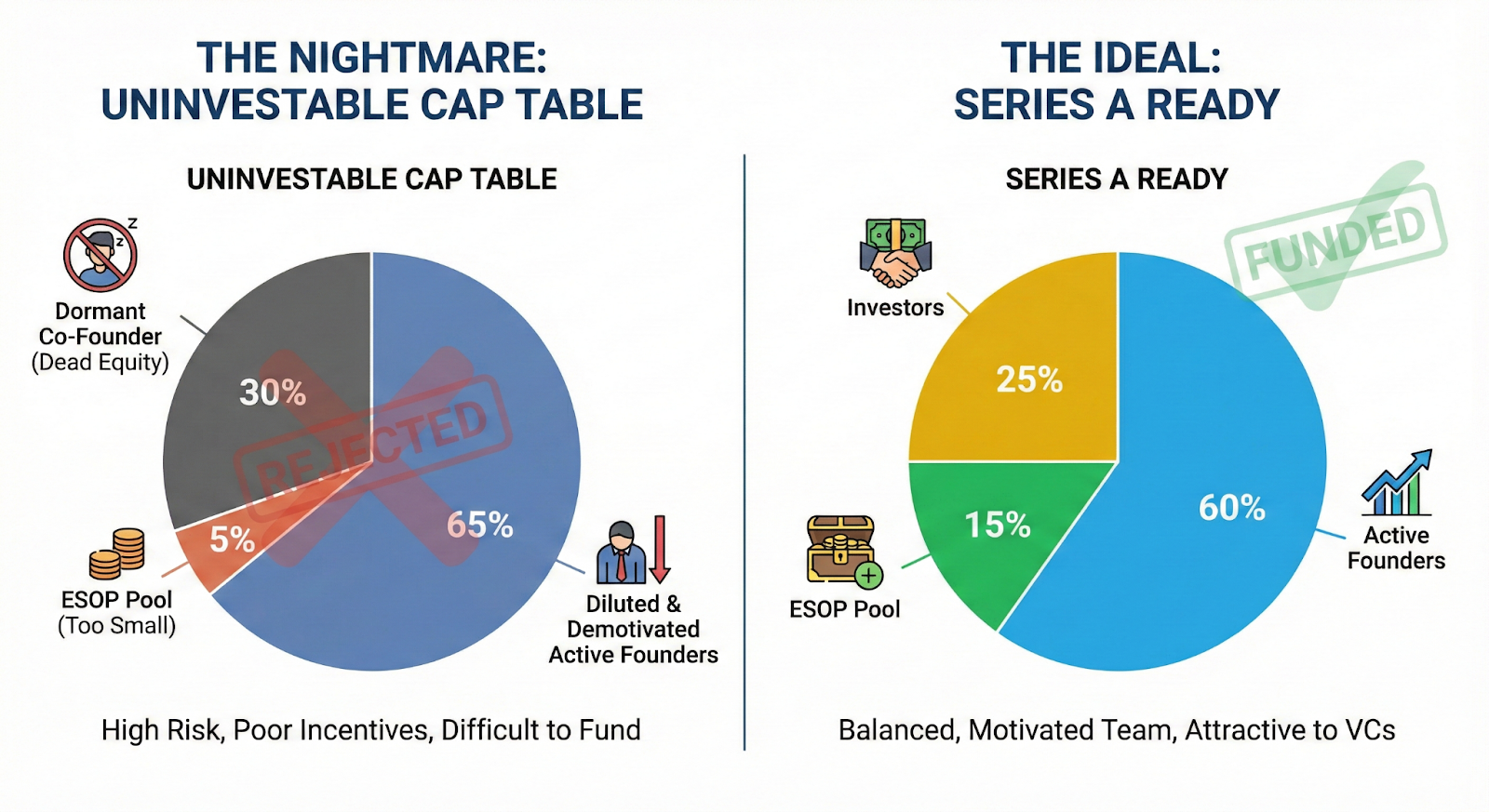
Conversely, companies like Zepto have managed to raise massive rounds like their recent $450 million Series G partly because their governance and cap table structures were pristine, allowing them to move fast and confidentially file for an IPO.
The Cost of Clarity
The romantic notion of the startup garage of two friends against the world is a powerful myth. But in the high-stakes reality of India’s 2026 ecosystem, romance is a liability. Clarity is the asset.
Writing a "prenup" with your best friend is uncomfortable. It requires you to discuss divorce before the marriage has even begun. You have to ask hard questions: What if you stop working? What if you commit fraud? What if I want to sell and you don't?
But the founders who survive the next cycle will not be the ones who avoided these conversations. They will be the ones who codified them. In the end, a Shareholders' Agreement isn't about planning for failure; it's about defining the terms of success so clearly that nothing, not even a fallout can derail the mission.
Disclaimer: This article is for informational purposes only and does not constitute legal advice. Founders should consult with legal professionals to draft agreements tailored to their specific needs.
Contact Us
An expert will call you within 24 hours. No payment required to get started.
6.png) How to Claim a TDS Refund: Step-by-Step Guide
5 minutes read
How to Claim a TDS Refund: Step-by-Step Guide
5 minutes read
6.png) DIR-3 KYC Compliance: A Director's Guide to Avoiding Disqualification
5 minutes read
DIR-3 KYC Compliance: A Director's Guide to Avoiding Disqualification
5 minutes read
2.png) ITR Filing Last Date September 2026: The Founder's Guide to Tax Audits & Belated Returns
5 minutes read
ITR Filing Last Date September 2026: The Founder's Guide to Tax Audits & Belated Returns
5 minutes read
4.png) Register For ESI & PF Now Or Face Employer Penalties On Every Payroll!
5 minutes read
Register For ESI & PF Now Or Face Employer Penalties On Every Payroll!
5 minutes read
Have a question about this?
Our team can walk you through what applies to your business and what to do next.
Talk to our teamRelated posts
.png)
Why Do 9 In 10 Startups Fail in India?
Learn how from science exhibitions in schools to the hostel rooms of IITs and IIMs, each day a startup is born. Also, explore the reasons for failed startups in India.
. 5 min read.png)
Startup India Fund Scheme- How to Apply, Features, Benefits
Discover this scheme's contribution to the growth of early-stage startups through seed funding, mentoring, networking, and others.
. 3 min read.png)
4 Common Reasons Why Businesses Need to Amend Their Registered Trademark
Learn why businesses often need to make amendments to their registered trademarks. Discover the importance of trademark name search for business identity and the procedure for making changes in India.
. 5 min readEverything right at your mail.
Request a Call Back
Leave your details and our team will call you.
Chat with us on WhatsApp
Hi there! 👋 Connect with our team on WhatsApp.
Hello FilingBuddy, I would like to know more about your services.
Chat Now