
Co-working Space for Startups: Smart Guide
By Filing Buddy . 03 Apr 26


Co-Working Space as Strategy
Every business eventually faces this decision: “Do we invest heavily in office space, or stay flexible while we grow?”
At first glance, it feels like an operational choice. But in reality, it’s a capital allocation decision.
In the early days, teams behind platforms like Uber operated out of shared environments instead of committing to expensive office leases. This wasn’t a limitation; it was a deliberate move to preserve capital and stay agile while the business model was still evolving.
That’s the real shift in thinking.
A co working space for startups today is not just about affordability. It’s about:
- keeping fixed costs low,
- staying adaptable to change,
- and avoiding premature commitments.
This guide will help you understand how to evaluate coworking and office space decisions not just from a cost lens, but from a growth and flexibility perspective.
Understanding Coworking and Office Space
Types of Flexible Office Space
Not all co-working spaces function the same way, and choosing the wrong format can quietly affect productivity and cost.
At one end, you have hot desks, where seating is unassigned and works well for highly flexible or remote-heavy teams. On the other end are managed offices, which feel almost like traditional office space but come with services bundled in.
In between, there are dedicated desks and private cabins, each offering a different balance between privacy and flexibility.
The emergence of companies like WeWork shows how demand has evolved, from simply renting space to consuming workspace as a service. Businesses today don’t just want desks; they want plug-and-play environments that reduce operational friction.
Coworking and Office Space Models
When you compare coworking and office space, the difference isn’t just about cost, it’s about how the cost behaves over time.
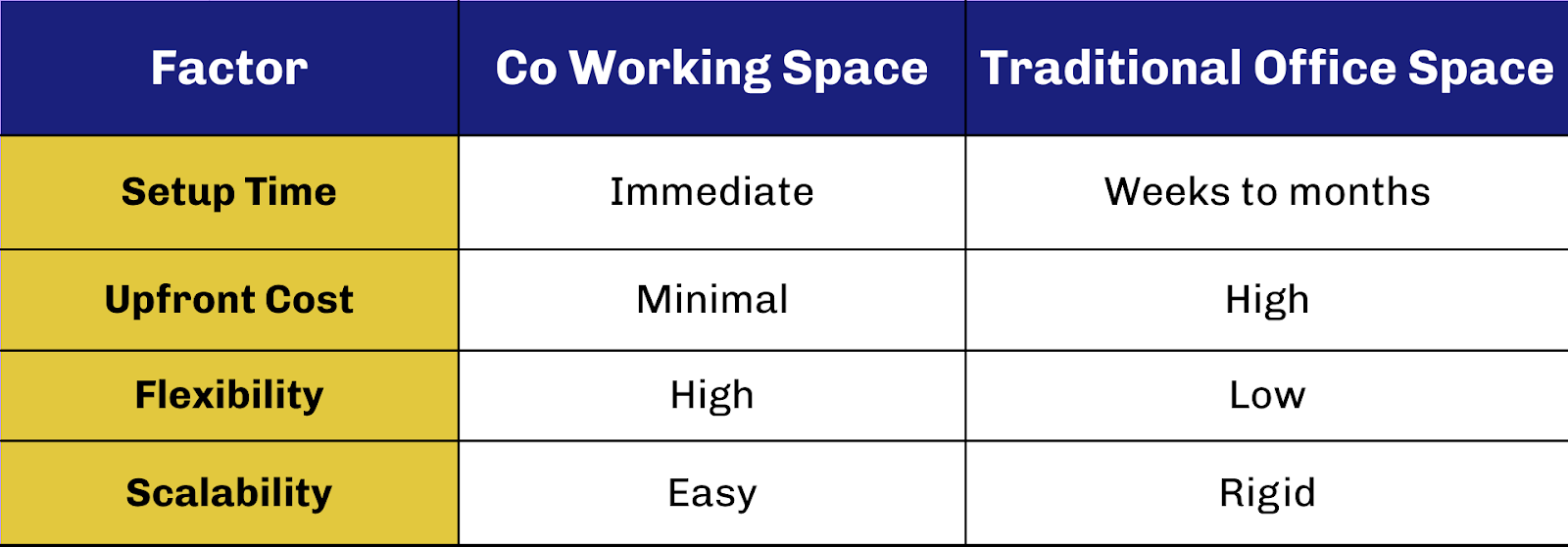
A traditional office demands commitment upfront, interiors, deposits, long leases. A co-working space shifts that into a monthly operating cost, which is easier to manage when revenue is still stabilizing.
This difference becomes critical when growth is unpredictable.
Defining Your Space Thesis
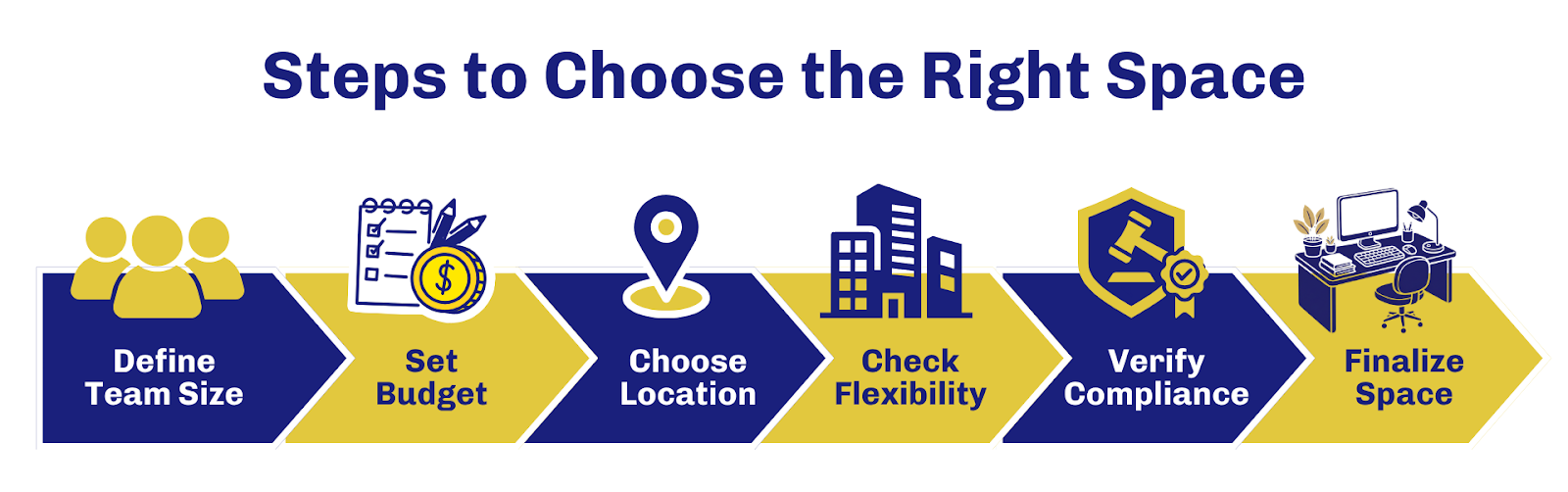
Team Size and Runway
Before shortlisting the best coworking spaces, it’s important to define your internal reality.
How big is your team today?
How quickly do you expect it to grow?
And more importantly, how certain are those projections?
Many businesses make the mistake of planning for an ideal future instead of a realistic one. The result is either unused capacity or constant relocation.
Early teams behind Airbnb were extremely cautious about locking money into fixed costs. By avoiding long-term office commitments, they ensured that most of their capital stayed focused on building and scaling the core product.
That discipline often matters more than the workspace itself.
Budgeting Flexible Office Space
Budgeting for office space often starts with a simple number, cost per seat. But that number rarely tells the full story.
In reality, your monthly expenses include multiple layers:
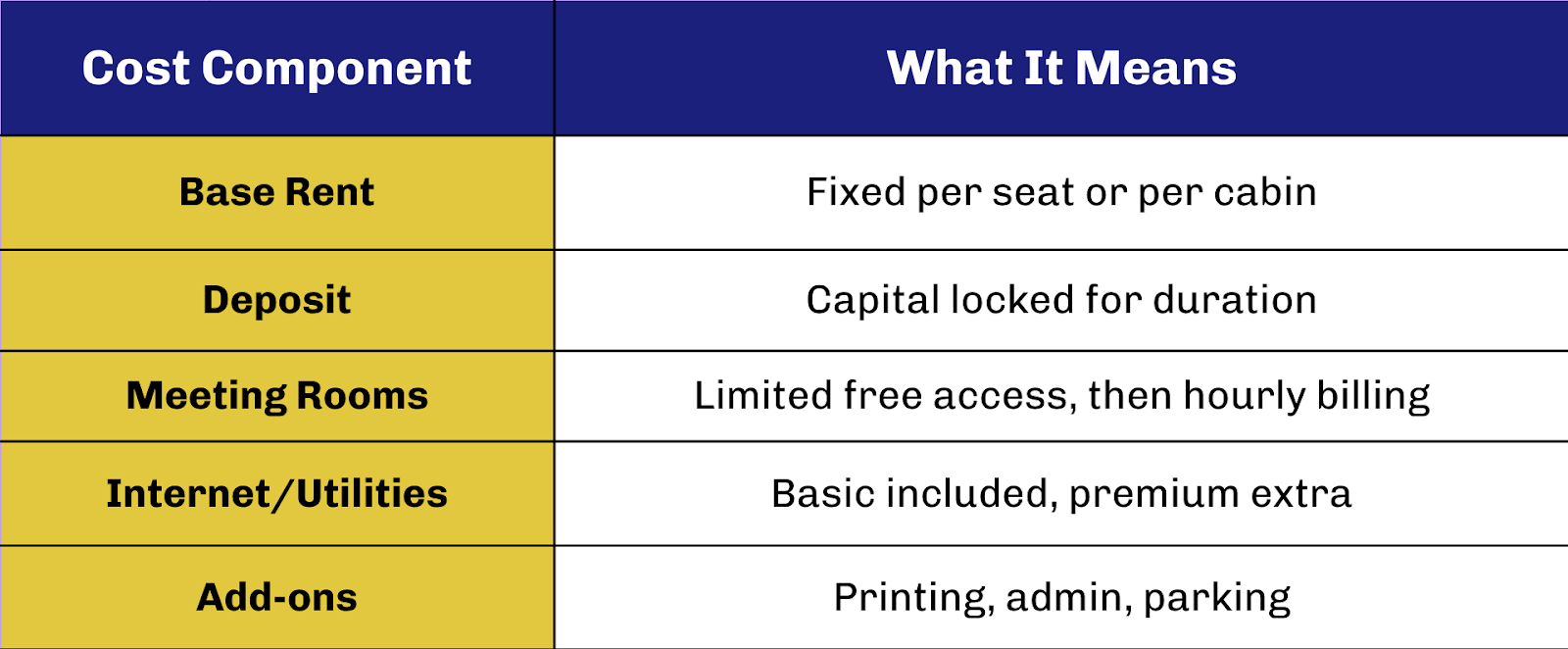
What seems like an affordable co-working space can become expensive if your team relies heavily on meeting rooms or additional services.
The smarter approach is to evaluate usage patterns, not just base pricing.
Location Strategy for Office Space
Talent and Market Access: Location decisions are often influenced by perception, but the real value lies in access.
An office space that looks premium but is difficult to commute to can quietly reduce productivity and hiring efficiency. On the other hand, a well-connected location improves:
- employee convenience,
- talent acquisition,
- and client accessibility.
As Spotify expanded into new markets, it used flexible office setups to establish a presence quickly without locking into long-term real estate decisions. This allowed them to test markets before making deeper commitments.
That’s a more strategic way to think about location, not as a fixed identity, but as a scalable asset.
Premium vs Practical Locations: Premium business districts offer visibility and brand perception. But they also come with higher costs and, sometimes, unnecessary pressure on early-stage budgets.
A practical location, while less glamorous, often provides better:
- cost efficiency,
- accessibility,
- and operational comfort.
In most cases, it makes sense to prioritize practicality first and upgrade positioning later when the business can fully leverage it.
Pricing in Coworking Spaces
Cost Structure of Office Space
Traditional office setups require a significant upfront investment, interiors, brokerage, deposits, and maintenance. This converts what could have been a manageable monthly expense into a large capital outflow.
In contrast, a co-working space converts these into operational expenses. You pay for what you use, when you use it.
This is why flexible office space is often preferred by businesses that want to:
- maintain liquidity,
- reduce financial risk,
- and scale without friction.
Hidden Costs in Co-working
However, flexibility doesn’t mean complete transparency.
Hidden costs often appear in areas like meeting room usage, peak-hour access, or additional services. Over time, these can add up, especially for teams that rely heavily on collaboration spaces.
The key is not to avoid coworking, but to enter with clarity.
Understanding how pricing scales with usage is what separates a smart decision from an expensive one.
Infrastructure in Best Coworking Spaces
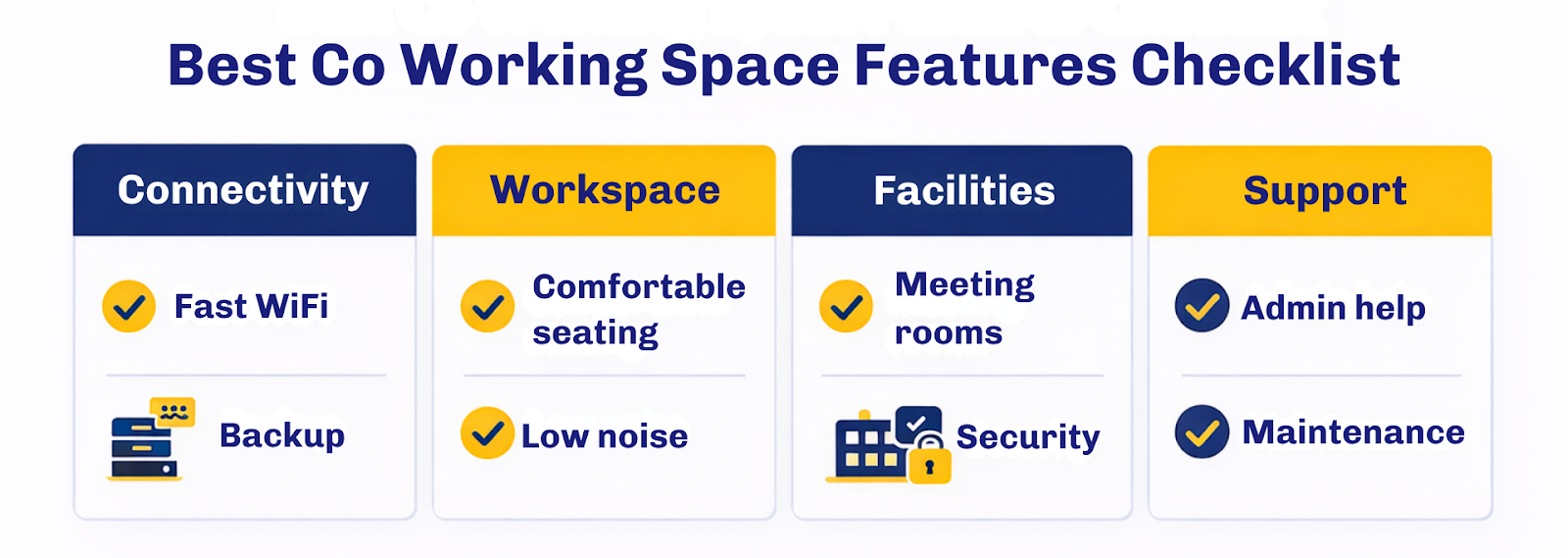
Must-have Flexible Office Features
While aesthetics can be appealing, infrastructure is what determines daily efficiency.
A reliable workspace should ensure:
- consistent high-speed internet,
- uninterrupted power supply,
- accessible meeting rooms,
- and a secure environment.
These aren’t luxuries; they are baseline requirements for smooth operations.
Productivity Over Aesthetics
Visually appealing spaces are easy to market, but they don’t always translate into productive environments.
Noise levels, seating comfort, and workspace density often matter more in the long run.
When Instagram was still in its early phase, the focus wasn’t on building a visually impressive office, it was on creating an environment where teams could move fast and iterate quickly.
That principle still applies. A good workspace should enable work, not distract from it.
Flexibility in Coworking and Office Space
Scaling Within Co-Working Space
One of the strongest advantages of coworking is its ability to adapt as your business evolves.
You can start small, expand when needed, and even reduce space during slower phases. This kind of elasticity is difficult to achieve in traditional office setups.
As discussed earlier with Uber, early teams benefit from avoiding rigid commitments. Growth rarely follows a straight line and your workspace should reflect that reality.
Lock-ins and Exit Clauses
Despite the promise of flexibility, not all coworking agreements are equally flexible.
Some spaces include:
- minimum lock-in periods,
- notice requirements,
- or exit penalties.
It’s important to review these terms carefully. A space that appears flexible on the surface may still impose constraints when you need to make quick decisions.
Compliance and Office Space Legitimacy
GST and Business Address Use
This is one area where many businesses face unexpected challenges.
Not every co-working space can be used as a registered business address for GST or incorporation. Without the right documentation, applications may be delayed or rejected.
A compliant setup typically requires:
- a valid rent agreement,
- a No Objection Certificate (NOC),
- and proper address proof.
Ignoring this can create operational bottlenecks at critical stages of growth.
Documents for Coworking Space
Before finalizing any space, it’s worth confirming the documentation you’ll receive.
This includes agreements, approvals, and any supporting documents required for legal and financial processes.
A workspace that supports compliance from day one saves time and prevents complications later.
Make Workspace a Strategic Advantage
If there’s one clear takeaway from this, it’s that choosing a co-working space is far more than a logistical decision; it directly shapes how efficiently your business operates and scales.
Here are the 3 key takeaways to keep in mind:
- Flexibility protects your capital: Choosing the right flexible office space ensures you’re not locking funds into long-term leases when that capital could be better used for hiring, marketing, or expansion.
- Clarity beats convenience: Not all best coworking spaces are the right fit. Understanding pricing structures, hidden costs, and scalability options upfront prevents expensive corrections later.
- Execution matters more than selection: Most businesses choose decent spaces, but it’s overlooking details like compliance, documentation, and usage patterns that create operational friction over time.
At its core, this isn’t just about finding office space; it’s about building an environment that supports growth without slowing you down. When your workspace aligns with your business strategy, it stops being an expense and starts becoming an enabler.
And if you want to ensure your coworking and office space setup is fully compliant, from GST registration to documentation, Filing Buddy can help you get it right from day one, without the guesswork.
FAQ’s
1. What is a co-working space?
A co-working space is a shared office environment where individuals or teams can work on flexible terms, without long-term leases or heavy setup costs.
2. Is a co-working space good for startups?
Yes, it offers low upfront cost, flexibility, and faster setup, ideal for businesses still figuring out team size, revenue stability, and growth direction.
3. How much does a co-working space cost in India?
Costs typically range from ₹5,000 to ₹25,000 per seat per month, depending on city, location, and amenities.
4. What is the difference between coworking and office space?
Coworking offers shared, flexible usage with low commitment, while traditional office space requires long-term leases, higher setup costs, and full control.
5. Can a co-working space be used for GST registration?
Yes, but only if proper documents like a rent agreement, NOC, and address proof are provided by the coworking provider.
6. What are the benefits of flexible office space?
It reduces upfront investment, improves scalability, offers operational convenience, and allows businesses to adapt quickly to growth or downsizing.
7. Are coworking spaces cheaper than traditional offices?
Initially, yes. But the total cost depends on usage, meeting rooms, add-ons, and hidden charges, which can increase overall expenses.
8. What should I check before choosing a coworking space?
Check location, pricing structure, hidden costs, infrastructure, lock-in terms, scalability options, and compliance support.
9. What are the hidden costs in coworking spaces?
Common hidden costs include meeting room charges, printing, parking, internet upgrades, and administrative fees.
10. Is coworking suitable for growing teams?
Yes, if the space allows easy expansion or upgrading. Always confirm scalability options before committing.
11. Can I take a private cabin in a co-working space?
Yes, most coworking spaces offer private cabins for teams needing privacy while still benefiting from shared infrastructure.
12. What is the lock-in period in coworking spaces?
It varies—some offer monthly flexibility, while others require 3–6 month commitments. Always review terms before signing.
13. How do I choose the best coworking space?
Focus on business needs, not aesthetics. Evaluate cost, flexibility, location, infrastructure, and compliance suitability.
14. Is coworking better than renting an office?
For early and growth-stage businesses, yes. It reduces risk and increases flexibility compared to traditional office leases.
15. Can coworking spaces support business growth?
Yes, they allow businesses to scale up or down easily, enter new markets quickly, and manage costs more efficiently.
Contact Us
An expert will call you within 24 hours. No payment required to get started.
Related Post

LLP vs. LLC: Choosing the Right Structure for Your Business
Making the appropriate legal structure choice is one of the most important decisions you'll need to make when launching a business in India. Limited Liability Companies (LLCs) and Limited Liability Partnerships (LLPs) are two well-liked alternatives.
. 3 min read2.png)
LLP Agreements: Creating a Solid Foundation for Your Business
A Limited Liability Partnership (LLP) is a business structure that combines the benefits of a partnership with limited liability protection, typically associated with corporations. It is designed to provide a more flexible and tax-efficient framework for professionals and businesses with multiple partners.
. 3 min read.png)
Revised LLP (Amendment) Rules for 2023 – Enhanced LLP Form No. 3
The Ministry of Corporate Affairs (MCA) has recently issued the Limited Liability Partnership (LLP) (Amendment) Rules, 2023, which were officially gazetted on June 2, 2023. These rules bring about amendments to the pre-existing Limited Liability Partnership Rules of 2009. These amendments came into effect upon their publication in the Official Gazette. A noteworthy change introduced through these amendments is the revision of the LLP Form No.3, which pertains to "Information concerning Limited Liability Partnership Agreement."
. 3 min read