
Gross Margin: Meaning & Formula & Example

What is Gross Margin?
Gross margin (or gross profit margin) measures how much of your revenue remains after covering the cost of goods sold (COGS).
It focuses only on the direct costs of creating or delivering your product—not your overall business expenses.
In simple terms
It answers:
“After producing your product, how much money do you actually keep?”
Key components:
Revenue → Total income from sales
Cost of Goods Sold → Direct production or service costs
Gross Margin → Remaining percentage after COGS
A strong gross margin means your core offering is financially efficient.
Gross Margin Formula (How Do You Calculate Gross Profit Margin?)
Understanding the gross margin formula is essential for tracking profitability.
Formula breakdown
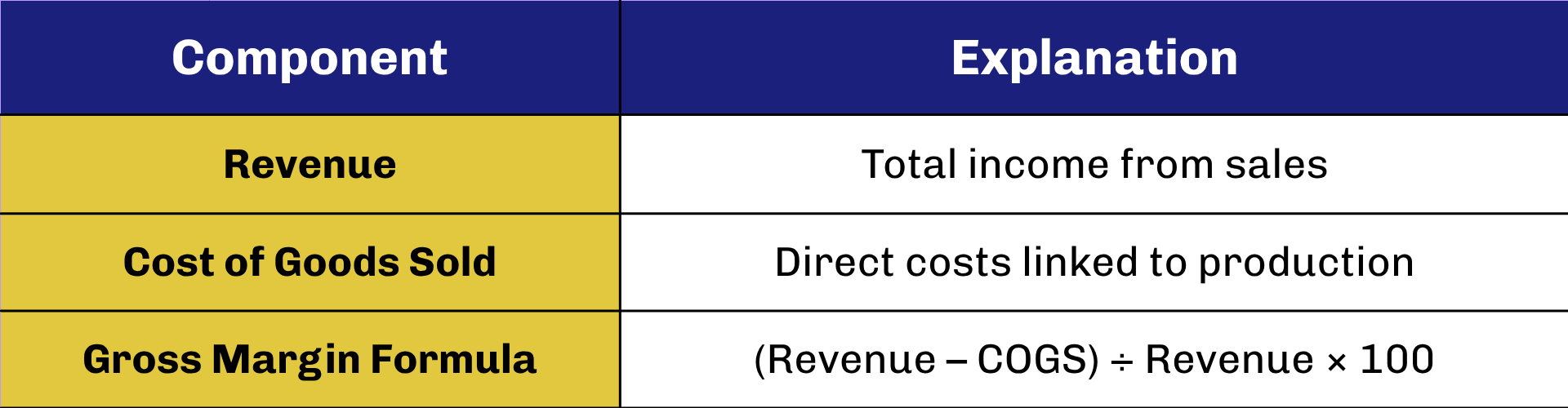
Example calculation
Revenue = ₹50,000
COGS = ₹30,000
Gross Margin = (50,000 – 30,000) ÷ 50,000 × 100 = 40%
This means you retain ₹40 out of every ₹100 earned before other expenses are deducted.
This percentage helps compare performance across products or time periods.
What is Included in Cost of Goods Sold (COGS)?
The accuracy of your cost of goods sold directly impacts your gross margin. Even small misclassifications can lead to misleading numbers.
Costs included in COGS
Raw materials used in production
Direct labor (workers involved in making the product)
Manufacturing expenses
Packaging costs
Delivery/logistics (if directly tied to the product)
Costs NOT included
Office rent and utilities
Marketing and advertising
Salaries of admin staff
Software or subscriptions
The key rule: If the cost is directly tied to creating the product, include it. Otherwise, exclude it.
Gross Margin Example (Real-World Scenario)
Let’s understand this with a practical example.
Example: Cloud Kitchen Business
Revenue from orders = ₹1,00,000
Ingredients + packaging + delivery = ₹65,000
Calculation
Gross Profit = ₹35,000
Gross Margin = 35%
What this means
For every ₹100 earned, ₹35 remains after covering direct costs.
This amount must cover:
Rent
Staff salaries
Marketing
Taxes
Only after these deductions do you reach your net profit margin.
Gross Margin vs Net Profit Margin
Understanding this difference is critical for financial clarity.
Comparison table
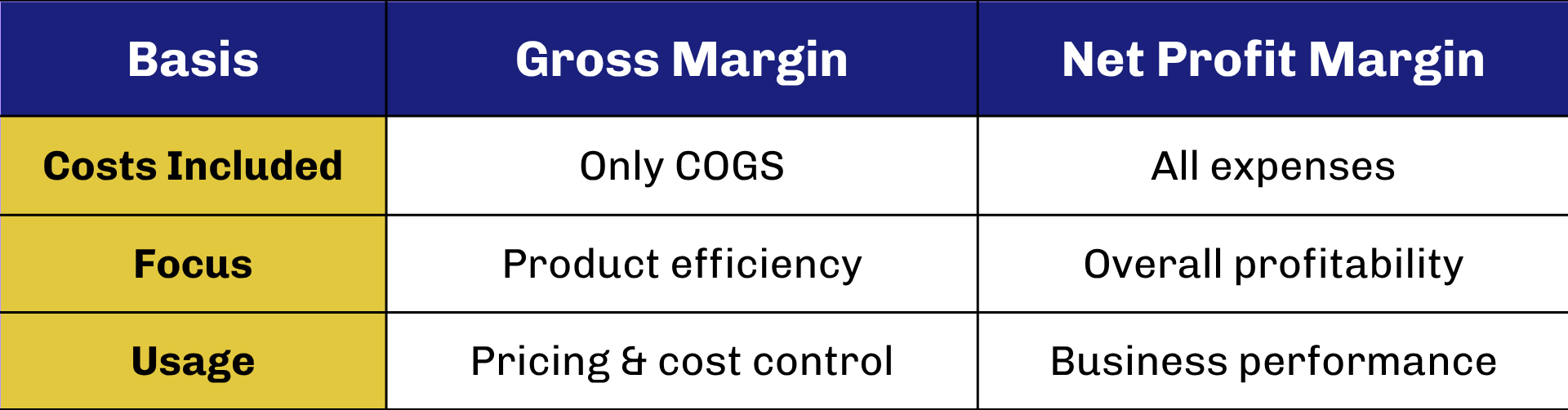
Practical insight
Gross margin tells you if your product is worth selling
Net profit margin tells you if your business is worth running
A business can have high gross margins but still struggle due to high operating costs.
Why Gross Margin Matters for Your Business
Gross margin is a decision-making tool—not just a financial metric.
Key benefits
Helps you set profitable pricing
Identifies high-margin vs low-margin products
Enables better cost control
Supports smarter inventory decisions
Builds confidence for investors and lenders
Strategic importance
If your gross margin is too low, scaling your business may increase revenue—but not profits.
Sustainable growth always starts with healthy margins.
How to Improve Gross Margin
Improving your gross profit margin requires both cost control and pricing strategy.
Practical ways to improve
Negotiate better rates with suppliers
Reduce production inefficiencies
Minimize waste and defects
Focus on higher-margin offerings
Adjust pricing based on value, not competition
Pro tip
Even a small increase in gross margin (5–10%) can significantly improve your bottom line over time.
Common Mistakes to Avoid
Many businesses make errors that distort their gross margin and lead to poor decisions.
Mistakes to watch out for
Confusing margin with markup
Including indirect costs in COGS
Not reviewing margins regularly
Setting prices without cost analysis
Ignoring low-margin products
???? These mistakes can make your business look profitable on paper but unviable in reality.
Are There Any Compliance or Tax Implications?
While gross margin itself is not a compliance requirement, it affects financial accuracy and pricing decisions.
Indirect implications
Incorrect pricing can impact GST calculations
Misreported margins affect financial statements
Poor cost tracking leads to compliance errors
Weak margins may cause cash flow issues
Understanding margins helps you make compliant, financially sound decisions.
Conclusion
Gross margin is more than just a formula—it’s a reflection of your business efficiency.
Takeaways
Gross margin shows how much you retain after direct costs
It helps in pricing, cost control, and profitability analysis
A strong gross margin is essential for long-term growth
Understanding your gross margin gives you control over your business decisions—not just your numbers.
Stay compliant and financially confident with Filing Buddy.
FAQs
1. What is gross margin in simple terms?
Gross margin is the percentage of revenue left after deducting direct costs like materials and production. It shows how efficiently your product generates profit before other expenses are considered.
2. How do you calculate gross profit margin?
You calculate it using: (Revenue – Cost of Goods Sold) ÷ Revenue × 100. This gives you a percentage that shows how much you retain from each sale.
3. What is a good gross margin percentage?
A good gross margin depends on the industry. For many businesses, 40–60% is considered healthy, but retail and manufacturing may have lower margins.
4. Is gross margin the same as net profit margin?
No. Gross margin considers only direct costs, while net profit margin includes all expenses like rent, salaries, and taxes.
5. What is included in cost of goods sold?
COGS includes raw materials, direct labor, production costs, and packaging—basically any cost directly tied to creating the product or service.
6. What expenses are excluded from COGS?
Expenses like rent, marketing, admin salaries, and software tools are excluded because they are indirect costs, not directly linked to production.
7. Why is gross margin important for small businesses?
It helps small businesses understand whether their products are profitable and guides pricing and cost decisions for sustainable growth.
8. Can gross margin be negative?
Yes. If your cost of goods sold is higher than your revenue, your gross margin becomes negative, indicating losses at the product level.
9. What is the difference between gross margin and markup?
Gross margin is based on selling price, while markup is based on cost. They are related but not interchangeable.
10. How often should businesses track gross margin?
Ideally, businesses should track it monthly or per product line to identify trends and make timely decisions.
11. Does gross margin affect GST?
Indirectly, yes. Since GST is calculated on selling price, incorrect pricing due to poor margin understanding can impact tax calculations.
12. Is a higher gross margin always better?
Not necessarily. Very high margins may reduce competitiveness, while very low margins can harm profitability. Balance is key.
13. Do service businesses have gross margin?
Yes. Their COGS includes direct service delivery costs like labor or tools used specifically for client work.
14. What happens if I don’t track gross margin?
You may end up increasing sales but still losing money, as you won’t know which products or services are actually profitable.
15. How can startups use gross margin effectively?
Startups use it to understand unit economics, identify scalable products, and make informed pricing and cost decisions early on.
Not sure how this applies to you?
Ask our team and we will point you to the right filing or registration.
Talk to our teamWhy choose Us?
Filing Buddy is an entity which is focused at providing legal, financial, and corporate and compliances consultancy services to business entities. Our organisation is a structure made of enthusiastics.

EXPERTISE & RELIABILITY
Trusted industry professionals ensuring compliance, accurate tax filing, and comprehensive services for your business needs.

TAILORED SOLUTIONS
Customized services to meet your specific requirements, including business incorporation, trademarks, patents, and seamless GST return filing.

TIMELY SUPPORT
Dedicated support team committed to providing prompt assistance, resolving queries, and ensuring smooth operations for your business.

COMPETITIVE ADVANTAGE
Gain a competitive edge with our comprehensive suite of services, enabling you to focus on growth while we handle your compliance and taxation needs.













.webp)
.webp)

.webp)

