
File Your Q1 TDS Return Instantly To Prevent Ruinous Government Fines!
By Filing Buddy . 24 Jul 26
3.png)

File Your Q1 TDS Return Instantly To Prevent Ruinous Government Fines!
Filing your Q1 TDS return on time is mandatory for businesses deducting tax at source to avoid steep daily late fees under Section 234E and interest penalties under Section 201. Completing your tds return filing online ensures your vendors get their tax credits smoothly while keeping your business safely away from Income Tax Department notices.
Hey founder! Let’s talk about something that rarely gets celebrated on LinkedIn, but can quietly drain your cash flow if ignored: TDS return filing.
If you are running an early-stage startup or managing an SME, your plate is already overflowing. You are chasing product-market fit, managing your team, and keeping customers happy. The last thing you want is a sudden notice from the Income Tax Department because a quarterly compliance deadline slipped through the cracks. Think of your business compliance like the foundation of a building skip it, and even the best-looking skyscraper starts to wobble.
Let's break down everything you need to know about getting your Q1 TDS return sorted without the stress, legal headache, or financial penalty.
What is Q1 TDS Return Filing and Why Does It Matter for Your Dhandha?
Q1 TDS return filing is a mandatory quarterly statement submitted to the government detailing all taxes deducted from payments like salary, rent, or professional fees between April and June. Doing a timely tds apply online process ensures your business maintains a clean compliance track record and protects working capital from avoidable fines.
When your business makes certain payments such as paying office rent, clearing vendor invoices, or distributing salaries the Income Tax Act often requires you to deduct a percentage of tax at source before handing over the balance. This is Tax Deducted at Source (TDS).
However, deducting the tax is only half the job. You also have to report who you paid and how much tax you deposited by filing a quarterly statement.
- Protecting Cash Flow: Every rupee saved from penalties goes right back into your growth runway.
- Vendor Trust: When you file correctly, the tax credit (Form 26AS/AIS) shows up in your vendors' accounts. Happy vendors mean stronger business partnerships.
- Peace of Mind: Clean compliance keeps your DIN (Director Identification Number) and PAN clear of red flags during audits or funding due diligence.
Key Deadlines for Q1 TDS Return
The statutory due date for filing your Q1 TDS return (for the quarter ending June 30) is July 31. Missing this deadline triggers automatic financial penalties that accumulate daily.
Mark this date in bold red on your startup calendar: July 31.
To give you a quick reference view of the financial year's rhythm, here is how the quarterly cycle looks:
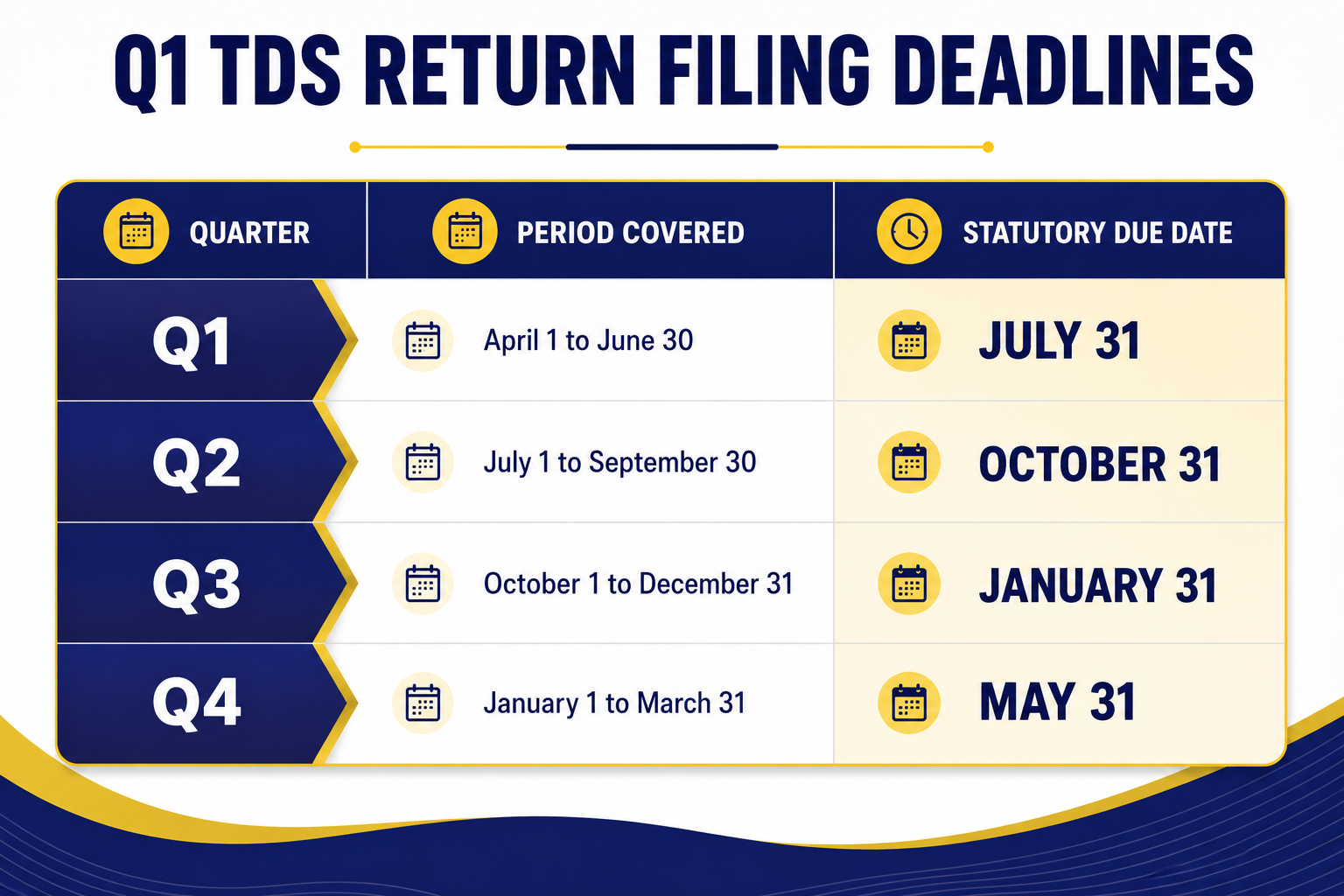 Staying ahead of the Q1 timeline sets the compliance tone for the rest of your financial year.
The Cost of Delay: Penalties You Can Easily Avoid
Delaying your tds return filing invites a flat late fee of ₹200 per day under Section 234E until the fine matches the total TDS amount, alongside penal interest for delayed deposit.
Procrastination is expensive in business, but compliance procrastination is a whole different level of painful. Here is what happens when a Q1 return misses the July 31 cutoff:
- Section 234E Late Fees: You are charged ₹200 for every single day the return remains unfiled. If you delay by two months, that is over ₹12,000 just in late fees for a paperwork delay!
- Section 271H Penalties: The Assessing Officer can impose an additional penalty ranging from ₹10,000 to ₹1,00,000 if returns are persistently filed late or contain incorrect information.
- Interest on Late Deposit: If you deducted the tax from your vendor's invoice on time but forgot to deposit it with the government, interest kicks in at 1% to 1.5% per month.
Step-by-Step Checklist for Seamless TDS Return Filing Online
A smooth tds return filing online process requires your TAN, deductor login details, verified challan payment receipts, and updated PAN data for all deductor-deductee transactions.
Don't let the technical jargon intimidate you. Here is the exact checklist you need to pull together before sitting down to file:
- Verify Your TAN & Credentials: Ensure your Tax Deduction and Collection Account Number (TAN) and income tax portal logins are active and accessible.
- Collect TDS Challans: Gather all challan details (BSR code, challan serial number, date of deposit, and amount) showing that the TDS deducted during April, May, and June has been paid to the government.
- Compile Deductee Details: Keep a clean spreadsheet of your vendors' and employees' PAN numbers, amounts paid, and exact tax deducted.
- Generate the FVU File: Use the Return Preparation Utility (RPU) provided by the government to prepare your statement and validate it through the File Validation Utility (FVU).
- Upload and File: Log into the Income Tax e-filing or TIN-NSDL portal and submit your quarterly return using your Digital Signature (DSC) or Electronic Verification Code (EVC).
Frequently Asked Questions (FAQs)
Founders often have questions about TDS challan mismatches, nil returns, and correcting past errors. Here are the straightforward, no-nonsense answers to keep your startup audit-ready.
1. What should I do if I didn't deduct or pay any TDS in Q1? Do I still need to file a return?
Even if you had zero transactions requiring TDS deduction during April, May, and June, it is always smart to verify whether a Nil return is required or if your active TAN demands a formal check. Skipping it completely without confirming can sometimes trigger automated compliance notices from the tax department. If you are unsure, a quick audit with Filing Buddy clears up the confusion instantly.
2. Can I revise my Q1 TDS return if I notice a mistake later?
Yes, absolutely. We are all human, and typos happen whether it is a wrong PAN number or an incorrect amount. The Income Tax Department allows you to file a revised TDS return to fix errors. However, getting it right the first time saves you the extra effort and keeps your vendor reconciliation smooth.
3. What is the difference between depositing TDS and filing the TDS return?
Think of it like paying your restaurant bill versus getting the itemized receipt. Depositing TDS means paying the actual tax money you deducted from your vendor's invoice to the government by the 7th of the following month. Filing the TDS return (due by July 31 for Q1) is submitting the actual quarterly report that tells the government who that money belongs to so your vendors can claim their tax credits.
4. What happens if I file my TDS return after July 31?
The system automatically calculates a flat late fee of ₹200 per day under Section 234E starting August 1. This fee keeps ticking until it matches the total TDS amount due in that return. Coupled with potential interest penalties for delayed deposits, a minor delay can unnecessarily hurt your monthly cash flow.
5. How does Filing Buddy make this easier for my startup?
We know you didn't start your company to spend hours wrestling with government utility tools and mismatched CSV files. Filing Buddy takes your raw vendor and challan data, runs the necessary validations, and handles your tds return filing online end-to-end. You stay focused on building your product; we make sure the tax authorities stay happy.
Actionable Next Steps with Filing Buddy
Compliance doesn't have to feel like a root canal. If you want to bypass the portal errors, formula mismatches, and deadline anxiety, let Filing Buddy handle the heavy lifting while you focus on scaling your product.
Ready to get your Q1 filing sorted in minutes?
- Step 1: Drop your details or connect with our compliance experts on the Filing Buddy platform.
- Step 2: Share your basic challan and vendor sheets we will review them for accuracy.
- Step 3: Relax as we execute a seamless tds apply online process, ensuring zero penalties and 100% peace of mind for your business.
Conclusion
At the end of the day, building a business is hard enough without government notices throwing a wrench in your momentum. Staying on top of your Q1 TDS return isn't just about ticking a bureaucratic box it is about protecting your hard-earned capital, keeping your vendor relationships rock-solid, and running a clean, investable company.
Don't wait until the final hours of July 31 to scramble through portal errors and missing challans. Get ahead of the deadline today, keep your compliance runway clear, and let Filing Buddy be the reliable partner your business deserves.
Contact Us
An expert will call you within 24 hours. No payment required to get started.
Related Post

How should a start-up complete ITR filing
Business entities must file their ITR annually to comply with the tax laws of their respective countries. It helps the government assess and collect the appropriate amount of income tax from taxpayers and ensures proper accountability of financial activities.
. 3 Mins.png)
5 step checklist for GST compliance in Indian Startups
Learn about how GST works. The basics of GST along with its compliances. Uncover what your business needs to keep in mind concerning GST rules and GST compliance.
. 3 min read.png)
₹20 Lakhs and Beyond: Understanding GST for Freelancers in India
Are you a freelancer or aspiring to be one? In this blog, uncover the basics of freelancing and requirements involving GST. Learn about all the exemptions, obligations, and compliances of GST for freelancers in india.
. 5 min read