
ITR Filing Service. Fast, Accurate & Stress-Free.
Avoid the July 31st deadline rush. Get your Income Tax Return filed by dedicated tax experts starting at just ₹1,199 + GST. We handle the technicalities, compare the Old vs. New Tax Regimes to maximize your refund, and deliver your Computation of Income within 2-3 business days. Your true Dhandhe Ka Saathi.
Contact Us
An expert will call you within 24 hours. No payment required to get started.
Why File Your ITR With Filing Buddy?
We aren't an automated portal we are your partners. Navigating the tax portal can be complex, and a single mistake can lead to notices. Our CA-assisted experts manually review your documents, guarantee 100% data confidentiality, and guide you through a seamless WhatsApp-based process. No server crashes, no bots, just maximum tax savings.

2-3 Day Turnaround
Once your documents are verified via WhatsApp or email, we guarantee your E-Verified Acknowledgment and Computation sheet within 3 business days.

Old vs. New Regime Analysis
We calculate your liabilities under both tax regimes and automatically file under the one that keeps the most money in your pocket.

Human Expert & Data Security
Your highly sensitive documents (Form 16, PAN) are securely processed by an assigned, real expert. We never use AI chatbots to handle your finances.

Error-Free Filing & Notice Protection
Government tax portals can be highly technical. Our experts navigate all backend complexities to ensure your ITR is filed with 100% accuracy, protecting you from unexpected tax notices and long-term compliance headaches.
Our Pricing Structure
One of the most common questions taxpayers ask is: "How much does a CA charge to file an ITR?"
If you look around the market, you will find that professional CA services can quote anywhere from ₹1,500 for a basic return to upwards of ₹15,000 for more complex financial situations. Too often, taxpayers are hit with unexpected upcharges, confusing tiers, or hidden fees right before their return is actually filed.
At Filing Buddy, we eliminate the guesswork. We believe elite, CA-assisted tax filing should be accessible, and the cost should be explicitly clear before you ever share a single document.
Our one-time pricing scales transparently based on your total income bracket, ensuring you only pay for the level of expertise your specific filing requires.
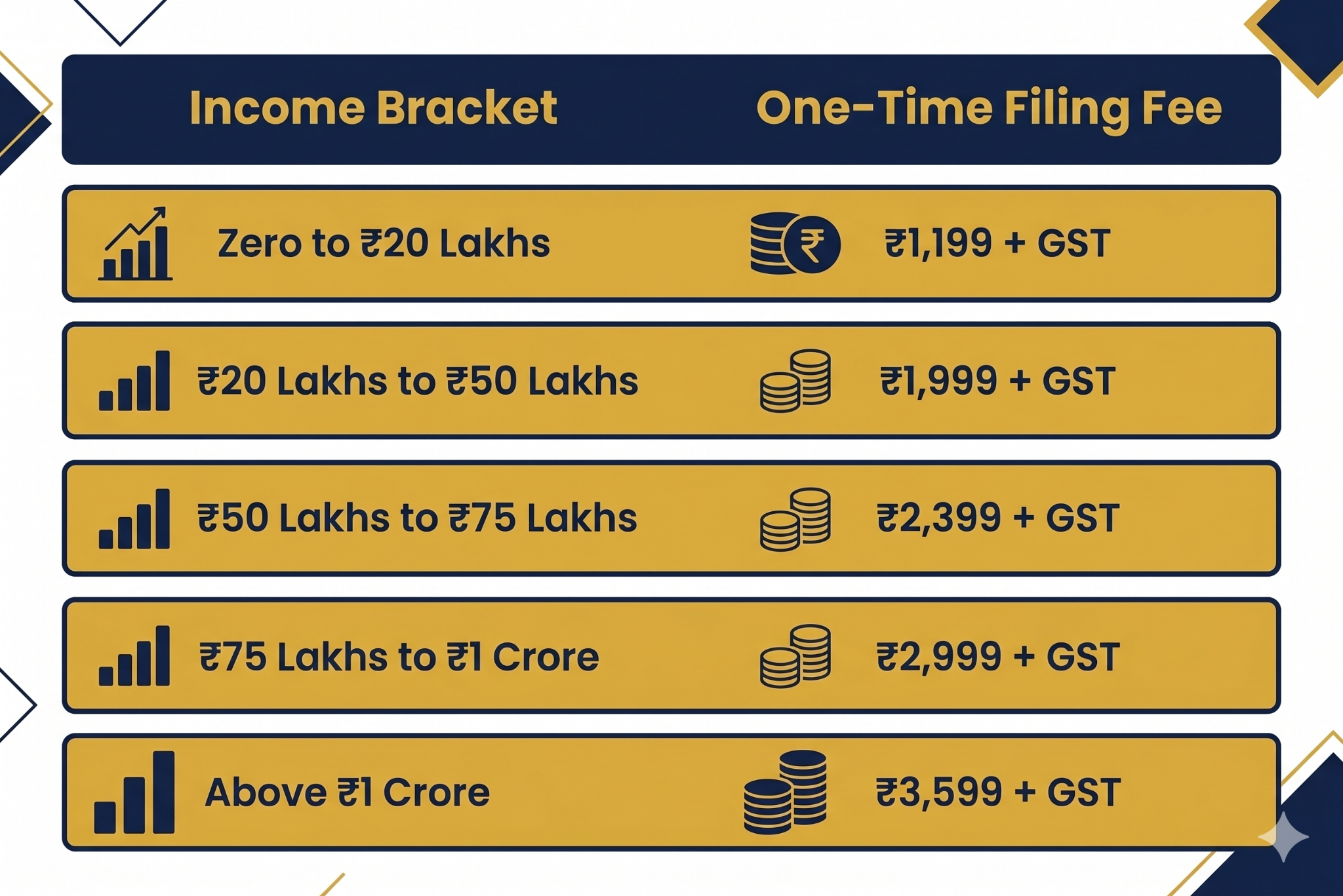
A Note for Business Owners & Directors:
If you are a Company Director, a Sole Proprietor, or have complex business income (requiring ITR-3 or ITR-4), your expert will provide a transparent, customized quote during your initial callback. We carefully account for capital gains, mandatory compliance disclosures, and business turnover to ensure absolute accuracy well ahead of the August 31st business deadline.
Old vs. New Regime Comparison
Choosing the right tax regime can mean the difference between paying zero tax and losing thousands of rupees. While the New Tax Regime is the default, the Old Tax Regime still offers powerful deductions for the right taxpayer.
Here is a quick look at how they stack up for FY 2025-26:
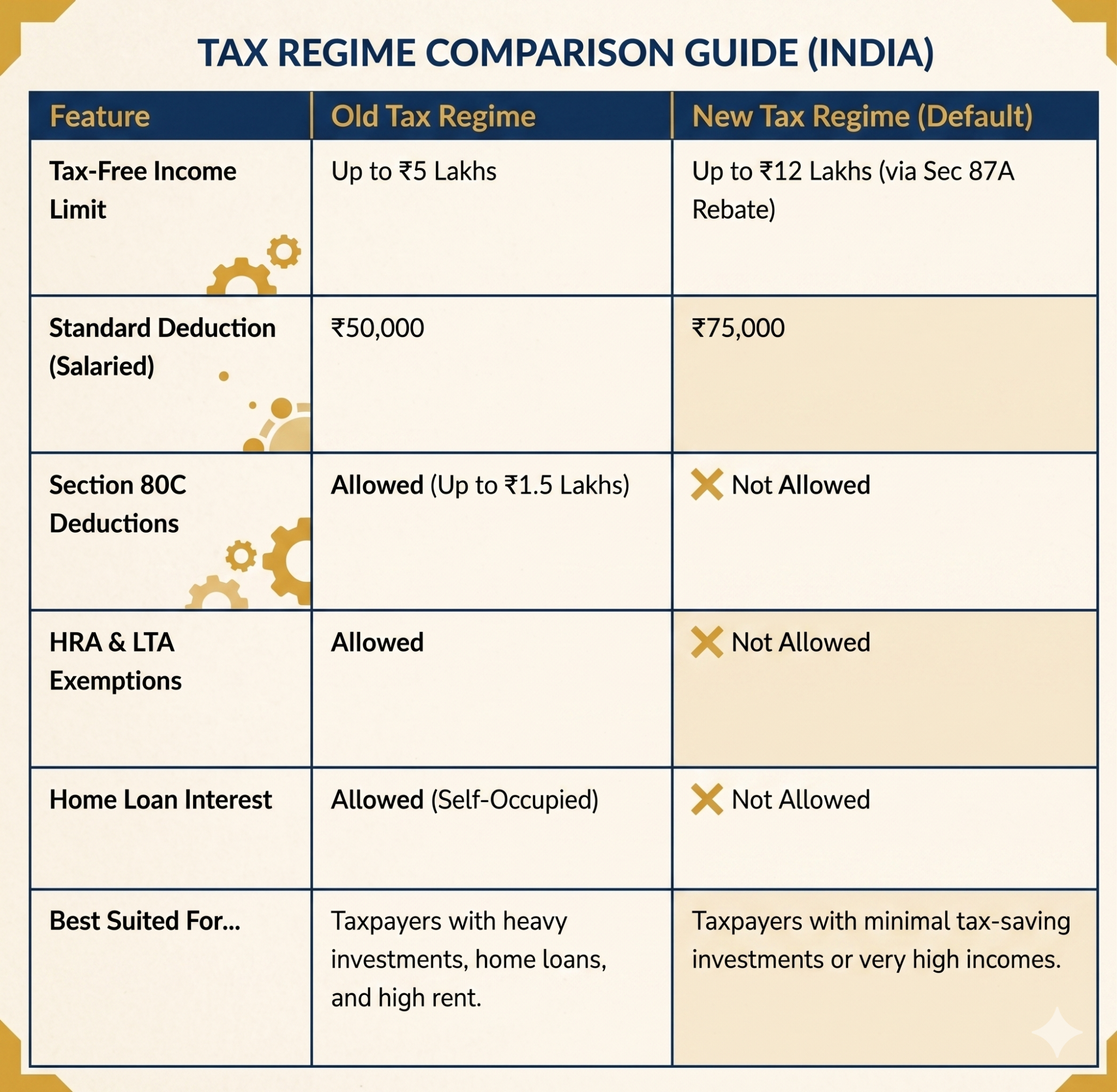
The Filing Buddy Advantage: You never have to guess which regime is better. Behind the scenes, your human tax expert runs a comprehensive dual-calculation on your specific income profile and automatically files under the regime that maximizes your final refund.
ITR Forms Chakravyuha
Filing the wrong ITR form is one of the most common reasons for delayed refunds and income tax notices. While automated portals expect you to know exactly which form applies to your life, here is a clear, jargon-free breakdown of the forms for FY 2025-26.
Who is eligible for ITR-1 (Sahaj)?
ITR-1 is the most common form, designed specifically for resident individuals with straightforward finances. You are eligible if:
Your total income is up to ₹50 Lakhs.
Your primary income comes from a Salary or Pension.
You earn from standard "Other Sources" (like savings account interest or family pension).
Update for this year: You can now report Long-Term Capital Gains (LTCG) from equity up to ₹1.25 Lakhs directly in ITR-1, provided you have no losses to carry forward.
Note: You are strictly ineligible for ITR-1 if you are a Company Director, hold unlisted equity shares, or own foreign assets.
What is the difference between ITR-1 and ITR-2?
The core difference lies in the complexity of your investments and assets. While ITR-1 handles basic salaried income, you must upgrade to ITR-2 the moment you cross certain financial thresholds (excluding business income). You need ITR-2 if:
Your total annual income exceeds the ₹50 Lakhs mark.
You have Short-Term Capital Gains (STCG) or LTCG above ₹1.25 Lakhs from selling stocks, mutual funds, or real estate.
You earn income from multiple house properties.
You are an NRI or hold any foreign bank accounts or assets.
Who will file ITR-3 and ITR-4?
If you run a business, operate as a freelancer, or work as an independent professional, your tax structure changes completely.
ITR-3: This is the most comprehensive form. It is required for individuals and Directors who generate income from a business or profession. (If you actively trade in the F&O market, this is your form).
ITR-4 (Sugam): This form is tailored for Sole Proprietors, freelancers, and small businesses who opt for the Presumptive Taxation Scheme meaning your taxable income is calculated at a flat percentage of your total turnover (up to specified limits).
The Filing Buddy Advantage: You never have to guess which form to use. During your initial call, your dedicated expert analyzes your income streams and automatically maps your file to the correct ITR form, ensuring absolute, penalty-free compliance.
Deadlines for FY 2025-26
Timing is everything when it comes to taxes. Missing a deadline doesn't just cause anxiety; it can freeze your refunds and trigger automatic penalties. Here is exactly when you need to act for the current Assessment Year (AY 2026-27).
What is the last date for ITR filing in 2026?
For Individuals & Salaried Employees: The strict, penalty-free deadline to file your ITR-1 or ITR-2 is July 31, 2026.
For Business Owners (Non-Audit): If you are a Sole Proprietor or Company Director filing business income, your deadline is August 31, 2026.
For Audit & Transfer Pricing Cases: Businesses requiring an audit have until October 31, 2026, and transfer pricing cases extend to November 30, 2026.
Can I file my individual ITR right now?
Yes, the government tax portal is officially open for filing! However, if you are a salaried professional, there is a strategic way to handle this. Employers are legally required to issue your final Form 16 by mid-June.
The Filing Buddy Strategy: Don't wait until late July when the government servers inevitably crash. Register with us today. You can get your initial consultation out of the way, lock in your pricing, and securely upload your basic details. The absolute second your Form 16 is released by your employer, your expert will process and file your return within our guaranteed 2-3 day TAT.
The Cost of Missing Your ITR Deadline
The July 31st deadline is not a suggestion, it is a hard wall. Missing it triggers an immediate, automated cascade of financial and legal consequences that can cost you thousands of rupees and restrict your financial flexibility for years.
Here is what happens the moment the clock strikes midnight on August 1st:
Immediate Financial Penalties: Under Section 234F, filing your return late automatically slaps you with a penalty of up to ₹5,000. On top of that, under Section 234A, the tax department will charge a penal interest of 1% per month (or part of a month) on any unpaid tax dues. You end up paying a premium simply for being late.
The Silent Killer (Lost Deductions & Losses): This is where most taxpayers lose out. If you miss the original deadline, you completely lose the legal right to carry forward your stock market capital losses, mutual fund losses, or business losses to the next financial year. You can no longer use those losses to offset future gains, which can drastically inflate your tax bill next year.
Long-Term Roadblocks: Your ITR is your most crucial financial identity document. A delayed or completely missed filing creates a permanent gap in your tax history. This single gap can lead to immediate rejections for future home loan applications, high-limit credit cards, and stringent international visa processing (like US or Schengen visas), which mandate 2 to 3 years of consistently filed, on-time ITRs.
The Filing Buddy Guarantee: Why risk penalties, lost investments, or a rejected visa over a missed deadline? When you partner with us, your filing is prioritized. We track the deadlines, process your Form 16 immediately, and guarantee an error-free, on-time submission.
Our Process
Filing your taxes shouldn't feel like a part-time job. We have re-engineered the entire process to remove the confusion, the automated bots, and the endless forms. Here is how your dedicated human partner takes your return from a stressful checklist to a completed submission in four simple steps.
1. Request a Quick Callbac
You don’t need to fill out long, confusing tax questionnaires upfront. Simply drop your absolute essentials Name, Phone Number, and Email into our form.
2. Meet Your Dedicated Tax Partner
A real Filing Buddy tax professional will call you directly. They will listen to your income sources and provide an exact, transparent quote on the call. We always assume our baseline ₹1,199 plan first, and we only adjust the pricing if you mention capital gains, multiple properties, or corporate directorships. No hidden fees, ever.
3. Share Documents Your Way
Once you agree on the plan, your expert will share our verified Filing Buddy UPI QR code via WhatsApp or Email. You can securely transfer the fee and send over your Form 16, PAN, or Aadhaar through the channel you find easiest whether that's an encrypted email thread or a direct WhatsApp chat.
4. 2-3 Day Guaranteed Delivery
Forget logging into broken portal dashboards to track progress. Your assigned expert manually manages your file and texts you personalized updates on WhatsApp as they progress (e.g., "Documents reviewed," "Draft prepared"). The moment our team verifies your documents are complete, the clock starts. Within 2-3 business days, we deliver your official Computation of Income and your E-Verified Acknowledgment.
Bonus Tax Planning: We don't just file and disappear. Once your submission is successful and you are happy with the service, your expert will guide you on how to optimize your investments for the upcoming financial year to lower your liabilities even further.
Your Tax Buddy

When you hand over your sensitive financial data, you deserve to know exactly who is processing it. We don't hide behind stock photos, AI avatars, or generic customer service chatbots.
The experts at Filing Buddy are real, certified professionals who take your financial compliance as seriously as you do. From the moment you request your first callback to the second your E-Verified Acknowledgement lands in your inbox, you have a dedicated partner ensuring your taxes are filed flawlessly, securely, and on time.
Ready to check taxes off your to-do list?
Book A Call Now
FAQs
1. Can we file an ITR for zero income?
Yes, and it is highly recommended. This is officially known as a "Nil Return." Even if your total income is below the basic taxable limit (or your tax liability is zero due to deductions), filing a Nil Return serves as a powerful legal document. It helps you:
Secure Loans & Visas: Banks and foreign embassies frequently require 2 to 3 years of ITR proofs to verify your financial stability for home loans or travel visas.
Claim Refunds: If any Tax Deducted at Source (TDS) was cut from your fixed deposits or freelance payments, a Nil Return is the only way to claim that money back.
Carry Forward Losses: You must file an ITR to carry forward capital market or business losses to the next financial year.
2. What if my ITR-1 is rejected or defective?
The Income Tax Department doesn't flatly "reject" a return; instead, they issue a Defective Return Notice under Section 139(9). This usually happens due to a TDS mismatch, incorrect bank details, or using the wrong form.
The 15-Day Rule: You have exactly 15 days from receiving the notice to revise your return.
The Consequence: If ignored, your return is treated as "invalid," meaning you forfeit refunds and invite late-filing penalties.
The Filing Buddy Advantage: If you ever receive a notice, our CA-assisted experts step in immediately to revise and resolve the defect securely.
3. Can I gift money to my wife? (Tax Implications)
Yes, you can gift any amount of money to your spouse, and the gift itself is 100% tax-exempt in India. However, you must be aware of the "Clubbing of Income" rule under Section 64. If you gift money to your wife and she invests it (e.g., in a Fixed Deposit), the interest earned on that initial investment will be added back ("clubbed") to your taxable income. Interestingly, if she re-invests that newly generated interest and makes a further profit, that secondary profit is taxable in her hands.
4. How to file an income tax return online for a salaried employee?
As a salaried employee, the fastest and most accurate way to file online is by relying on your Form 16 (which your employer provides by mid-June). Instead of struggling with the technical government portal yourself, simply share your Form 16, PAN, and Aadhaar with Filing Buddy. Our experts calculate your Old vs. New Regime benefits, claim your HRA/80C deductions, and file it on your behalf in 2-3 days.
5. How much does a CA charge to file an ITR?
Market rates for a CA vary wildly from ₹1,500 to over ₹15,000 depending on complexity. At Filing Buddy, we believe in radical transparency. Our expert-assisted ITR filing starts at just ₹1,199 + GST for individuals earning up to ₹20 Lakhs. The price scales transparently based on your income bracket and complexity (like capital gains or business income), which is agreed upon during your initial consultation call.
6. What is ITR-1 also called, and why is it filed?
ITR-1 is officially called Sahaj (which means "easy" or "simple" in Hindi). It is designed to simplify the tax filing process for the majority of Indian taxpayers. It is filed to declare standard income earned from a salary, pension, one house property, and other basic sources (like savings interest), ensuring the taxpayer remains legally compliant with the Income Tax Department.
7. Who is NOT eligible for ITR-1?
While ITR-1 is the most common form, you are strictly prohibited from using it if:
Your total annual income exceeds ₹50 Lakhs.
You are a Director in a company.
You hold investments in unlisted equity shares.
You have income from a business, profession, or freelancing.
You own foreign assets or earn income from outside India.
You have capital gains from trading crypto (Virtual Digital Assets).
(In these cases, our experts will automatically map you to ITR-2 or ITR-3).
8. Do individuals file ITR-1 or ITR-4?
It entirely depends on how you earn your money.
File ITR-1 if you are a standard employee drawing a monthly salary from an employer.
File ITR-4 (Sugam) if you are an individual working as a freelancer, small business owner, or independent professional (like a doctor or consultant) who has opted for the "Presumptive Taxation Scheme" under sections 44AD, 44ADA, or 44AE.
9. What is the maximum time to process ITR-1?
There are two timelines to consider:
Filing TAT: Once you provide your documents to Filing Buddy, we guarantee your ITR will be filed and your Computation of Income delivered within 2 to 3 business days.
Government Processing TAT: After we e-verify your return, the Income Tax Department takes anywhere from 15 to 45 days to process the return under Section 143(1) and credit any eligible tax refunds directly to your bank account.
10. Can I file my ITR now for an individual?
Yes! The e-filing portal for Assessment Year 2026-27 is officially open. If you have all your financial documents ready, you can file today. For salaried employees, we highly recommend registering with us right now so that the moment your employer hands you your Form 16 in June, we can instantly process your file and help you avoid the late-July portal crashes.
Contact Us
An expert will call you within 24 hours. No payment required to get started.
Related Blogs
.png)
Why You Shouldn't DIY Your Business ITR: The Hidden Risks of Self-Filing
Avoid costly tax traps. Use an income tax filing service for your business itr filing to beat the looming deadline safely. Learn how to protect your business.
5 min read.png)
Income Tax Return Filing for Business Owners: Complete FY 2025-26 Guide
Learn how to file your Income Tax Return online for FY 2025-26. Complete guide for business owners, startups, freelancers, consultants, and professionals.
5 min read
LLP Registration in India: Process, Fees, and Document Checklist
Discover the complete LLP registration process and exact LLP registration fees in India. Learn how to file on the MCA portal. Read the complete guide now.
3 minOur valuable clients




.png)
.png)
.png)
.png)
.png)
.png)
.png)
.png)
.png)
.png)
.png)
.png)
.png)
.png)
Our Google Rating is 4.7/5
Abhishek Menon

Filing Buddy has been looking after our business and personal accounts since the past 3 years. They're amazing. Haven't faced any problems whatsoever. I would highly recommend them.
Ashutosh Srivastava

I am taking the services from Filing buddy consultants Pvt. Ltd and found that these peoples are very helpful, the file the compliances on time. I would like to refer my colleagues & friends to avail the services from this firm.
Prateek Panchal

Filing buddy consultant Pvt Ltd is One of the best compliance company for start-up. And filing buddy providing a great service by Amazing people, Filing Buddy Team is Very co-operative and professional in nature.
Himanshu Kumar
.webp)
I have been using their annual compliance service from last two years. They have been cooperative throughout the compilations of my NGO. I would suggest their services to others.
Anshul Sharma
.webp)
Trusted company. Mr. Mohit with his rich industry experience and wisdom. They have good and efficient team
Subathra Devi

I have been associated with Filing buddy to provide consultation for my company. They are very supportive and provide appropriate legal and documentation guidance on timely manner. They are very clear on the processes!
AARAV SHARMA
.webp)
Filling buddy is very professional and experts for accounting and mandatory company’s compliance needs. Our company has significant achieved growth with their easy-to-handle approach, timely assistance, perfect accounting advice, priority completion of job with minimum communication gap.
Dr.Prasad Nagpure

I have got a very nice experience with Filing Buddy Consultants Private Limited. Their service is very good... Their employee Mr. Akshay is the best one I feel. He has been very prompt in support and has filled GST in time with great professionalism and compassion.
Priyanka Gupta

Services are amazing...good cooperation, timely filing... highly recommended for compliance and tax related services.
Why choose Us?
Disciplined Approach
We prioritize on-time delivery of your work at an affordable rate.
24/7 Availability
We work 24x7/365 days without leaving you disappointed.
Vast Team
Our experienced experts can handle all your regulatory and compliance requirements.
Pro Digital
We are pro digital platforms and take up execution efficiently.
10+
Year of Experience2000+
Active Clients90%
Client Retention Rate80+
Services Offered

We intend to reduce business compliance and regulation complexities for you. You chase your business dreams and we take care of the regulatory requirements.
Everything right at your mail.
Frequently Asked Questions
The Filing Buddy Advantage: If you ever receive a notice, our CA-assisted experts step in immediately to revise and resolve the defect securely.
Your total annual income exceeds ₹50 Lakhs.
You are a Director in a company.
You hold investments in unlisted equity shares.
You have income from a business, profession, or freelancing.
You own foreign assets or earn income from outside India.
You have capital gains from trading crypto (Virtual Digital Assets).
(In these cases, our experts will automatically map you to ITR-2 or ITR-3).
Request a Call Back
Leave your details and Divya from Filing Buddy will call you from +91 788 008 1056.
Prefer to call now? 📞 +91 788 008 1056
Chat with us on WhatsApp
Hi there! 👋 Connect with our team on WhatsApp.
Hello FilingBuddy, I would like to know more about your services.
Chat Now