
ITR Filing Last Date September 2026: The Founder's Guide to Tax Audits & Belated Returns
3.png)
ITR Filing Last Date September 2026: The Founder's Guide to Tax Audits & Belated Returns
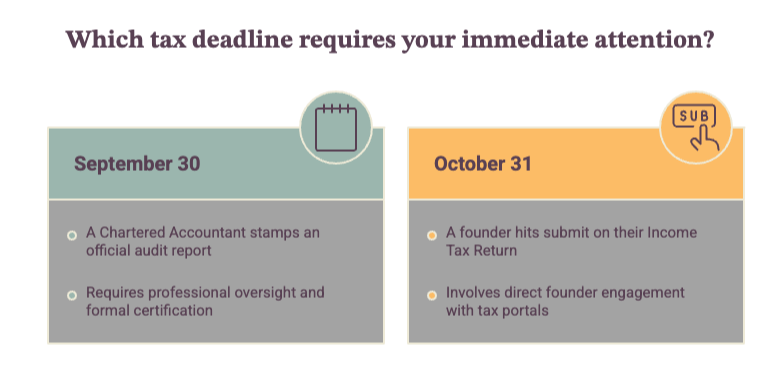
The ITR filing last date in September 2026 specifically refers to the September 30, 2026 deadline for uploading your Tax Audit Report (Form 3CA-3CD or 3CB-3CD). The actual Income Tax Return (ITR) for businesses subject to this audit is due on October 31, 2026.
It’s 11:30 PM, the festive season is just kicking in, and your CA is frantically WhatsApping you for final bank statements and your digital signature token. Sound familiar?
As a founder, missing statutory deadlines doesn't just mean paying a small penalty; it directly attacks your working capital. The chaos usually stems from confusing exactly what paperwork is due in September versus October. Let’s clear the noise. Knowing your exact deadlines isn't just about ticking compliance boxes it’s about protecting your dhandha from compound interest, severe penalties, and last-minute portal crashes.
What is the exact ITR filing last date in September 2026?
The exact "ITR filing last date" in September 2026 is a massive misconception September 30, 2026, is the strict deadline for submitting your Tax Audit Report, while the actual Income Tax Return (ITR) for those audit cases is due on October 31, 2026.
Founders constantly mix these two up. You do not file your final corporate tax return in September. However, if your CA does not upload the audit report by the end of the month, you cannot legally file that final ITR in October.
Here is exactly how to know if the September 30 tax audit deadline applies to your business:
- Standard Business Turnover: If your business gross receipts or turnover exceeds ₹1 Crore, you fall under the mandatory tax audit bracket.
- Digital-First Businesses: The government gives you breathing room if you run a clean, cashless operation. If 95% of your total receipts and payments are made digitally, your audit threshold jumps to ₹10 Crore.
- Independent Professionals: If you are a consultant, freelancer, or lawyer, your audit threshold triggers when gross receipts cross ₹50 Lakhs.
The Bottom Line: September is strictly for locking in the audited numbers. October is for submitting the final return based on those numbers.
Belated ITR Filing Due Date vs. MCA Deadlines: Clearing the Chaos
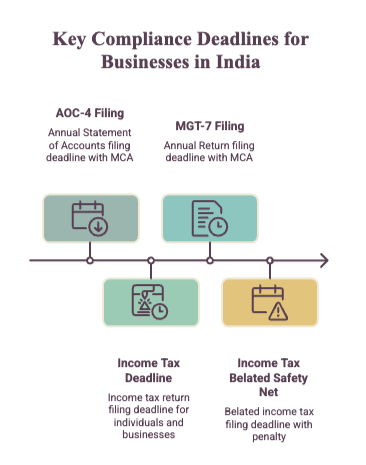
The belated ITR filing due date for FY 2025–26 (AY 2026–27) is December 31, 2026, under Section 139(4) of the Income Tax Act. Filing a belated return regularizes your tax status with a late fee of up to ₹5,000, but it operates independently of Ministry of Corporate Affairs (MCA) compliance and cannot remedy overdue MCA filings like Form AOC-4 or Form MGT-7.
A common pitfall for founders is assuming that "taxes" and "company compliance" are the same bucket. You might tell yourself, "Arre, if we miss October, our CA will just file a belated return in December. No big deal."
That assumption can cost you tens of thousands of rupees. Income Tax and MCA are governed by completely different authorities, with distinct portals, rules, and penalties.
1. The Income Tax Side: What Happens If You Rely on a Belated ITR?
If you miss the October 31 audit ITR deadline (or missed the July 31 non-audit deadline), Section 139(4) gives you a final safety net until December 31, 2026.
While it keeps you on the right side of the law, filing late exacts a heavy price on your dhandha:
- Statutory Late Fee (Section 234F): A flat fee of ₹5,000 applies automatically (reduced to ₹1,000 if your total taxable income is below ₹5 Lakhs).
- Accumulating Monthly Interest (Section 234A): You are charged 1% simple interest per month (or part of a month) on any unpaid tax liability from the original due date until the day you actually file.
- The Fatal Hit - Forfeiture of Business Losses (Section 80): This is the hidden risk that hurts startups the most. If your company made a business loss this year (from heavy product development, marketing spends, or inventory write-downs), you cannot carry that loss forward to offset future profits if you file a belated return. That missed deadline directly inflates your future tax bills.
2. The MCA Side: Why Your Belated ITR Won't Save Your Company Status
The Income Tax portal and the MCA V3 portal do not share a calendar. While the tax department gives you until December 31 for belated filings, the Registrar of Companies (RoC) does not wait.
- Form AOC-4 (Financial Statements): Due within 30 days of your AGM (typically October 30).
- Form MGT-7 / 7A (Annual Return): Due within 60 days of your AGM (typically November 29).
- LLP Form 8 (Statement of Account & Solvency): Due strictly on October 30.
If you delay these until December thinking you'll "wrap everything up together," the MCA adds a relentless penalty of ₹100 per day, per form, with no upper cap. Delaying both AOC-4 and MGT-7 by just 60 days results in an automatic penalty of ₹12,000 in statutory late filing fees alone on top of potential director disqualification warnings.
Income Tax Belated Return vs. MCA Annual Filings
| Parameter | Belated ITR (Income Tax) | MCA / RoC Filings (AOC-4 / MGT-7) |
| Governing Authority | Central Board of Direct Taxes (CBDT) | Ministry of Corporate Affairs (MCA) |
| Relevant Law | Income Tax Act, 1961 (Sec 139(4)) | Companies Act, 2013 |
| Standard Fall Deadline | Oct 31, 2026 (Audit cases) | Oct 30 (AOC-4) & Nov 29 (MGT-7) |
| Cut-off Window | Dec 31, 2026 | No cut-off (compounds daily until filed) |
| Late Filing Penalty | ₹5,000 flat (Sec 234F) + 1% monthly interest | ₹100 per day per form (No upper ceiling) |
| Operational Impact | Cannot carry forward business losses | RoC non-compliance status & director risk |
Tax Audit Report Due Date Extension: Should You Wait for It?
While the government occasionally grants a tax audit report due date extension, relying on it is a highly risky business strategy that exposes your company to severe portal glitches and a penalty of 0.5% of your turnover if the extension is ultimately denied.
Every year around September 25th, the hashtag #ExtendDueDates starts trending on social media. As a founder, it is incredibly tempting to see that noise and tell your CA, "Let's just wait, they always extend it."
This is a terrible strategy for your business. Here is why banking on a tax audit report due date extension is playing Russian roulette with your compliance:
- The Section 271B Penalty Trap: If the Central Board of Direct Taxes (CBDT) decides not to extend the deadline, the penalty for missing your September 30 audit upload is brutal. The Income Tax Department will levy a penalty of 0.5% of your total sales, turnover, or gross receipts, up to a maximum of ₹1,50,000. If your startup is doing ₹2 Crores in revenue, waiting on a Twitter rumor could instantly cost you ₹1,00,000.
- The DSC & Portal Meltdown: Even when extensions are granted, the e-filing portal often buckles under the weight of millions of last-minute uploads. Digital Signature Certificate (DSC) utilities crash, and OTPs stop delivering. You do not want your company's compliance held hostage by a server timeout at 11:45 PM on deadline day.
The "Dhandha" Impact: Audit vs. Non-Audit Filing Deadlines
To make sure you never mix up these dates again, here is the ultimate cheat sheet. Keep this table handy to understand exactly which deadline applies to your business and what it costs if you miss it.
| Filing Category | Who Does This Apply To? | The Hard Deadline | Consequence of Missing It |
| Standard ITR (Non-Audit) | Small businesses/freelancers with turnover below ₹1 Cr (or ₹50L for professionals). | July 31, 2026 | ₹5,000 late fee + 1% monthly interest. |
| Tax Audit Report (Form 3CD) | Businesses over ₹1 Cr turnover (or ₹10 Cr if 95% digital transactions). | September 30, 2026 | 0.5% of turnover penalty (capped at ₹1,50,000). |
| Corporate ITR (Audit Cases) | The actual tax return for the businesses mentioned directly above. | October 31, 2026 | ₹5,000 late fee + blocked from carrying forward business losses. |
| Belated ITR | Anyone who missed their July 31 or October 31 deadlines. | December 31, 2026 | Final safety net. Miss this, and you cannot file a standard return at all. |
The 3-Step Filing Buddy Survival Checklist
You now know the exact difference between the September audit deadline, the October ITR deadline, and the December belated safety net. Do not let this knowledge sit idle.
Take these three immediate steps to secure your business today:
- Check Your Turnover Threshold Today: Pull your provisional profit and loss statement. Did your gross receipts cross ₹1 Crore? Did your professional consulting fees cross ₹50 Lakhs? If yes, you are in the September 30 audit sprint.
- Run an Early AIS/TIS Check: Do not wait for your CA to find a mismatch on September 29. Log into the Income Tax portal now and cross-check your Annual Information Statement (AIS) against your actual bank statements. Dispute any incorrect TDS entries immediately.
- Pre-Register Your DSC: Ensure your digital signature token is active, unexpired, and successfully registered on both the Income Tax and MCA V3 portals well before the deadline week.
Stop managing portals and start managing your business.
If you are tired of tracking these overlapping deadlines and dealing with portal errors, let Filing Buddy take the wheel. From executing your tax audit to filing your MCA annual returns flawlessly, our certified experts ensure your dhandha stays 100% compliant, penalty-free, and ready for growth.
FAQs
1. What is the ITR filing last date in September 2026? The September 30, 2026 deadline is strictly for submitting your Tax Audit Report (Form 3CD). You do not file your actual corporate Income Tax Return in September. The final ITR filing deadline for businesses subject to this audit is October 31, 2026.
2. What is the belated ITR filing due date for FY 2025-26? The belated ITR filing due date for FY 2025-26 (AY 2026-27) is December 31, 2026. Filing a belated return incurs a late fee of up to ₹5,000 and strictly prevents you from carrying forward any business losses to the next financial year.
3. Will there be a tax audit report due date extension this year? While the government occasionally grants a tax audit report due date extension, it is highly risky to rely on it. If an extension is not officially announced, missing the September 30 deadline triggers a severe penalty of 0.5% of your turnover (up to ₹1,50,000).
4. Does filing a belated ITR also fix my missed MCA deadlines like Form AOC-4? No. Income Tax and the Ministry of Corporate Affairs (MCA) operate independently. Filing a belated ITR in December does not stop the daily ₹100 compounding penalty for missing your MCA annual filings like AOC-4 or MGT-7, which are typically due in October and November.
5. Who is required to get a tax audit done before September 30? Businesses with a gross turnover exceeding ₹1 Crore (or ₹10 Crore if 95% of transactions are digital) and independent professionals with gross receipts over ₹50 Lakhs are mandatorily required to undergo a tax audit.
Contact Us
An expert will call you within 24 hours. No payment required to get started.
6.png) How to Claim a TDS Refund: Step-by-Step Guide
5 minutes read
How to Claim a TDS Refund: Step-by-Step Guide
5 minutes read
6.png) DIR-3 KYC Compliance: A Director's Guide to Avoiding Disqualification
5 minutes read
DIR-3 KYC Compliance: A Director's Guide to Avoiding Disqualification
5 minutes read
4.png) Register For ESI & PF Now Or Face Employer Penalties On Every Payroll!
5 minutes read
Register For ESI & PF Now Or Face Employer Penalties On Every Payroll!
5 minutes read
8.png) Complete Your Professional Tax Registration Online Before Penalties Pile Up!
5 minutes read
Complete Your Professional Tax Registration Online Before Penalties Pile Up!
5 minutes read
Frequently Asked Questions
Have a question about this?
Our team can walk you through what applies to your business and what to do next.
Talk to our teamRelated posts

How should a start-up complete ITR filing
Business entities must file their ITR annually to comply with the tax laws of their respective countries. It helps the government assess and collect the appropriate amount of income tax from taxpayers and ensures proper accountability of financial activities.
. 3 Mins.png)
5 step checklist for GST compliance in Indian Startups
Learn about how GST works. The basics of GST along with its compliances. Uncover what your business needs to keep in mind concerning GST rules and GST compliance.
. 3 min read.png)
₹20 Lakhs and Beyond: Understanding GST for Freelancers in India
Are you a freelancer or aspiring to be one? In this blog, uncover the basics of freelancing and requirements involving GST. Learn about all the exemptions, obligations, and compliances of GST for freelancers in india.
. 5 min readEverything right at your mail.
Request a Call Back
Leave your details and our team will call you.
Chat with us on WhatsApp
Hi there! 👋 Connect with our team on WhatsApp.
Hello FilingBuddy, I would like to know more about your services.
Chat Now