
MCA CCFS-2026 Scheme Extended: Save Lakhs on Pending Compliance
By Filing Buddy . 15 Jul 26
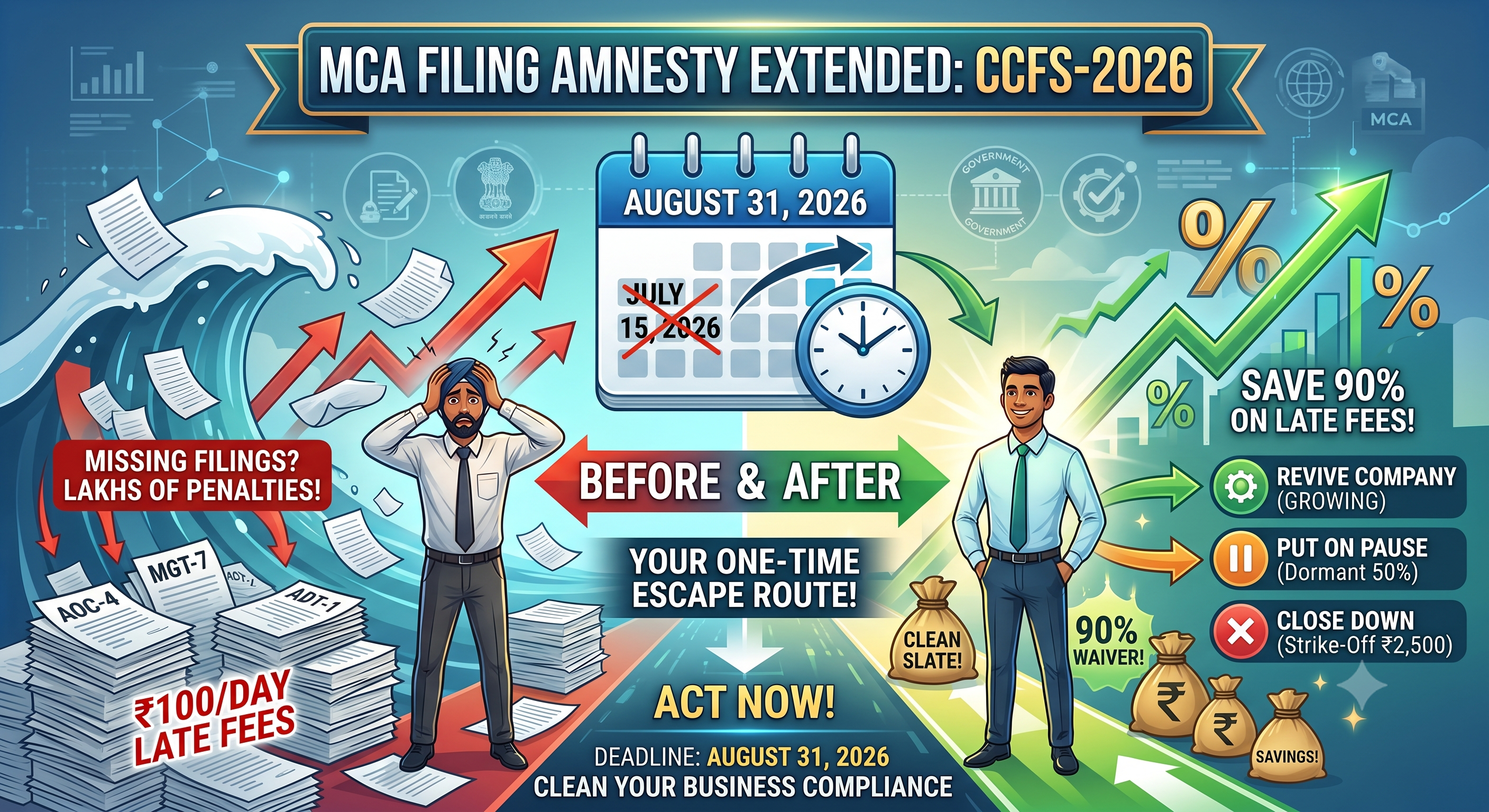

Missing MCA Filings? Why You Need to Use the Extended CCFS-2026 Scheme Right Now.
If you run a Private Limited Company or a startup, you already know how quickly life gets in the way. Maybe a project failed, partners parted ways, or you simply put an inactive business on the back burner. But in the background, the compliance clock was ticking.
Ever since the Ministry of Corporate Affairs (MCA) introduced a flat late fee of ₹100 per day for delayed forms with absolutely no upper limit, a couple of years of missed paperwork could easily snowball into a penalty running into lakhs.
This created a brutal trap: promoters couldn't afford the penalties to make the company active again, but they also couldn't pay the penalties required to shut the company down. So, they did nothing, leaving a legal and financial time bomb hanging over their heads.
If that sounds like your company, take a deep breath. The MCA just handed you a massive, one-time escape route.
It’s called the Companies Compliance Facilitation Scheme, 2026 (CCFS-2026). And thanks to a brand-new update, you now have until August 31, 2026, to clean your slate.
Let’s break down exactly how this works, why the deadline was extended, and how much money you can save right now.
Why the Government Extended the Compliance Deadline to August 31st
Originally, the CCFS-2026 was a tight 90-day window set to wrap up on July 15, 2026.
However, on July 8, 2026, the MCA released General Circular No. 03/2026.
Due to a fire incident at the MCA data center on June 5, 2026, the ministry had to undergo major data restoration and system capacity upgrades.
To make up for the downtime and technical glitches, the government extended the scheme's deadline to August 31, 2026
This is an incredibly lucky break for business owners. It gives you an extra month and a half to gather your documents, sort your accounts, and file without last-minute portal crashes.
Your Three Options Under the Scheme: Revive, Pause, or Close Your Company
The beauty of CCFS-2026 is that it isn’t just for active businesses. Whether you want to keep going, hit pause, or pull the plug entirely, the MCA has given you a discounted path:
Path A: Clean the Slate and Keep Growing (90% Savings)
If you want to make your company fully compliant and active again, you can file all your pending Annual Returns and Financial Statements by paying the normal filing fee and only 10% of the accumulated late fees. The MCA is completely waiving the other 90%.
Path B: Put Your Brand on "Pause" (50% Savings)
Maybe you aren't doing business right now, but you love your company name and want to use it in the future. Instead of letting it accumulate penalties, you can officially apply for Dormant Status (Form MSC-1). Under the scheme, the filing fee for this is slashed by 50%.
Path C: Shut It Down for Good (75% Savings)
If you just want to walk away without any lingering legal liability, you can apply for an official Strike-Off (Form STK-2).
Normal Cost: ₹10,000
CCFS-2026 Cost: Just ₹2,500 (a flat 75% discount)
How Much Penalty Fees You Can Save
If you think "90% off" sounds like a generic retail sale, let's look at how much actual cash stays in your bank account.
Imagine you registered a Private Limited Company but didn't file your statutory returns for two years (approximately 730 days). Here is how your bill would look:
Without CCFS-2026:
Form AOC-4 (Financials) Late Fee: 730 days × ₹100/day = ₹73,000
Form MGT-7 (Annual Return) Late Fee: 730 days × ₹100/day = ₹73,000
Your total penalty bill: ₹1,46,000 (plus normal filing fees)
Under CCFS-2026:
You get a 90% waiver on those accumulated late fees.
You pay only 10% of the penalty: ₹14,600.
Total Money Saved: ₹1,31,400
For companies that have defaulted for three, four, or five years, this scheme literally saves lakhs of rupees that would otherwise be gone forever.
List of Eligible MCA Forms and Key Exceptions to Keep in Mind
Covered Forms Include:
AOC-4 / AOC-4 CFS / AOC-4 XBRL: Your annual financial statements.
MGT-7 & MGT-7A: Your annual returns (including the shorter version for small companies and OPCs).
ADT-1: Auditor appointment forms (a very common form that promoters forget to file in their first year).
FC-3 & FC-4: Required filings for foreign companies operating in India.
Who Cannot Apply?
The MCA has designed this to help honest businesses get back on track, not to rescue bad actors. You cannot use this scheme if:
The Registrar of Companies (ROC) has already initiated and issued a final notice of strike-off to your company under Section 248.
Your company has already been declared a "vanishing company."
Step-by-Step Filing Checklist for Company Directors
Do not wait until August 30th to start this process. System upgrades and data migrations are still happening, and the portal will inevitably slow down as the final hours tick away.
If you want to secure these savings, follow this exact checklist starting today:
1. Fix Your KYC First
If your company has been inactive, the directors' DINs (Director Identification Numbers) are likely deactivated. You must file your DIR-3 KYC to reactivate your status before you can sign off on any corporate returns.
2. Compile and Audit Your Accounts
Get in touch with your accountant. You will need audited balance sheets and profit & loss statements signed by a statutory auditor for every single missing financial year.
3. Keep the Sequence Right
The MCA portal is strict about the order of operations. You must draft, sign, and file your financial statements (AOC-4) before the portal will let you submit your annual returns (MGT-7).
4. Let the Portal Do the Math
When you upload your forms onto the MCA-21 V3 portal, the system will automatically calculate the CCFS-2026 concession. You don't need to apply for a separate waiver certificate, just pay the discounted amount generated on your screen.
FAQs
The most common questions regarding the Companies Compliance Facilitation Scheme, 2026 (CCFS-2026) revolve around the extended deadlines, exact penalty savings, and eligibility criteria for inactive startups.
1. What exactly is the CCFS-2026 scheme?
The Companies Compliance Facilitation Scheme, 2026 (CCFS-2026) is a one-time relief window by the MCA that allows defaulting companies to file their pending annual returns at a massive 90% discount on accumulated late fees. Think of it as a massive, limited-time amnesty program to clear your startup's compliance backlog without bankrupting your business.
2. What is the new extended deadline for the scheme?
Thanks to a recent extension, you now have until August 31, 2026, to file your pending documents under the CCFS-2026 scheme. Originally set to close on July 15, this extra month and a half is a lifeline for founders scrambling to get their past financial audits signed and uploaded.
3. Why did the government extend the CCFS-2026 deadline?
The MCA extended the deadline via General Circular No. 03/2026 because a severe fire at the MCA data center on June 5, 2026, required major system restoration and capacity upgrades. The government gave this extension to ensure you have enough time to file without facing technical glitches or last-minute portal crashes.
4. How much money can my startup actually save under this scheme?
If you want to keep your company active, you only pay 10% of your accumulated additional fees—meaning the MCA is completely waiving the other 90%. For a company that missed its AOC-4 and MGT-7 filings for just two years, this scheme translates to over ₹1.3 Lakhs in pure cash savings.
5. Which MCA forms are eligible for the fee waiver?
The scheme covers your primary annual compliance forms, including financial statements (AOC-4), annual returns (MGT-7/MGT-7A), auditor appointments (ADT-1), and forms for foreign companies (FC-3/FC-4). It is basically everything you need to bring your defaulting company back to a fully active and compliant status.
6. Can I use this scheme to finally close down an inactive company?
Yes, if you want to walk away without lingering legal liability, you can file for an official Strike-Off (Form STK-2) at a flat 75% discount. Instead of paying the standard ₹10,000 closure fee, it will only cost you ₹2,500 during the scheme window.
7. What if I am not doing business right now but want to keep my brand name?
You can officially put your company on "pause" by applying for Dormant Status (Form MSC-1), and the MCA has slashed the filing fee for this by 50%. This is perfect for founders who love their company name and plan to revive operations in the future, without accumulating any further daily penalties.
8. Who is NOT eligible to apply for CCFS-2026?
The scheme is strictly for honest businesses trying to get back on track; you cannot apply if the ROC has already issued a final strike-off notice, or if your business is officially tagged as a "vanishing company". If the government has already pulled the plug on your entity for severe non-compliance, this scheme will not save it.
9. My company has been inactive for years, and my Director DIN is deactivated. What should I do?
Before you can sign off on any corporate returns under this scheme, you must first file your DIR-3 KYC to reactivate the directors' DIN statuses. The MCA portal will not let you submit any compliance forms if the digital signature being used belongs to a deactivated director.
10. Do I need to apply for a separate waiver certificate to get the discount?
No, the MCA-21 V3 portal will automatically calculate the 90% concession when you upload your forms. You do not need to hunt down special approval certificates or write letters to the ROC; just follow the correct filing sequence and pay the automatically discounted amount generated on your screen.
Contact Us
An expert will call you within 24 hours. No payment required to get started.
Related Post

LLP vs. LLC: Choosing the Right Structure for Your Business
Making the appropriate legal structure choice is one of the most important decisions you'll need to make when launching a business in India. Limited Liability Companies (LLCs) and Limited Liability Partnerships (LLPs) are two well-liked alternatives.
. 3 min read2.png)
LLP Agreements: Creating a Solid Foundation for Your Business
A Limited Liability Partnership (LLP) is a business structure that combines the benefits of a partnership with limited liability protection, typically associated with corporations. It is designed to provide a more flexible and tax-efficient framework for professionals and businesses with multiple partners.
. 3 min read.png)
Revised LLP (Amendment) Rules for 2023 – Enhanced LLP Form No. 3
The Ministry of Corporate Affairs (MCA) has recently issued the Limited Liability Partnership (LLP) (Amendment) Rules, 2023, which were officially gazetted on June 2, 2023. These rules bring about amendments to the pre-existing Limited Liability Partnership Rules of 2009. These amendments came into effect upon their publication in the Official Gazette. A noteworthy change introduced through these amendments is the revision of the LLP Form No.3, which pertains to "Information concerning Limited Liability Partnership Agreement."
. 3 min read