
Process to Shift Registered Office State-to-State Guide
By Filing Buddy . 16 Feb 26
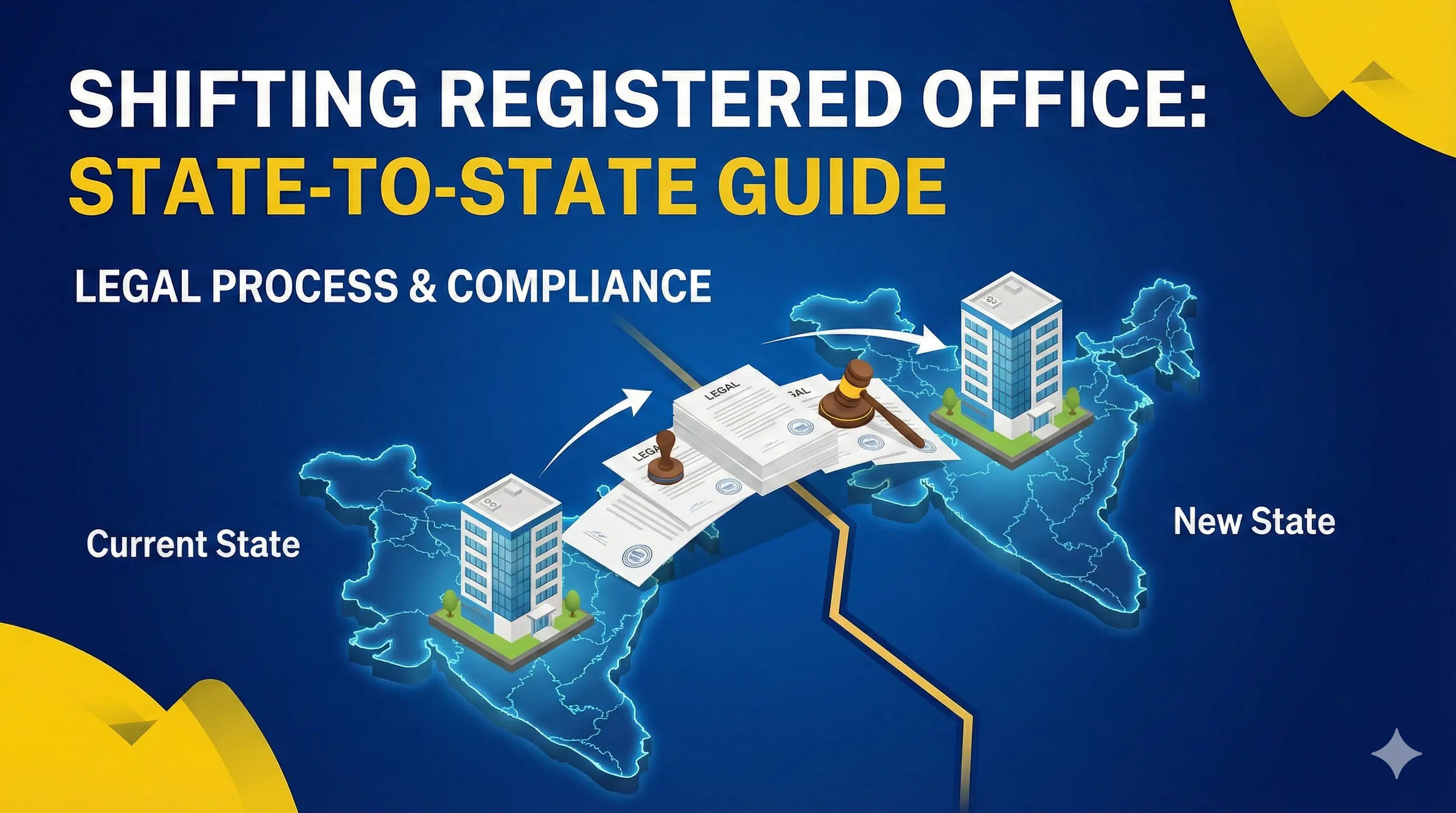

Shifting of Registered Office from One State to Another under Companies Act, 2013
Shifting the registered office of a company from one State to another is a significant corporate action governed by Section 13(4) of the Companies Act, 2013. Such a change requires prior approval of the Central Government, whose powers are presently delegated to the Regional Director (RD).
The process is detailed, compliance-heavy, and involves multiple filings, notices, affidavits, and approvals. Below is a step-by-step guide explaining the complete procedure as prescribed under the Companies Act, 2013 read with Rules 30 and 31 of the Companies (Incorporation) Rules, 2014.
The process is detailed, compliance-heavy, and time-bound, involving Board and shareholder approvals, public advertisements, preparation and verification of creditor lists, filings with the Registrar of Companies (RoC), and formal approval from the Regional Director. This article provides a comprehensive step-by-step guide to the entire procedure as prescribed under the Companies Act, 2013 read with Rules 30 and 31 of the Companies (Incorporation) Rules, 2014.

Legal Framework Governing the Change
Section 13(4) of the Companies Act, 2013
As per Section 13(4), any alteration of the Memorandum of Association (MOA) relating to the place of the registered office from one State to another shall not have any effect unless approved by the Central Government.
Applicable Rules
The procedural requirements are governed by:
Rule 30 – Application to Central Government for approval
Rule 31 – Notice of change of registered office
The application seeking approval must be filed in E-Form INC-23, accompanied by extensive documentation and statutory declarations.
Step 1: Conduct of Board Meeting
The process begins with convening a Board Meeting in accordance with Section 173 of the Companies Act, 2013. At this meeting, the Board of Directors must pass resolutions approving:
- The proposal to shift the registered office from one State to another
- Alteration of Clause II of the Memorandum of Association
- Fixing the date, time, and venue of the Extraordinary General Meeting (EGM)
- Authorization to issue notice of the General Meeting
The Board Resolution serves as the foundation for all subsequent compliance steps.
Step 2: Conduct of Extraordinary General Meeting (EGM)
An Extraordinary General Meeting must be convened after issuing notice to all members in accordance with Section 101 and Section 102 of the Act.
At the EGM, the shareholders must pass Special Resolutions for:
- Approval of shifting the registered office from one State to another
- Alteration of Clause II of the Memorandum of Association
Filing of E-Form MGT-14
Within 30 days of passing the Special Resolutions, the company must file E-Form MGT-14 with the Registrar of Companies along with:
- Certified true copy of the Special Resolution(s)
- Explanatory Statement under Section 102
- Altered Memorandum of Association
Failure to file MGT-14 within the prescribed timeline attracts additional fees and penalties.
Step 3: Preparation of List of Creditors and Debenture Holders
One of the most critical compliance steps is the preparation of a list of creditors and debenture holders, if any.
Key Requirements:
The list must be not older than one month from the date of filing INC-23
It must include:
- Name and address of each creditor/debenture holder
- Nature of debt or liability
- Amount outstanding
Verification:
- The list must be verified by an affidavit
- It must be certified by the Statutory Auditor
- The list must be kept open for inspection at the registered office
This step ensures that the interests of creditors are protected and that the relocation does not prejudice their rights.
Step 4: Publication and Service of Public Notice (Form INC-26)
To ensure transparency, the company must publish a public notice in Form INC-26.
Newspaper Publication:
- One vernacular newspaper in the principal vernacular language of the district where the registered office is currently situated
- One English newspaper with wide circulation in the State.
Service of Notices:
Copies of the notice must also be sent by registered post with acknowledgment due to:
- Individual creditors and debenture holders (inviting objections)
- Registrar of Companies
- SEBI (if applicable)
- Chief Secretary of the concerned State Government
- Any other relevant regulatory authorit
These notices must be served not more than 30 days before filing INC-23.
Step 5: Filing of Petition with ROC (Form GNL-1)
Before approaching the Regional Director, the company is required to file a petition with the Registrar of Companies in E-Form GNL-1.
Attachments:
- A detailed, serially numbered application/petition
- Proof of service of the application to the Chief Secretary of the State
This filing formally places the proposed shift on record with the RoC.
Step 6: Filing of Application with Regional Director (Form INC-23)
Within one month of preparing the list of creditors, the company must file E-Form INC-23 with the Regional Director seeking approval.
Major Attachments Include:
- Copy of MOA and altered MOA
- Certified true copy of Special Resolution
- Minutes of the General Meeting
- Newspaper advertisements
- Proof of service of notices to authorities
- List of creditors with auditor’s certificate
- Certificate of Incorporation
- Power of Attorney / Board Resolution
- MGT-14 challan
- Numerous affidavits from directors
This is the most document-intensive stage of the entire process.
Step 7: Submission of Hard Copy to Regional Director
In addition to electronic filing, a physical set of documents along with the INC-23 challan must be submitted to the concerned Regional Director’s office.
Step 8: Approval by the Regional Director
If no objections are received:
The RD may pass an order without hearing within 15 days
If objections are received:
The RD conducts a hearing and passes an order within 60 days of filing
The RD may approve the application with or without conditions or may reject it.
Step 9: Filing of RD Order with ROC (Form INC-28)
Upon receipt of the RD’s order, the company must file E-Form INC-28 within 30 days, along with:
- Certified copy of the RD order
- Proof of payment of penalty, if imposed
Step 10: Filing of Notice of New Registered Office (Form INC-22)
Finally, the company must file E-Form INC-22 to notify the RoC of the new registered office address.
Attachments Required:
- Proof of registered office address
- Utility bill (not older than two months)
- Altered MOA
- Certified copy of RD order
- Certified copy of Special Resolution
- NOC from the owner of the premises
- List of companies having the same registered office address, if any
Upon verification, the RoCs of both States update their records, and the new Certificate of Incorporation is issued by the RoC of the destination State.
Mandatory Core Documents for INC-22 Filing
To complete the shifting process, the company must file Form INC-22 to formally notify the Registrar of Companies (ROC) of the new registered office location. Ensuring these documents are accurate is crucial to avoid rejection.
Required Attachments:
- Board Resolution: A certified copy of the resolution authorizing the change of address.
- Proof of Registered Office Address:
- If Rented: Valid Lease Deed or Rent Agreement.
- If Owned: Title Deed or Property Ownership documents.
- Utility Bill: A copy of a utility bill (Electricity, Telephone, Gas, or Mobile) depicting the address in the name of the owner or company.
- Note: Must not be older than 2 months.
- NOC (No Objection Certificate): A certificate from the owner/landlord permitting the use of the premises as the registered office.
- Rent Receipt: Proof of rental payment.
- Note: Must not be older than 1 month.
Estimated Timeline: Shifting Registered Office State-to-State
Total Estimated Time: 110 – 140 Days
The process of shifting a registered office from one state to another is time-bound and sequential. Below is the breakdown of the compliance calendar from the initial Board Meeting to the final certificate issuance.
| Timeframe | Phase | Key Compliance Actions |
| Day 0 – 7 | Initiation | • Convene Board Meeting. • Approve the proposal to shift the office. • Schedule the Extraordinary General Meeting (EGM). |
| Day 8 – 20 | Shareholder Approval | • Hold the Extraordinary General Meeting (EGM). • Pass Special Resolutions for shifting the office and altering the MOA. • File Form MGT-14 with ROC (within 30 days). |
| Day 21 – 35 | Creditor Verification | • Prepare a detailed list of Creditors & Debenture Holders. • Obtain certification from the Statutory Auditor. • Keep the list open for inspection at the registered office. |
| Day 36 – 45 | Public Notice | • Publish advertisement in Form INC-26 (1 English + 1 Vernacular newspaper). • Dispatch notices to Creditors, ROC, Chief Secretary, and SEBI (if listed). |
| Day 46 – 50 | ROC Petition | • File the formal petition with the ROC using Form GNL-1. |
| Day 51 – 65 | Regional Director Filing | • File application to the Regional Director (RD) via Form INC-23. • Submit a physical set of documents to the RD’s office. |
| Day 66 – 80 | RD Scrutiny & Order | • No Objection: RD may pass an order within 15 days. • Objection: RD conducts a hearing and passes an order within 60 days. |
| Day 81 – 110 | Filing the Order | • File the certified copy of the RD’s order with the ROC using Form INC-28 (within 30 days of receipt). |
| Day 111 – 140 | Final Shift | • File Form INC-22 to update the new address. • Attach all address proofs and NOCs. • Receive new Certificate of Incorporation from the destination state ROC. |
Important Restriction
Shifting of registered office is not permitted if:
Any inquiry, inspection, or investigation has been initiated against the company, or
Any prosecution is pending under the Companies Act, 2013
Shifting a registered office from one State to another is not just a geographical move, it is a legal transition that demands precision, transparency, and strict adherence to statutory procedures. While the process may appear lengthy, it ensures protection of stakeholders, creditors, employees, and regulatory interests.
As Rahul eventually realized, and Neha patiently explained, corporate compliance is not about speed it is about certainty. With proper planning and professional guidance, companies can navigate this process smoothly and legally.
Frequently Asked Questions (FAQs)
1. What is the legal process to shift a registered office from one state to another?
Shifting a registered office from one state to another is governed by Section 13(4) of the Companies Act, 2013. The process involves passing a Special Resolution at an EGM, filing Form MGT-14, publishing advertisements (Form INC-26), and obtaining approval from the Regional Director (RD) by filing Form INC-23. Finally, the order is filed with the ROC in Form INC-28 and the new address is notified via Form INC-22.
2. How long does it take to shift a registered office between states in India?
The entire process generally takes between 110 to 140 days to complete, provided all documents are in order. This timeline includes conducting Board and General Meetings (approx. 20 days), creditor verification and public notice periods (30 days), and the Regional Director’s processing time, which can range from 15 to 60 days depending on whether objections are raised.
3. Is Regional Director (RD) approval mandatory for shifting the registered office interstate?
Yes, Regional Director (RD) approval is mandatory. According to Section 13(4) of the Companies Act, 2013, any alteration of the Memorandum of Association (MOA) regarding a change of state does not take effect until it is approved by the Central Government, a power currently delegated to the Regional Director.
4. Which forms are required to shift a registered office to a different state?
The key e-forms required for this process are:
MGT-14: To file the Special Resolution.
GNL-1: To file the petition with the ROC.
INC-23: Application to the Regional Director for approval.
INC-28: To file the RD's approval order with the ROC.
INC-22: To notify the ROC of the new registered office address.
5. Can a company shift its registered office if an inquiry or inspection is pending?
No, a company cannot shift its registered office from one state to another if any inquiry, inspection, or investigation has been initiated against it, or if any prosecution is pending under the Companies Act, 2013. The shift is only permitted once these legal proceedings are resolved.
6. What is the purpose of Form INC-26 when changing the registered office?
Form INC-26 is used to publish a public notice regarding the proposed shift. This advertisement must appear in at least one vernacular newspaper (in the district's principal language) and one English newspaper with wide state circulation. Its purpose is to ensure transparency and invite objections from stakeholders before the shift is approved.
7. Who must be sent a notice before shifting the registered office?
To protect stakeholder interests, the company must send individual notices by registered post to:
All creditors and debenture holders.
The Registrar of Companies (ROC).
The Chief Secretary of the state government.
SEBI, if the company is listed.
These notices must be served at least 30 days before filing the application with the Regional Director.
8. What documents are required to be attached with Form INC-23?
Form INC-23 (Application to RD) requires extensive documentation, including:
Copy of the altered Memorandum of Association (MOA).
Minutes of the EGM and a certified copy of the Special Resolution.
Proof of service of notices to creditors, ROC, and the Chief Secretary.
Newspaper advertisements (Form INC-26).
List of creditors verified by the Statutory Auditor.
9. What happens if the Regional Director receives an objection to the office shift?
If an objection is received, the Regional Director (RD) will conduct a hearing. In such cases, the RD must pass an order within 60 days of the application filing. The RD has the authority to approve the application with specific conditions or reject it entirely based on the merit of the objection.
10. Why is the list of creditors required for shifting a registered office?
A list of creditors and debenture holders is required to ensure that the relocation does not negatively impact their rights or ability to recover dues. This list must be certified by the Statutory Auditor and verified by an affidavit. It confirms the names, addresses, and outstanding debt amounts, ensuring no creditor is left uninformed about the major corporate change.
Contact Us
An expert will call you within 24 hours. No payment required to get started.
Related Post

How to Obtain a Company Registration Number in India
Understanding Corporate Identification Numbers (CINs) and How to Obtain Them in India
. 2 mins.png)
Difference between Udyog Adhaar and Udyam Certificate
Want to get registered for Udyog Aadhar and Udyam Certificate? Here is their registration processes. Also, know about their differences. Explore their features, benefits, and processes to register online for each, helping you to choose the right option as per your need.
. 3 min read.png)
Changing Your Bank Signatory? Here are the Y Documents Required by Most Banks in India
Learn how bank signatory is important for financial workflow. Know why bank signatories are important and discover the documents required to change signature of your signatory.
. 5 min read