
Trademark Classes in India Guide
By Filing Buddy . 21 Jul 26
1.png)

When Trademark Class Goes Wrong
Most business owners believe trademarking is about locking a name. In reality, it’s about locking in where that name operates commercially.
In Yahoo Inc. v. Akash Arora, one of India’s earliest internet trademark disputes, the issue wasn’t just a similar name; it was service overlap. A similar domain offering comparable services created confusion, and the court intervened because both operated in closely aligned categories.
That’s the overlooked layer.
A trademark doesn’t give blanket ownership of a name. It gives you exclusive rights within specific classes. If those classes are wrongly chosen or too narrow, you’re essentially leaving parts of your brand exposed.
In this guide, we’ll break down how trademark classes in India actually work, how to choose them strategically, and how to avoid the subtle mistakes that cost businesses time, money, and control.
Trademark Classes India Decoded
At its core, a trademark class is a structured way to define what your business does in the market. It tells the registry and your competitors which commercial space your brand belongs to.
India follows the globally standardised NICE Classification, which divides trademarks into 45 categories. These are not random; they are designed to prevent overlap and confusion across industries.

- Classes 1 to 34 cover physical goods
- Classes 35 to 45 cover services
This distinction becomes critical as businesses evolve. A brand that sells a product today may offer services tomorrow, and if your classification doesn’t reflect that, your protection won’t either.
Goods Vs Service Trademark Split
The difference between goods and service trademarks seems obvious, but in practice, it’s where many filings go wrong.
A goods trademark protects tangible products, something you can manufacture, package, and sell. A service trademark, on the other hand, protects the experience, expertise, or activity your business delivers.
The complexity arises when businesses operate in both spaces. For example, a company selling skincare products (goods) while also offering dermatology consultations (services) cannot rely on a single class. Filing under just one leaves a gap that competitors can legally step into.
Understanding this split early helps avoid structural weaknesses in your trademark.
Trademark Class List Snapshot
The trademark class list may look overwhelming at first glance, but it follows a logical structure. Once you understand the division between goods and services, navigating it becomes significantly easier.
Overview Table
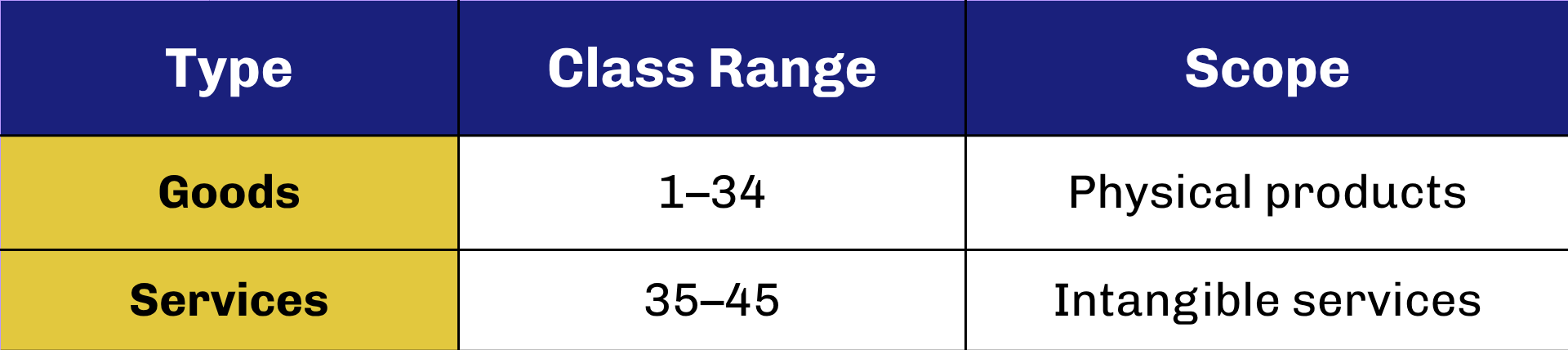
Instead of memorising all 45 classes, a smarter approach is to focus on the ones most relevant to modern businesses.
High Impact Trademark Classes
Certain classes consistently show up across industries, especially in today’s digital and consumer-driven economy.
Class 9, for instance, covers software, mobile applications, and electronics, making it essential for tech-led businesses. Class 35 focuses on advertising and business management, which is why it’s widely used by agencies, marketplaces, and even e-commerce brands.
Then there’s Class 42, which covers IT and SaaS services, and Class 41, relevant for education platforms and training businesses. Apparel brands naturally fall under Class 25.
What’s interesting is that many businesses no longer operate within a single class. A digital-first brand might simultaneously fall under Class 9 (product), Class 42 (service), and Class 35 (business operations). That overlap is where strategic filing becomes important.
Picking the Right Trademark Class
Choosing the right trademark class is less about ticking a compliance box and more about mapping your business model accurately.
Map Business To Trademark Class
The process starts with clarity. Instead of jumping directly into class numbers, break your business down into what it actually delivers.
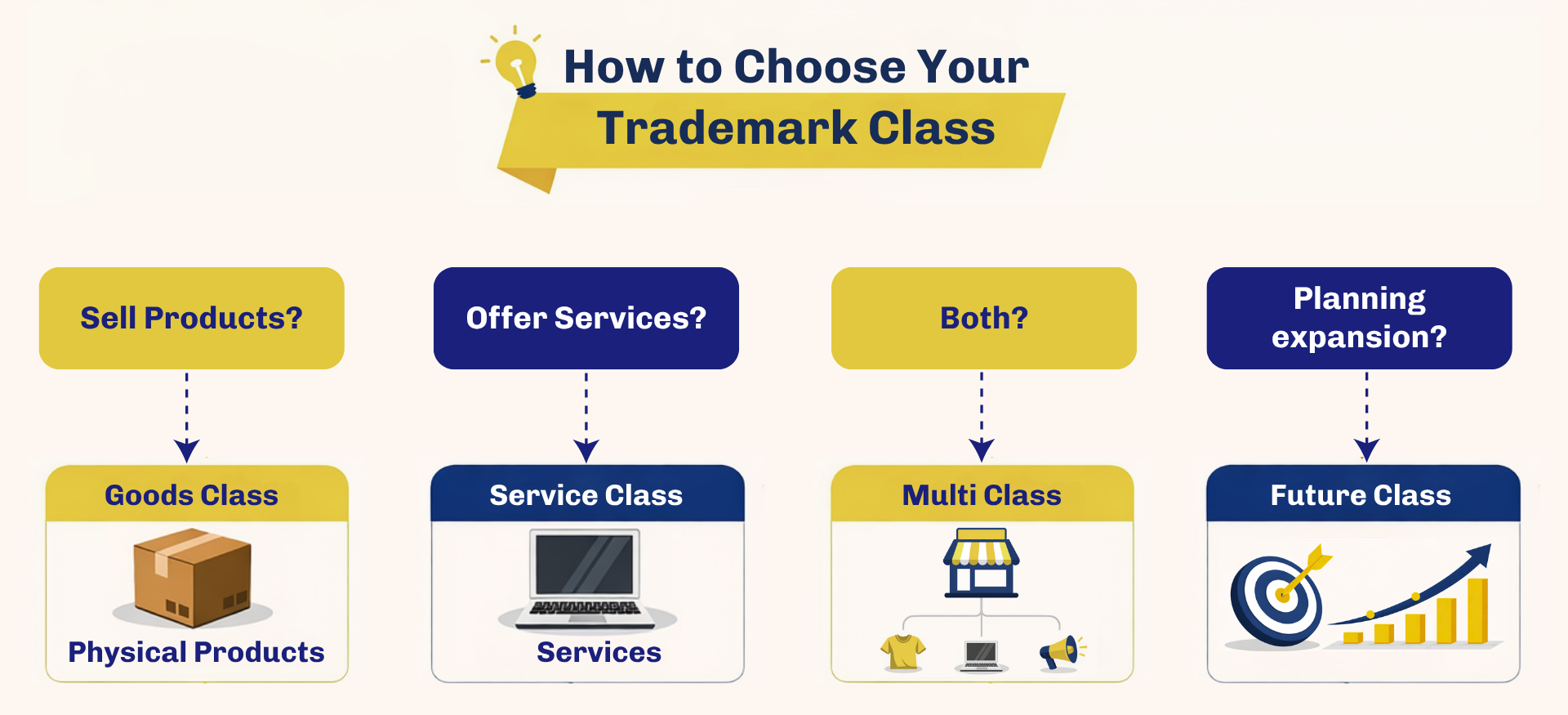
Once this is clear, you can align your business with official class descriptions and cross-check existing trademarks in similar categories. This step is often underestimated, but it significantly reduces the chances of objections or weak protection.
Think Beyond Current Offering
One of the biggest strategic mistakes is filing a trademark based only on your current operations.
The dispute between Apple Corps v. Apple Inc. highlights this perfectly. Initially, both entities operated in separate domains, music and technology. But as Apple expanded into music distribution, the overlap created a conflict that lasted years.
The insight here is simple but powerful:
Your trademark class should reflect where your business is going, not just where it is today.
If expansion is even remotely on your roadmap, your classification should account for it.
Multi-Class Trademark Strategy
As businesses scale, a single-class trademark often becomes insufficient. This is where a multi-class approach comes in, not as a luxury, but as a strategic necessity.
When Multi-Class Makes Sense
Multi-class filing becomes relevant when your business spans multiple touch points. This could mean selling products while offering services, or operating across digital and physical channels.
For instance, a brand that sells fitness equipment and also offers online coaching programs is effectively functioning in two different trademark classes. Protecting only one side of the business creates an imbalance.
Cost Vs Coverage Tradeoff
At first glance, multi-class filing may seem expensive. But when you evaluate it from a business lens, the equation changes.
The cost of filing in additional classes is often far lower than the cost of:
Reapplying later
Handling disputes
Losing brand exclusivity in a new segment
Take Amul as a reference point. While widely known for dairy, the brand has proactively secured its trademark across multiple classes, ensuring its identity remains protected even as it expands into adjacent categories.
That’s not over-protection, it’s brand foresight.
Trademark Registration Workflow
Once your classification is clear, the registration process itself is fairly structured. The key is to execute each step correctly, because errors at the beginning tend to compound later.
Filing Trademark Class Application
The process starts with a trademark search to check availability. This is followed by selecting the appropriate class (or classes) and filing the application with the required details.
After submission, the application is examined by the registry. If there are no objections, it moves to publication, where third parties can raise opposition. If everything goes smoothly, the trademark is registered.
While the steps seem straightforward, the accuracy of your class selection directly influences how smoothly this process unfolds.
Common Trademark Class Mistakes
Trademark classification errors are rarely due to lack of effort; they usually stem from misinterpretation.
A common pattern is businesses filing under a single class to save costs, even when their operations clearly span multiple categories. Others rely on competitor filings without understanding whether their business models actually align.
The case of MakeMyTrip India Pvt Ltd v. MakeMyTravel India Pvt Ltd reinforces how classification strengthens enforcement. The dispute wasn’t just about similar names; it was about operating in the same service space, which made the conflict legally actionable.
This is why classification isn’t a technicality; it’s your first line of defence.
Trademark Class Risk Impact
An incorrect trademark class doesn’t always fail immediately. Sometimes, the consequences show up later, when you try to enforce your rights or expand your brand.
What Wrong Class Costs
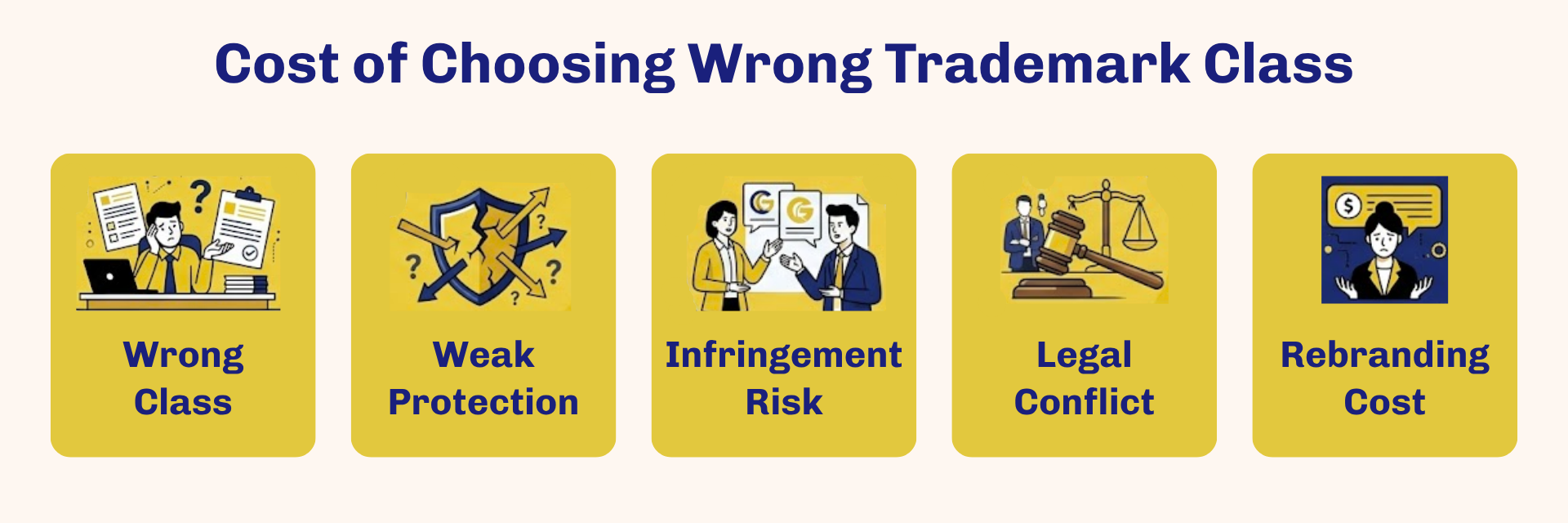
The risks go beyond rejection.
A wrongly classified trademark can limit your ability to act against infringement, because your protection doesn’t extend to the relevant category. It can also force you to refile, delaying expansion and increasing costs.
In disputes like Cadbury India Limited v. ITC Limited, product category alignment played a significant role in how rights were interpreted. Trademark protection is not universal; it is deeply tied to classification.
That’s why getting it right early matters.
Conclusion: Turn Trademark into Strategy
If there’s one clear takeaway from this, it’s that trademark classes are not just a filing requirement; they directly shape how well your brand is protected as it grows.
Here are the 3 key takeaways to keep in mind:
1. Trademark classes define your protection scope: Your trademark isn’t universally protected; it’s only as strong as the classes you register under. Choosing the right ones ensures your brand is secure in the spaces where it actually operates.
2. Future planning matters as much as current filing: Many disputes arise not from what a business does today, but from where it expands tomorrow. A well-thought-out classification strategy prevents conflicts before they even begin.
3. Accuracy beats shortcuts every time: Most businesses don’t lose rights due to ineligibility; they lose them due to incorrect or incomplete classification. Small oversights here can lead to larger legal and financial consequences later.
At its core, this isn’t just about registering a trademark; it’s about owning your business category with clarity and confidence. When classification aligns with business strategy, your trademark becomes more than a legal asset; it becomes a competitive advantage.
And if you’d rather focus on scaling your brand while ensuring your trademark is structured correctly from day one, Filing Buddy helps you get it right, without second guesses or rework.
FAQs
1. What are trademark classes in India?
Trademark classes are categories that define the type of goods or services your brand operates in. They determine the exact scope of your legal protection, ensuring your trademark is enforceable within a specific commercial space.
2. Why are trademark classes important?
They define where your trademark is legally protected. Even if your brand name is unique, incorrect classification can limit your ability to stop others from using a similar name in your actual business category.
3. How many trademark classes are there in India?
India follows the NICE classification system, which includes 45 classes—34 for goods and 11 for services. Each class represents a distinct commercial category.
4. What is NICE classification in trademarks?
It is an internationally accepted system that standardizes how trademarks are categorized. It helps maintain consistency across countries and simplifies trademark filing and enforcement globally.
5. What is the difference between goods and service trademarks?
Goods trademarks apply to physical products like clothing or electronics, while service trademarks apply to activities like consulting, education, or digital services. Many businesses today require both.
6. Can I register my trademark under multiple classes?
Yes, you can file a multi-class application. This is especially useful if your business operates across multiple categories or plans to expand into new areas in the future.
7. What happens if I choose the wrong trademark class?
Your application may be objected to, or worse, approved with limited protection. This means you may not be able to take legal action against similar brands in your actual business category.
8. Can the same brand name exist in different classes?
Yes, identical or similar names can coexist if they operate in completely different classes and there is no likelihood of consumer confusion.
9. Which trademark classes are most commonly used?
Classes like 9 (technology), 35 (business services), and 42 (IT services) are widely used, especially by modern and digital-first businesses.
10. How do I choose the right trademark class?
Start by clearly defining your business activity, then match it with official class descriptions. It’s also important to consider future expansion and not just your current offering.
11. Is trademark protection valid across all classes?
No, trademark protection is limited to the classes you register under. That’s why choosing the right class—or multiple classes—is critical.
12. Can I change my trademark class after filing?
No, once filed, the class cannot be changed. You would need to submit a new application with the correct classification.
13. How long does trademark registration take in India?
The process typically takes 6 to 18 months, depending on objections, oppositions, and the accuracy of your application.
14. Do I need a trademark for services as well?
Yes, if your business provides services, registering under the relevant service class is essential to ensure complete protection.
15. Is multi-class trademark filing worth the cost?
In most cases, yes. It provides broader protection and reduces the risk of future disputes or re-filing, making it a strategic investment rather than just an added expense.
Contact Us
An expert will call you within 24 hours. No payment required to get started.
Related Post

How to Obtain a Company Registration Number in India
Understanding Corporate Identification Numbers (CINs) and How to Obtain Them in India
. 2 mins.png)
Difference between Udyog Adhaar and Udyam Certificate
Want to get registered for Udyog Aadhar and Udyam Certificate? Here is their registration processes. Also, know about their differences. Explore their features, benefits, and processes to register online for each, helping you to choose the right option as per your need.
. 3 min read.png)
Changing Your Bank Signatory? Here are the Y Documents Required by Most Banks in India
Learn how bank signatory is important for financial workflow. Know why bank signatories are important and discover the documents required to change signature of your signatory.
. 5 min read