
Vendor Agreement Format Guide for FY 26–27
The $2.75 Billion Exit Mistake
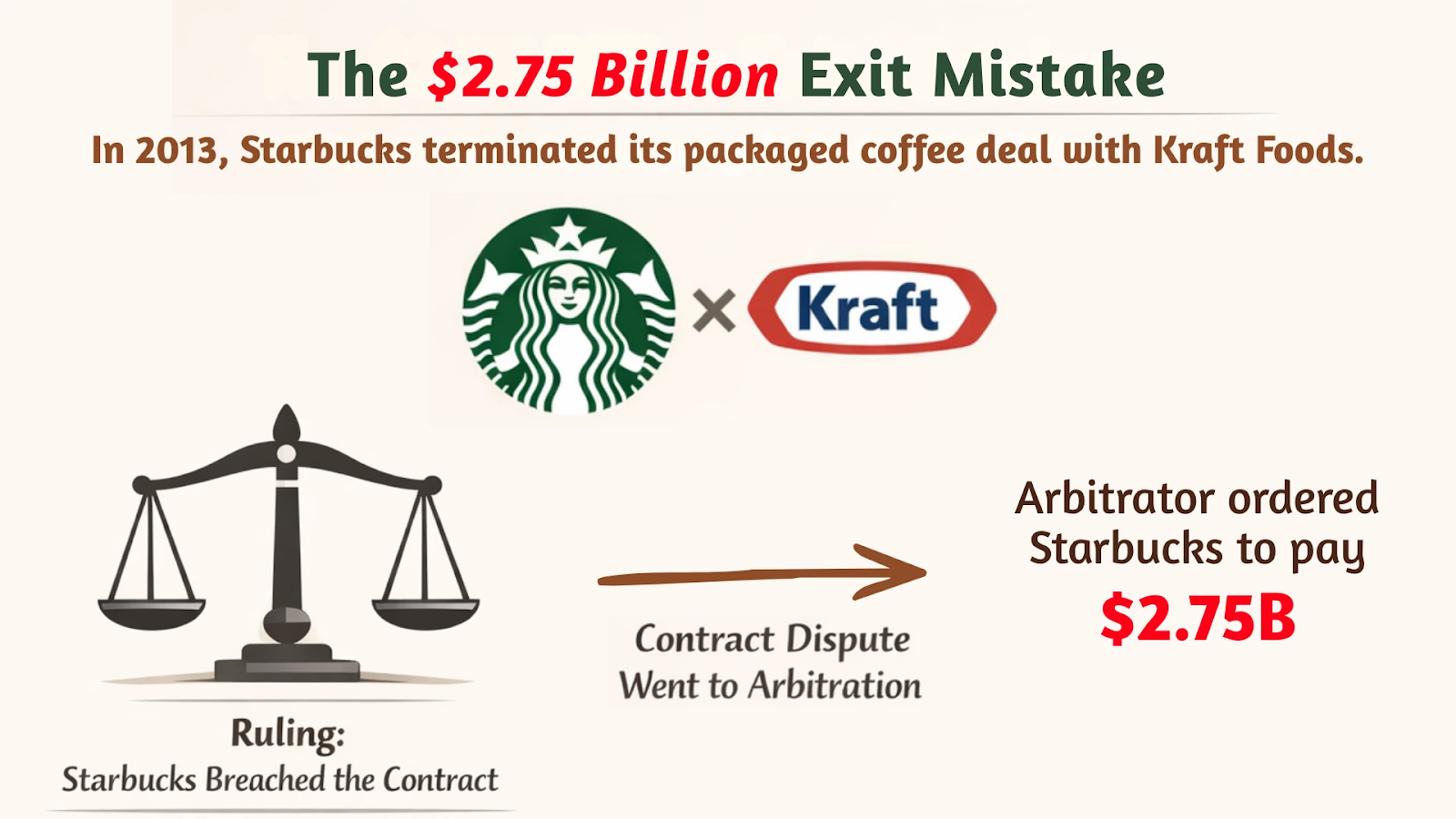
In 2013, Starbucks terminated its packaged coffee distribution agreement with Kraft Foods before the contract term expired. The matter went to arbitration under the agreement’s dispute clause. The arbitrator ruled that Starbucks had breached the contract and ordered it to pay approximately $2.75 billion in damages.
This was not a branding misstep. It was not a market failure. It was a contract structure issue.
Starbucks wanted strategic flexibility. The agreement did not provide it without financial consequence. Termination rights, compensation mechanics, and exit economics were not aligned with business objectives.
The result became one of the most referenced examples in commercial contract law: a vendor agreement can materially impact enterprise value.
As you enter FY 26-27, remember:
Your vendor agreement is not documentation. It is downside protection.
Why FY 26-27 Demands Contract Recalibration
A new financial year should automatically trigger a review of every suppliers contract.
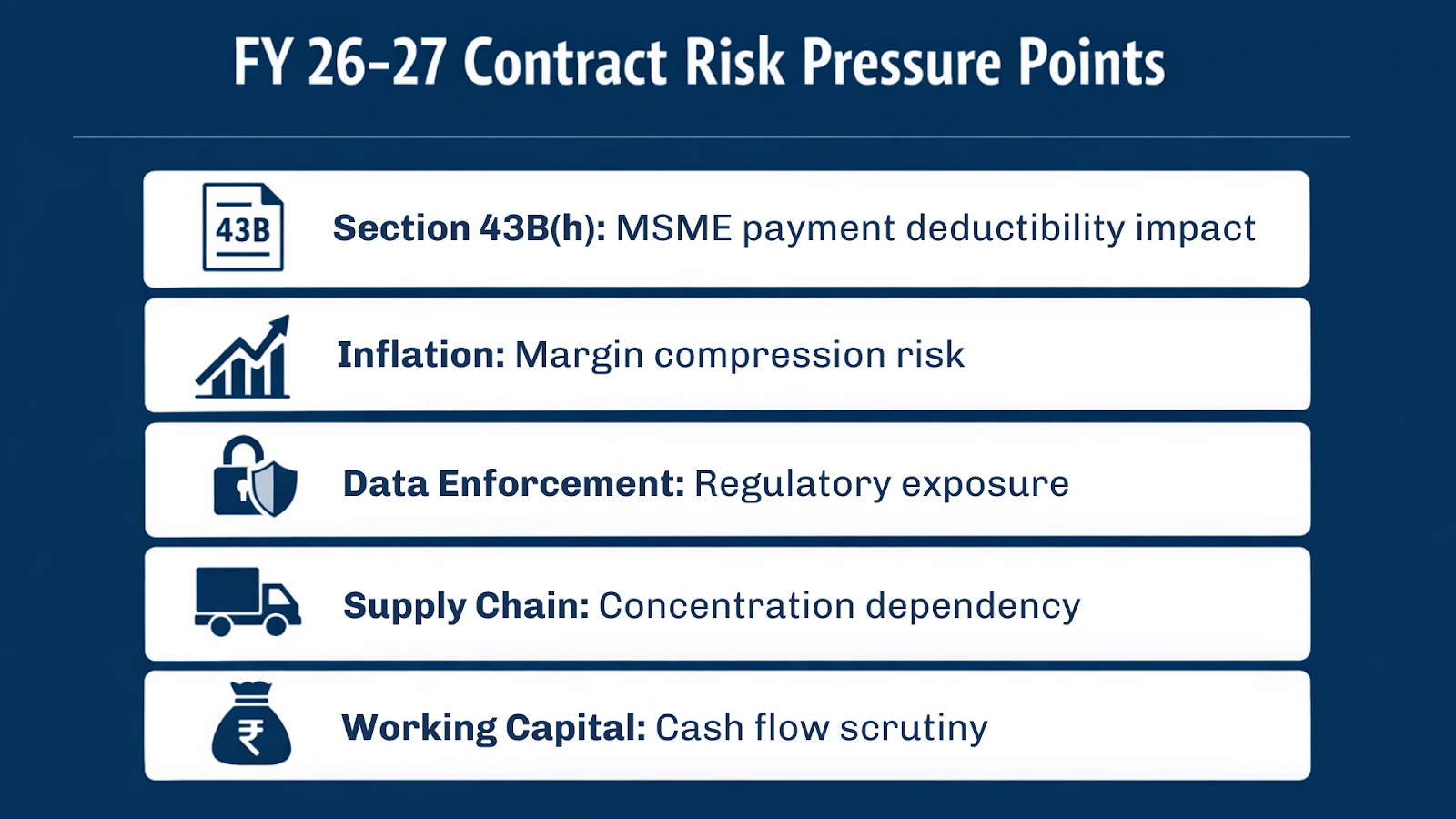
FY 26-27 is particularly critical because:
- Section 43B(h) now directly affects MSME payment deductibility
- Inflation and input cost volatility continue to pressure margins
- Data protection enforcement is tightening
- Supply chain concentration risks remain real
- Working capital discipline is under scrutiny
If your agreement format has not evolved post-pandemic, post-MSME amendments, and in light of emerging data compliance standards, it is outdated.
Vendor contracts should be reviewed with the same seriousness as financial statements. Governance begins at the agreement level.
Termination Clauses Define Exit Power
Termination is not about ending relationships. It is about preserving commercial leverage.
The Starbucks arbitration outcome demonstrates how expensive poorly structured exit rights can become.
Defined Triggers and Cure Periods
A well-drafted vendor agreement must clearly define:
- Termination for cause (material breach, insolvency, regulatory non-compliance)
- Termination for convenience with structured notice periods
- Cure period mechanics
- Immediate termination triggers for critical failures
When triggers are vague, disputes shift from performance to interpretation. Clear drafting reduces ambiguity and negotiation friction.
Transition Support and Compensation Caps
Your suppliers contract should also address what happens after termination:
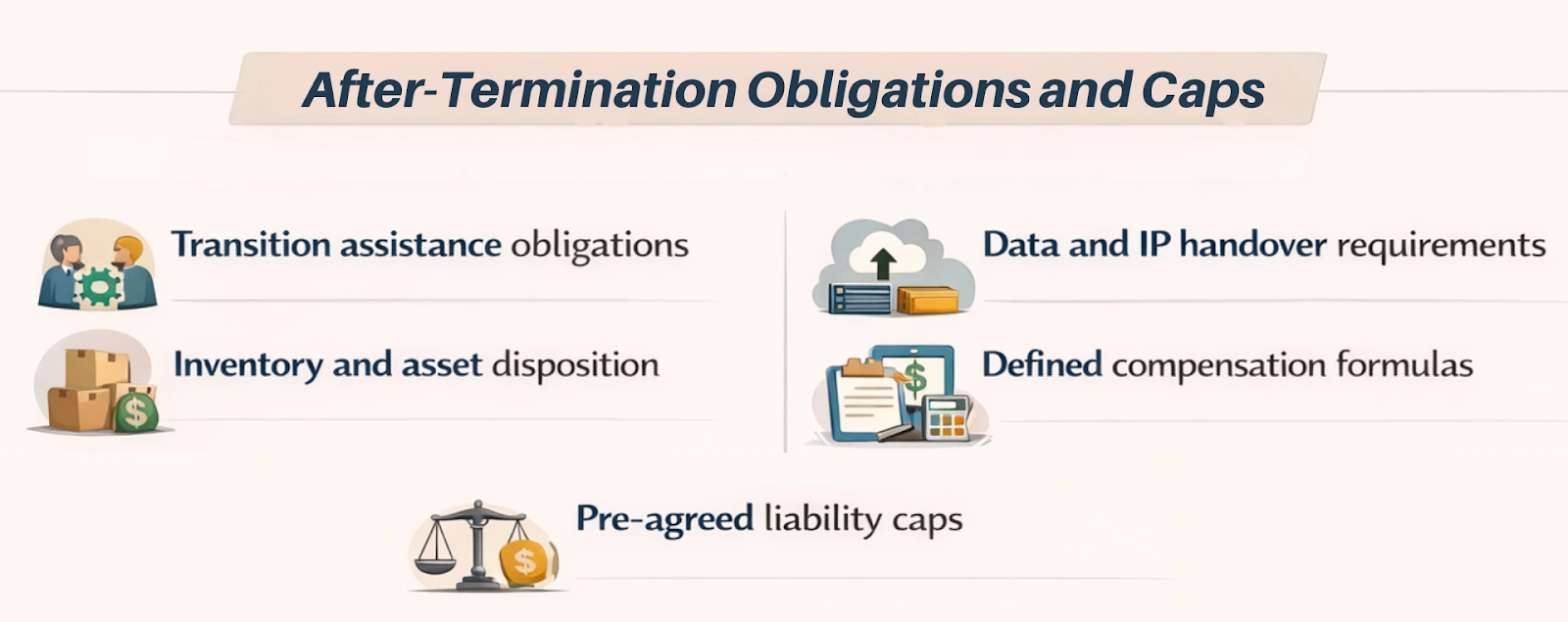
- Transition assistance obligations
- Data and IP handover requirements
- Inventory and asset disposition
- Defined compensation formulas
- Pre-agreed liability caps
Exit economics should be predictable. If not, separation becomes financially disruptive.
Pricing Clarity Prevents Costly Disputes
Between 2017 and 2019, Apple and Qualcomm were engaged in multi-jurisdictional litigation over patent royalty payments linked to iPhone sales. The dispute centred on how royalties were calculated and whether they were excessive relative to chip value.
The disagreement involved billions in contested payments before settlement.
The lesson is simple: Pricing ambiguity escalates into litigation.
Royalty Computation and Audit Rights
Your vendor agreement form must specify:
- Pricing basis (per unit, revenue share, fixed retainer)
- Detailed calculation formula
- Reporting and certification obligations
- Audit rights with defined frequency
- Reconciliation and dispute escalation process
If the formula requires interpretation, it is insufficient.
Indexed Pricing and Escalation Controls
For FY 26-27, consider embedding:
- Inflation-linked revision mechanisms
- Annual escalation ceilings
- Objective cost-index benchmarks
- Structured renegotiation triggers
Without pricing guardrails, margin erosion happens gradually and often unnoticed.
SLA Structure Drives Operational Accountability
An SLA (Service Level Agreement) is not decorative language. It operationalises performance expectations.
If deliverables are not measurable, they are not enforceable.
Measurable KPIs and Service Credits
A strong SLA should clearly define:
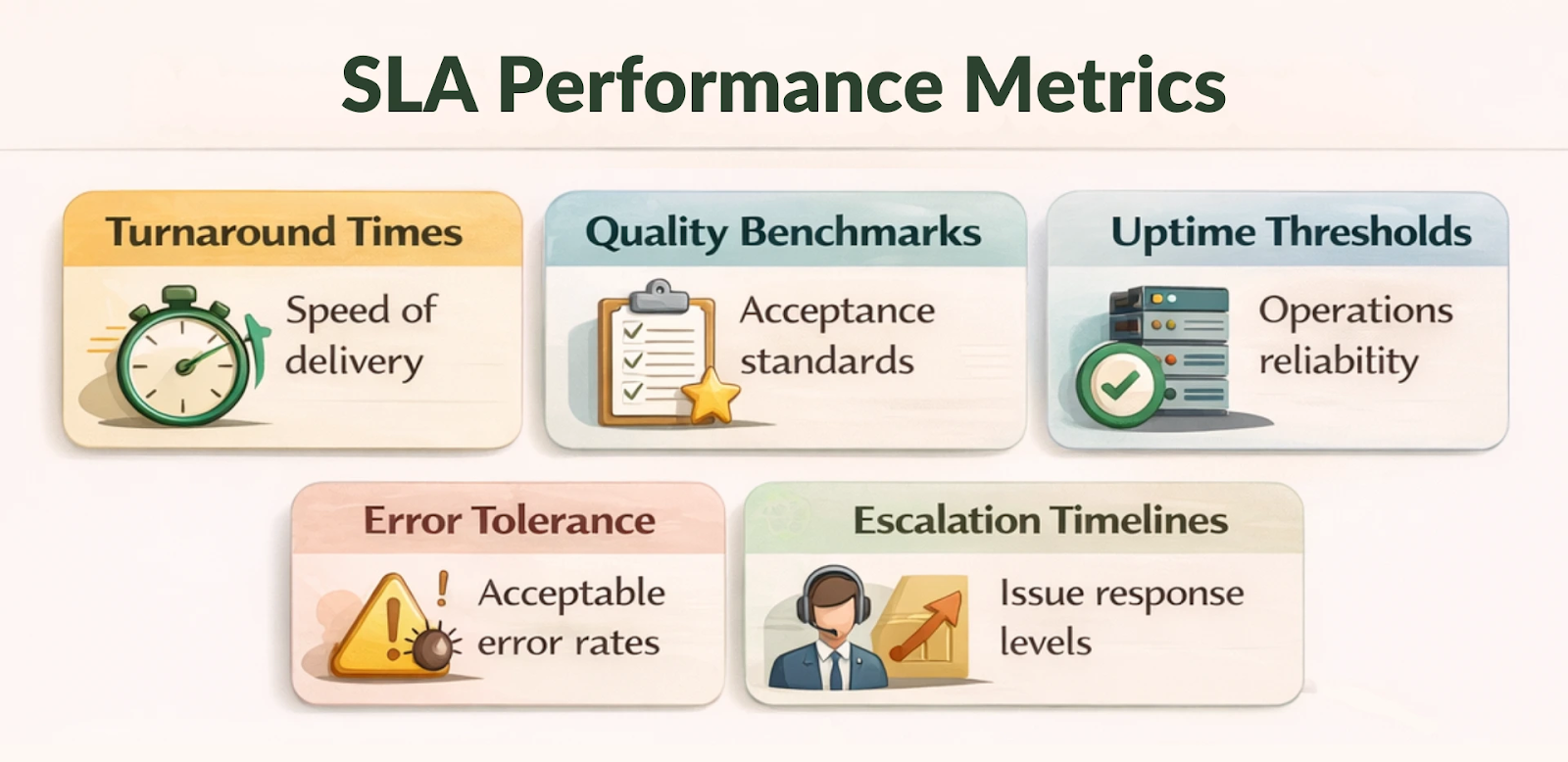
- Turnaround times
- Quality acceptance benchmarks
- Uptime or downtime thresholds
- Error tolerance levels
- Escalation timelines
Link these metrics to a service credit or penalty matrix. Performance must have commercial consequences.
Linking SLA Breach to Payment Terms
Align payment with performance:
- Milestone-based disbursements
- Retention amounts
- Withholding rights for SLA breaches
- Performance-linked incentives
Paying vendors irrespective of output weakens contractual discipline.
MSME Compliance and Payment Discipline
India’s MSME framework has materially shifted the allocation of risk.
Section 43B(h) links delayed payments to MSMEs with tax deductibility implications.
Section 43B(h) Tax Implications
Businesses must:
- Obtain MSME declarations from vendors
- Track statutory payment timelines
- Monitor interest exposure under the MSME law
Delayed payments can attract significant statutory interest and affect tax positions. This is no longer merely a vendor relations issue, it is a financial reporting issue.
Vendor Classification and Interest Exposure
Your suppliers contract should:
- Capture MSME registration details
- Clearly define payment cycles
- Clarify dispute-linked withholding mechanics
Failing to identify MSME status creates avoidable financial exposure.
Dispute Clauses Determine Enforcement Strength
The dispute between Amazon and Future Group illustrated how arbitration clauses influence the power of enforcement. Emergency arbitration proceedings and cross-border enforcement became central to the conflict.
The clause determined procedural control.
Arbitration Seat and Governing Law
A robust vendor agreement should clearly specify:
- Governing law
- Arbitration seat
- Institutional rules
- Number of arbitrators
Omissions here often trigger preliminary disputes before substantive issues are even addressed.
Emergency Relief and Multi-Tier Resolution
Consider structuring:
- Mandatory negotiation windows
- Mediation requirements
- Emergency arbitrator provisions
- Interim relief mechanisms
In commercial disputes, speed determines leverage.
Indemnity Caps and Liability Allocation
After the 737 MAX crisis, Boeing faced significant financial exposure across suppliers, regulators, and customers. While aviation operates at a different scale, the principle remains universal:
Risk must be contractually allocated.
Financial Caps Linked to Contract Value
Your vendor agreement form should include:
- Cap liability to a defined percentage of contract value
- Exclude fraud or wilful misconduct from caps
- Clarify treatment of consequential damages
Unlimited liability clauses should be evaluated carefully, not accepted reflexively.
Insurance Backed Risk Allocation
Include:
- Mandatory insurance coverage thresholds
- Evidence of valid policies
- Survival of indemnity obligations
Protection without financial backing offers limited practical value.
Data Protection Obligations in Vendor Agreements
The controversy involving Meta demonstrated how third-party data misuse can expose a company to regulatory scrutiny and reputational damage. Vendor ecosystems now extend risk beyond internal teams.
Data governance must be contractual.
Breach Notification and Audit Rights
Include clauses covering:
- Defined breach notification timelines
- Minimum security standards
- Audit rights
- Incident cooperation requirements
Delayed reporting magnifies regulatory and reputational consequences.
Sub-Processor and Confidentiality Controls
Your suppliers contract should:
- Restrict unauthorised subcontracting
- Mandate confidentiality safeguards
- Require regulatory compliance warranties
Data protection cannot rely on assumptions.
Force Majeure and Supply Continuity Planning
The pandemic fundamentally reshaped force majeure interpretation.
Courts globally examined whether lockdowns, supply disruptions, and governmental restrictions triggered contractual relief. Businesses discovered that generic clauses offered limited protection.
Defining Unforeseen Events Precisely
Modern force majeure drafting should clearly include:
- Epidemics and pandemics
- Government-imposed restrictions
- Natural disasters
- Supply chain interruptions
Precision reduces interpretational disputes.
Mitigation and Alternative Sourcing Rights
A commercially balanced clause should also require:
- Prompt written notice
- Reasonable mitigation efforts
- Defined suspension periods
- Right to alternate sourcing if disruption persists
Force majeure should not become a shield for inefficiency.
Common Mistakes in Vendor Agreement Formats
Even mature businesses make avoidable drafting errors.
Copy-Paste Templates Without Risk Mapping
Using a generic agreement format without aligning it to business risk results in:
- Weak termination rights
- Missing SLA benchmarks
- Inadequate pricing controls
“Template se kaam chal jayega” thinking often proves costly.
Unlimited Liability and Weak SLA Drafting
Other frequent mistakes include:
- Accepting unlimited liability
- Failing to link the SLA to the payment
- Ignoring MSME compliance
- Leaving arbitration clauses vague
- Omitting audit rights
A vendor agreement form must reflect commercial strategy, not borrowed language.
FY 26-27 Vendor Agreement Review Checklist
Before renewing or executing any suppliers contract, verify:
- Termination triggers are precise
- SLA metrics are measurable
- Pricing formulas are transparent
- MSME status is documented
- Liability caps are commercially balanced
- Indemnity scope is defined
- Arbitration seat is specified
- Force majeure is updated
- Data protection clauses are embedded
- Audit rights are included
Make this checklist part of your annual governance framework.
Strategic Takeaways for Business Leaders
As FY 26-27 begins, vendor agreements should be reviewed strategically, not mechanically.
Three clear takeaways stand out:
- Engineer your exit: Termination and liability clauses protect leverage and prevent expensive surprises.
- Draft with precision: Clear pricing formulas, defined SLA metrics, and structured indemnity caps reduce disputes and margin erosion.
- Allocate risk consciously: MSME compliance, data protection, dispute resolution, and force majeure must reflect current business realities.
A strong vendor agreement does not complicate business. It strengthens it.
As you recalibrate for FY 26-27, ensure your suppliers contract works as hard as your strategy does.
For structured compliance support and agreement review, stay compliant with Filing Buddy.
FAQs
1. What is a vendor agreement?
A vendor agreement is a legally binding contract that defines commercial terms between a business and its supplier, including pricing, SLA standards, payment terms, liability, termination rights, and dispute-resolution mechanisms.
2. Why should vendor contracts be reviewed annually?
Annual review ensures alignment with tax changes, MSME compliance, pricing volatility, data protection laws, and operational risks. FY-based review prevents outdated clauses from creating financial exposure.
3. What clauses must be included in a suppliers contract?
Key clauses include termination rights, SLA benchmarks, pricing structure, MSME payment terms, indemnity caps, dispute resolution, data protection, audit rights, and force majeure provisions.
4. What is the importance of termination clauses in vendor agreements?
Termination clauses define exit rights, notice periods, compensation mechanisms, and cure timelines. Poorly structured termination language can result in heavy financial penalties.
5. What is an SLA in a vendor agreement?
An SLA (Service Level Agreement) defines measurable performance standards such as turnaround time, quality metrics, uptime thresholds, and penalties for non-performance.
6. How does Section 43B(h) impact vendor payments?
Section 43B(h) links delayed payments to MSMEs with tax deductibility implications. Businesses must ensure timely payment to MSME vendors to avoid interest liability and tax exposure.
7. What is a force majeure clause in a contract?
A force majeure clause excuses performance obligations during unforeseen events like pandemics, government restrictions, or natural disasters, provided the clause is clearly drafted.
8. What are common mistakes in vendor agreement formats?
Common mistakes include copy-paste templates, undefined SLA metrics, unlimited liability acceptance, missing arbitration clauses, and ignoring MSME classification.
9. How should pricing clauses be structured in vendor contracts?
Pricing clauses should clearly define calculation basis, escalation formula, reporting frequency, audit rights, and dispute mechanisms to prevent ambiguity and litigation.
10. What is an indemnity clause in a vendor agreement?
An indemnity clause allocates financial responsibility for losses arising from breach, negligence, IP infringement, or regulatory non-compliance, often subject to liability caps.
11. Why is arbitration important in supplier contracts?
Arbitration clauses determine governing law, seat, procedure, and enforcement speed. A well-drafted clause reduces jurisdictional disputes and ensures faster resolution.
12. What should a vendor agreement form include for data protection?
It should include breach notification timelines, security standards, audit rights, confidentiality obligations, and restrictions on unauthorised sub-processing.
13. How can businesses reduce vendor dependency risk?
Businesses can include minimum supply guarantees, alternate sourcing rights, termination flexibility, and performance-linked obligations within the suppliers contract.
14. When should liability caps be applied in vendor agreements?
Liability caps should generally align with contract value and exclude fraud or wilful misconduct. They balance commercial risk while protecting financial exposure.
15. What is the ideal checklist before signing a vendor agreement?
Verify termination rights, SLA clarity, pricing formula, MSME status, liability caps, indemnity scope, arbitration clause, force majeure definition, and data compliance provisions.
Contact Us
An expert will call you within 24 hours. No payment required to get started.
6.png) How to Claim a TDS Refund: Step-by-Step Guide
5 minutes read
How to Claim a TDS Refund: Step-by-Step Guide
5 minutes read
6.png) DIR-3 KYC Compliance: A Director's Guide to Avoiding Disqualification
5 minutes read
DIR-3 KYC Compliance: A Director's Guide to Avoiding Disqualification
5 minutes read
2.png) ITR Filing Last Date September 2026: The Founder's Guide to Tax Audits & Belated Returns
5 minutes read
ITR Filing Last Date September 2026: The Founder's Guide to Tax Audits & Belated Returns
5 minutes read
4.png) Register For ESI & PF Now Or Face Employer Penalties On Every Payroll!
5 minutes read
Register For ESI & PF Now Or Face Employer Penalties On Every Payroll!
5 minutes read
Frequently Asked Questions
Have a question about this?
Our team can walk you through what applies to your business and what to do next.
Talk to our teamRelated posts

How to Obtain a Company Registration Number in India
Understanding Corporate Identification Numbers (CINs) and How to Obtain Them in India
. 2 mins.png)
Difference between Udyog Adhaar and Udyam Certificate
Want to get registered for Udyog Aadhar and Udyam Certificate? Here is their registration processes. Also, know about their differences. Explore their features, benefits, and processes to register online for each, helping you to choose the right option as per your need.
. 3 min read.png)
Changing Your Bank Signatory? Here are the Y Documents Required by Most Banks in India
Learn how bank signatory is important for financial workflow. Know why bank signatories are important and discover the documents required to change signature of your signatory.
. 5 min readEverything right at your mail.
Request a Call Back
Leave your details and Divya from Filing Buddy will call you from +91 788 008 1056.
Prefer to call now? 📞 +91 788 008 1056
Chat with us on WhatsApp
Hi there! 👋 Connect with our team on WhatsApp.
Hello FilingBuddy, I would like to know more about your services.
Chat Now