
Advance Tax Explained

What Is Advance Tax?
Advance tax refers to income tax paid during the financial year in installments instead of paying the entire tax amount while filing the return.
It follows the “pay-as-you-earn” principle. Instead of waiting until the end of the year, taxpayers estimate their annual income and pay taxes periodically.
This system benefits both taxpayers and the government. Taxpayers avoid a sudden large payment, while the government receives a steady flow of revenue throughout the year.
Advance tax may apply to income earned from several sources such as:
- Business income
- Professional or freelancing income
- Capital gains from investments
- Interest income from savings or deposits
- Rental income from property
- Dividend income
If the total tax payable on these incomes exceeds the prescribed threshold, advance tax provisions may apply.
Who Is Liable to Pay Advance Tax?
A taxpayer is required to pay advance tax if their total tax liability during the financial year exceeds ₹10,000.
This rule applies to most categories of taxpayers, including individuals, businesses, and companies. However, the applicability varies depending on the type of income and Tax Deducted at Source (TDS).
Income Sources That May Trigger Advance Tax
Advance tax is commonly required when income is received without sufficient TDS deduction. Examples include:
- Freelancing or consultancy income
- Business profits
- Capital gains from sale of shares or property
- Rental income from property
- Interest earned on deposits or investments
For salaried individuals, employers usually deduct tax through TDS. However, advance tax may still apply if there are additional income sources where tax has not been deducted adequately.
Advance Tax Due Dates and Installment Schedule
Advance tax is not paid in a single payment. Instead, it is divided into four installments throughout the financial year.
Following the correct advance tax due dates helps taxpayers avoid interest and penalties.
Quarterly Advance Tax Installments
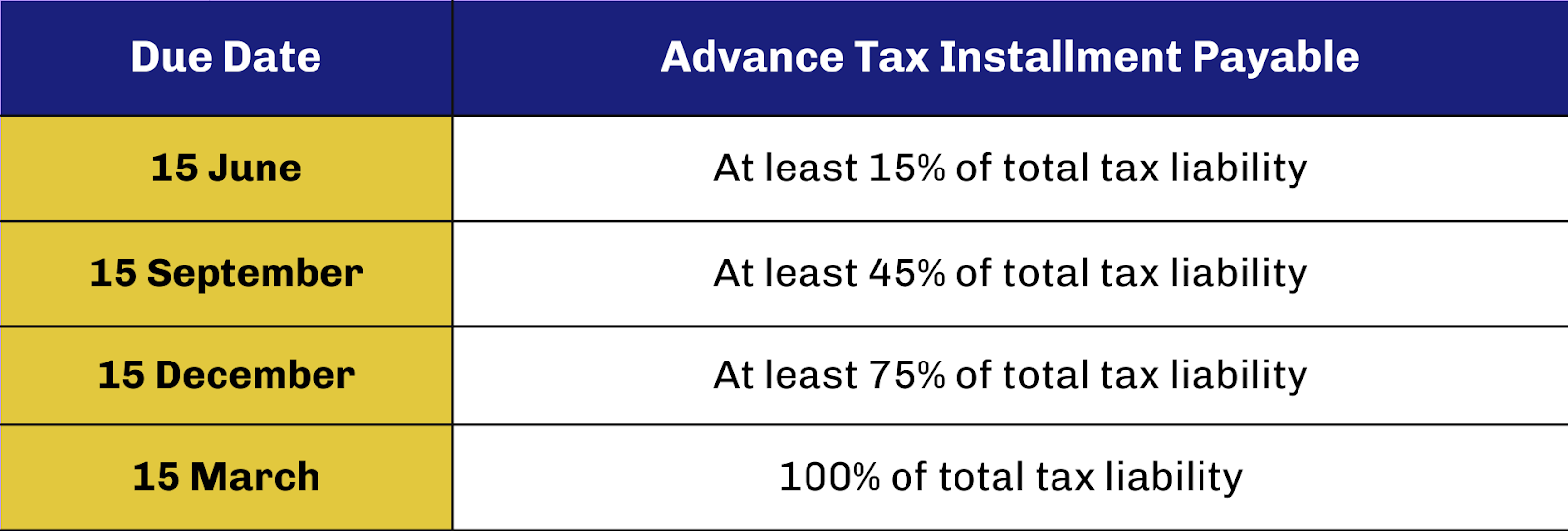
This schedule ensures that tax payments are spread evenly across the year.
Taxpayers opting for presumptive taxation schemes such as Sections 44AD or 44ADA generally pay the entire advance tax amount in a single installment by 15 March.
Advance Tax Calculation: How to Estimate Your Tax Liability
The process of advance tax calculation is based on estimating your total income for the financial year and determining the tax payable on that income.
Since income may vary during the year, the estimate can be revised while paying subsequent installments.
Step-by-Step Advance Tax Calculation
The basic process involves the following steps:
- Estimate your total income for the financial year.
- Add income from all sources such as salary, business, interest, rent, or capital gains.
- Deduct eligible deductions under the Income Tax Act.
- Calculate the total tax liability based on applicable tax rates.
- Subtract tax already deducted at source (TDS).
- Pay the remaining amount as advance tax according to the installment schedule.
Regularly reviewing income projections during the year helps ensure accurate payments.
Example of Advance Tax Calculation
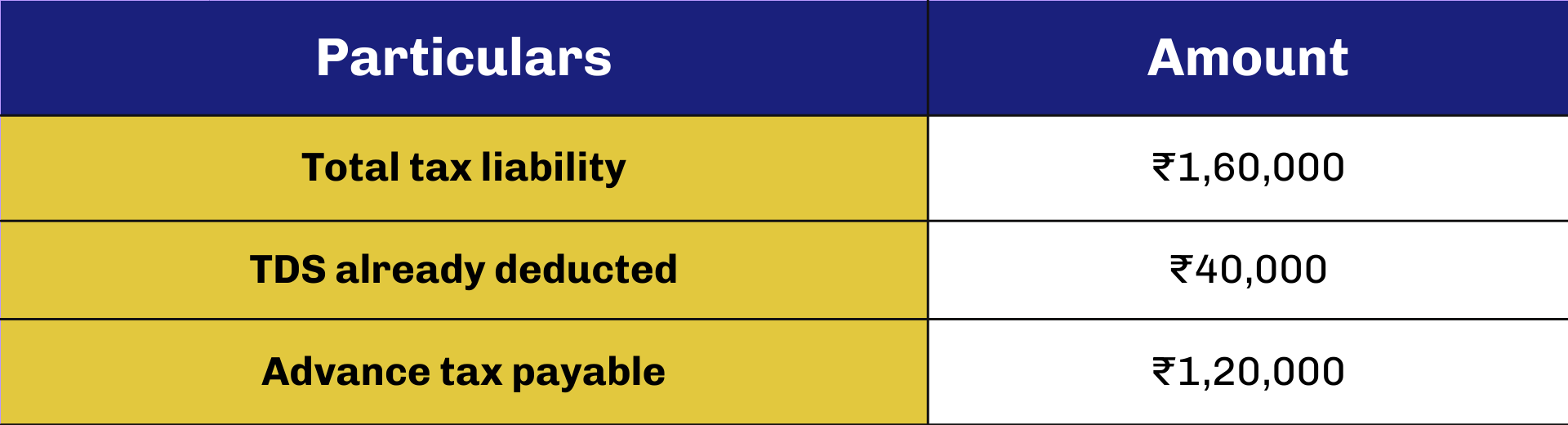
In this example, the total tax liability of ₹1,60,000 is assumed after calculating tax under the applicable income tax rules for the financial year. After adjusting TDS already deducted, the remaining ₹1,20,000 must be paid as advance tax according to the installment schedule.
How to Pay Advance Tax Online
Advance tax can be paid conveniently through the Income Tax e-filing portal using an online payment system.
The process is straightforward and usually takes only a few minutes.
Steps to pay advance tax online:
- Visit the Income Tax e-filing portal.
- Select the option for e-Pay Tax.
- Choose Advance Tax (Challan ITNS 280).
- Enter the relevant assessment year.
- Select the payment mode such as net banking, debit card, or UPI.
- Complete the payment and download the challan receipt.
The payment receipt should be preserved carefully as it is required while filing the income tax return.
Advance Tax Interest and Penalties
Failure to follow the advance tax schedule may lead to interest under Sections 234B and 234C of the Income Tax Act. These provisions apply when taxpayers either fail to pay sufficient advance tax or delay their advance tax installments.
Interest Under Section 234B: Non-Payment of Advance Tax
Interest under Section 234B is applicable when the advance tax paid during the financial year is less than 90% of the total tax liability.
In such cases, interest is charged at 1% per month or part of the month or part of the month on the unpaid tax amount until the tax is paid.
This interest continues until the outstanding tax liability is cleared.
Interest Under Section 234C: Delay in Advance Tax Installment
Interest under Section 234C applies when taxpayers defer or underpay advance tax installments.
To avoid interest, taxpayers must ensure that their cumulative advance tax payments meet the minimum required percentages of total tax liability by each due date.
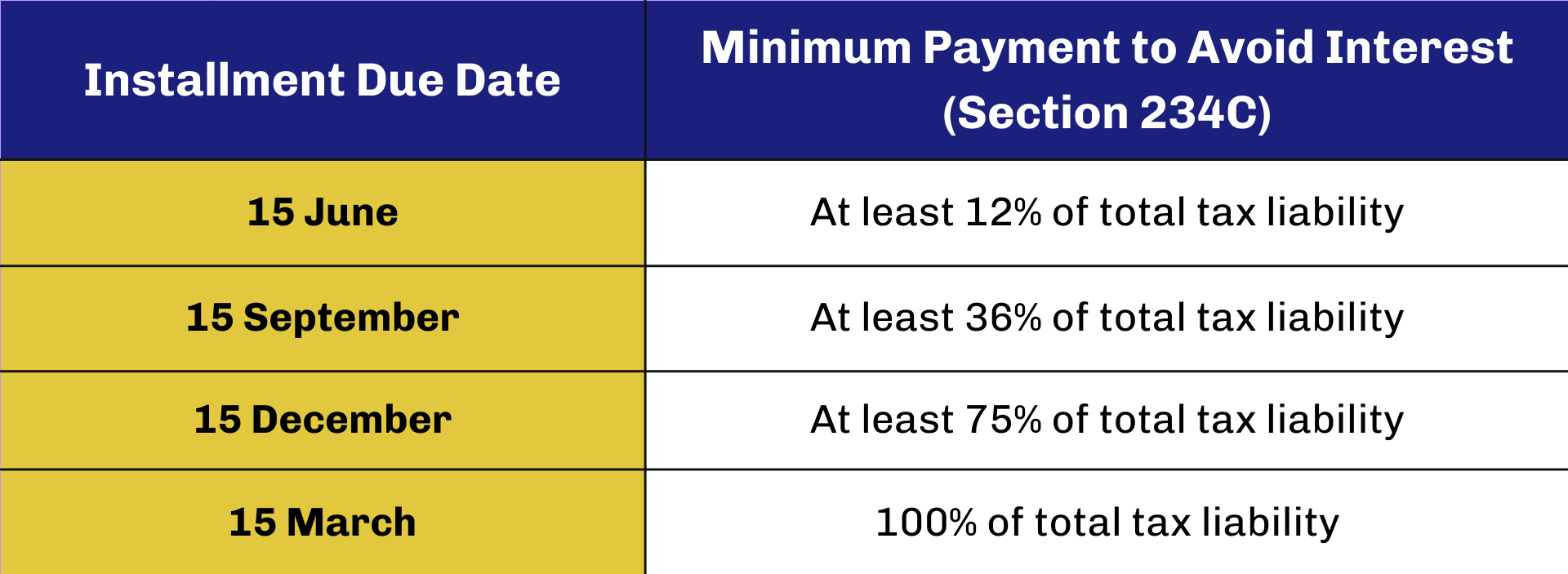
If the advance tax paid falls below these thresholds, interest of 1% per month or part of the month charged on the shortfall amount for the relevant period.
These percentages apply to the total tax payable on the estimated income for the financial year.
Common Mistakes and Tips to Manage Advance Tax Efficiently
Many taxpayers face interest charges not because of deliberate non-compliance, but due to small mistakes in planning their tax payments.
Some common mistakes include:
- Ignoring income sources where TDS is not deducted
- Missing important advance tax due dates
- Underestimating total annual income
- Paying incorrect advance tax installments
- Forgetting to include capital gains or interest income
To manage advance tax efficiently, taxpayers can follow a few simple practices.
- Review income estimates before every installment date.
- Track TDS deductions through Form 26AS or AIS.
- Maintain quarterly records of income and expenses.
- Set reminders for advance tax deadlines.
- Seek professional assistance if income fluctuates significantly.
These steps can help minimize errors and reduce the risk of advance tax interest.
Staying Ahead with Advance Tax
Key takeaways:
Advance tax ensures that income tax is paid gradually during the financial year rather than in a single lump sum at the end. For taxpayers with business, professional, or additional income sources, understanding this system helps avoid surprises during return filing.
- Advance tax applies when your tax liability exceeds ₹10,000 in a financial year.
- It must be paid in scheduled installments during the year based on estimated income.
- Missing payments can lead to interest under Sections 234B and 234C.
With timely estimates and payments, advance tax becomes easy to manage rather than stressful.
Stay compliant and stress-free with Filing Buddy.
FAQ:
1. What is advance tax?
Advance tax is income tax paid in installments during the financial year instead of paying the entire amount when filing the income tax return. It follows the pay-as-you-earn principle and applies when a taxpayer’s total tax liability exceeds ₹10,000.
2. Who is liable to pay advance tax?
Individuals, freelancers, professionals, businesses, and companies must pay advance tax if their total tax liability exceeds ₹10,000 in a financial year after adjusting TDS. Senior citizens without business or professional income are generally exempt.
3. What are the advance tax due dates?
Advance tax is paid in four installments:
15 June (15%), 15 September (45%), 15 December (75%), and 15 March (100%) of total tax liability.
4. How is advance tax calculated?
Advance tax is calculated by estimating total income for the financial year, computing the tax liability, subtracting TDS already deducted, and paying the remaining amount according to the advance tax installment schedule.
5. Do salaried employees need to pay advance tax?
Salaried employees usually do not need to pay advance tax if their employer deducts adequate TDS. However, it may apply if they have additional income such as capital gains, interest, or rental income.
6. What happens if advance tax is not paid?
If advance tax is not paid or is underpaid, the taxpayer may be charged interest under Sections 234B and 234C of the Income Tax Act.
7. What is interest under Section 234B?
Section 234B imposes interest when a taxpayer fails to pay at least 90% of their total tax liability as advance tax. Interest is charged at 1% per month or part of the month on the unpaid amount.
8. What is interest under Section 234C?
Section 234C applies when advance tax installments are not paid on time or the required percentage is not met. Interest is calculated on the shortfall amount for each missed installment.
9. How can advance tax be paid online?
Advance tax can be paid through the Income Tax e-filing portal using Challan ITNS 280. Taxpayers can pay using net banking, debit card, UPI, or other online payment methods.
10. Is advance tax required for freelancers?
Yes. Freelancers and consultants often need to pay advance tax because their income typically does not have TDS deductions. If their tax liability exceeds ₹10,000, advance tax provisions apply.
11. Do small business owners have to pay advance tax?
Yes. Small business owners must pay advance tax if their tax liability exceeds ₹10,000. Those opting for presumptive taxation generally pay the entire advance tax by 15 March.
12. Can advance tax be revised during the year?
Yes. Taxpayers can revise their income estimates during the financial year and adjust the remaining advance tax installments accordingly.
13. What is the minimum tax liability for advance tax?
Advance tax becomes applicable when the total tax liability during a financial year exceeds ₹10,000 after adjusting TDS and other tax credits.
14. Is advance tax the same as self-assessment tax?
No. Advance tax is paid during the financial year in installments, while self-assessment tax is paid after the financial year ends when filing the income tax return.
15. What are common mistakes when paying advance tax?
Common mistakes include ignoring additional income, missing advance tax due dates, underestimating annual income, and forgetting to account for capital gains or interest income. These errors may result in advance tax interest charges.
Not sure how this applies to you?
Ask our team and we will point you to the right filing or registration.
Talk to our teamWhy choose Us?
Filing Buddy is an entity which is focused at providing legal, financial, and corporate and compliances consultancy services to business entities. Our organisation is a structure made of enthusiastics.

EXPERTISE & RELIABILITY
Trusted industry professionals ensuring compliance, accurate tax filing, and comprehensive services for your business needs.

TAILORED SOLUTIONS
Customized services to meet your specific requirements, including business incorporation, trademarks, patents, and seamless GST return filing.

TIMELY SUPPORT
Dedicated support team committed to providing prompt assistance, resolving queries, and ensuring smooth operations for your business.

COMPETITIVE ADVANTAGE
Gain a competitive edge with our comprehensive suite of services, enabling you to focus on growth while we handle your compliance and taxation needs.













.webp)
.webp)

.webp)

