
DSC Expiry Check Before Filing Season
By Filing Buddy . 05 Mar 26
1.png)

The Cryptographic Foundation of Digital India
The contemporary Indian regulatory environment has undergone a fundamental shift from a paper-based documentation system to a high-assurance cryptographic identity framework. At the center of this transformation is the Digital Signature Certificate (DSC), which serves as the electronic equivalent of a physical signature, providing the foundational trust required for the digital economy. Under the Information Technology Act, 2000, digital signatures are granted full legal recognition, establishing a regime where electronic submissions carry the same weight and legal binding as their handwritten counterparts.
For professional practitioners, particularly Chartered Accountants and compliance officers, the DSC is no longer a peripheral tool of convenience but a core statutory prerequisite for navigating the complexities of Income Tax, Goods and Services Tax (GST), and Corporate Law. The cryptographic integrity of this system relies on a Public Key Infrastructure (PKI) that ensures three essential pillars of digital security: authenticity (confirming the signer's identity), integrity (preventing data tampering), and non-repudiation (preventing a signer from denying their involvement). As we enter the high-stakes filing season, the management of these digital identities becomes a critical component of risk management for businesses and their professional advisors.
Statutory Provisions: The Legal Mandate for DSC
The legal mandate for DSC usage is woven into several primary statutes, creating a mandatory compliance net for various classes of taxpayers and corporate entities.
Income Tax Provisions & Rule 12
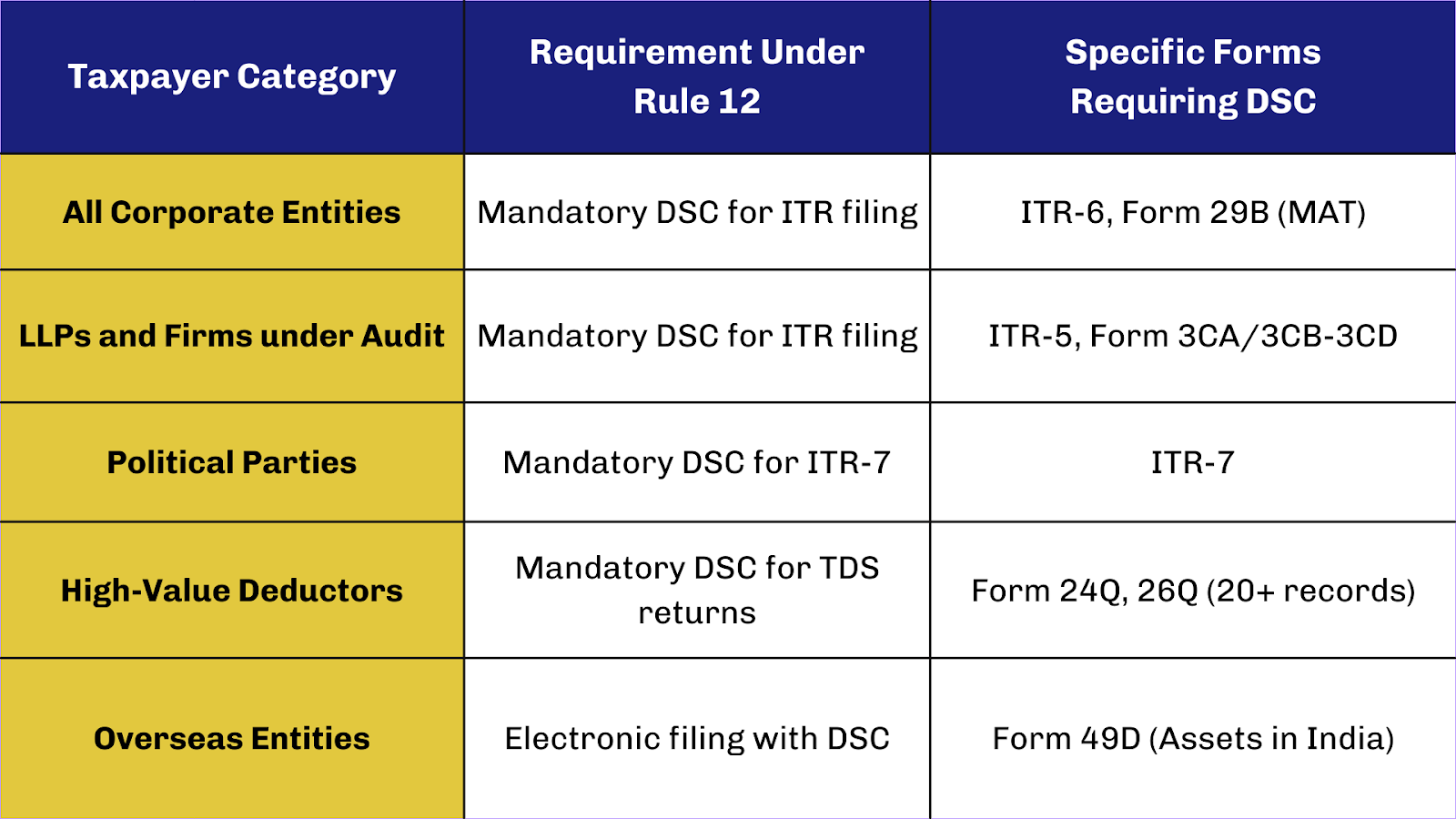
The Income Tax Act, 1961, and the accompanying Income Tax Rules, 1962, establish clear boundaries regarding who must utilize a DSC. Rule 12(3) specifically prescribes the manner in which returns of income must be furnished.
- Mandatory Usage: For companies, Limited Liability Partnerships (LLPs), and entities subject to a tax audit under Section 44AB, the use of a DSC for filing the Income Tax Return (ITR) is mandatory. Without a valid DSC, the portal will not accept the return, leading to immediate non-compliance.
- Tax Audit Thresholds: Section 44AB mandates a tax audit for businesses with turnover exceeding ₹1 crore (or ₹10 crore if 95% of transactions are digital) and for professionals with gross receipts exceeding ₹50 lakh. In these cases, the final audit report (Forms 3CA, 3CB, and 3CD) must be digitally signed by a Chartered Accountant using a Class 3 DSC.
- Specific Forms: DSCs are also mandatory for ITR-6, MAT certificates (Form 29B), and high-value TDS returns (Forms 24Q and 26Q with 20+ records).
GST Authentication Protocols & Rule 26
The GST regime is built on a "digital-by-default" architecture. Rule 26 of the CGST Rules, 2017, dictates that all applications, including registration, returns (GSTR-1, GSTR-3B), appeals, and replies to notices, must be submitted electronically with a digital signature.
- Corporate Mandate: While individuals may use an Electronic Verification Code (EVC), any person registered under the Companies Act, 2013, must verify their documents using a DSC.
- Key Operations: A DSC is required for GST registration and amendments, filing annual returns (GSTR-9/9C), and submitting refund claims for unutilized Input Tax Credit (ITC).
Corporate Compliance and the Companies Act, 2013
The Ministry of Corporate Affairs (MCA) maintains one of India’s most comprehensive digital filing ecosystems through the MCA V3 portal.
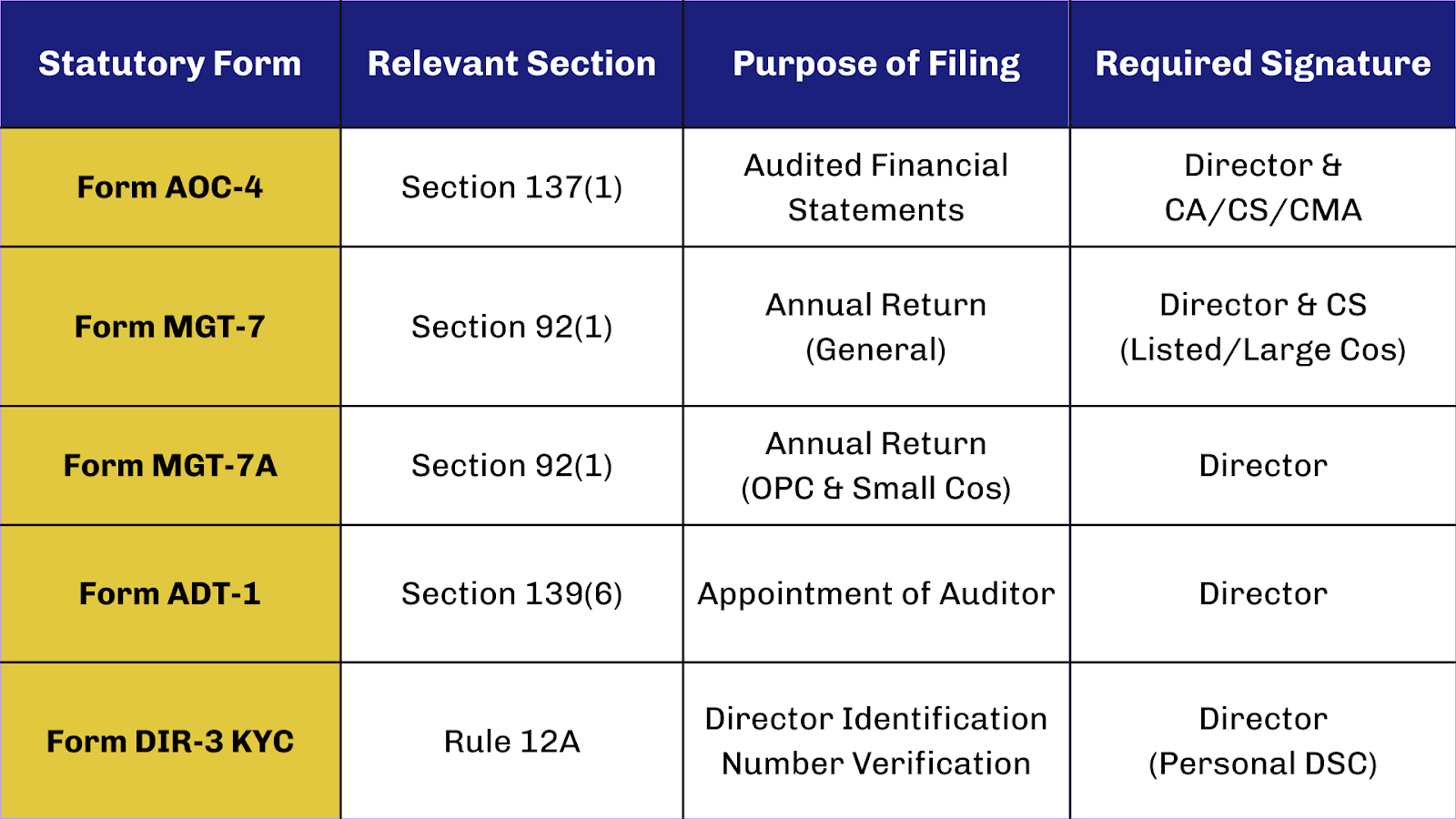
- Annual Filings: Under Sections 92 and 137, every registered company must file its annual return (MGT-7/7A) and audited financial statements (AOC-4) with the ROC.
- Director KYC: Rule 12A requires a DIR-3 KYC filing for every director, which necessitates a personal DSC for identity verification.
- Penalties: If a DSC is expired or improperly registered, the MCA system rejects the form, leading to daily penalties of ₹100 per form with no upper limit
Technical Architecture: Hardware and Software Synergy
Understanding the hardware and software components of a DSC is vital for maintaining an uninterrupted compliance cycle. As of 2025, the standard for all government-to-business (G2B) transactions in India is the Class 3 Digital Signature Certificate.
Hardware Cryptographic Tokens
A DSC is stored on a FIPS 140-2 compliant cryptographic USB token. This hardware is designed to be "tamper-evident" and ensures the private key never leaves the device. Common manufacturers include ePass 2003, mToken (CryptoID), and Watchdata Proxkey. These tokens require specific drivers to enable communication with government portals.
Utilities: emSigner and emBridge
Portals do not interact directly with the USB token; they utilize intermediary software known as "signers" or "bridges".
- Income Tax & GST: These portals typically require the emSigner utility. A critical detail often overlooked is the port configuration: recent emSigner versions have transitioned from Port 1645 to Port 1585.
- MCA V3: This portal relies on the emBridge utility.
- Java Requirements: Many systems still necessitate specific versions of the Java Runtime Environment (JRE), often Java 8 or 32-bit versions for legacy components.
Identity Verification Guidelines (IVG) 2024-25
The process for obtaining a DSC underwent a significant transformation under the CCA IVG Guidelines 2024, prioritizing data security in alignment with the Digital Personal Data Protection (DPDP) Act, 2023.
- No Technical Renewal: A DSC technically cannot be "renewed" once it expires; a new certificate must be issued, requiring fresh identity verification.
- Live Video Verification (LVV): All applicants must now complete a real-time video session. The applicant must hold their original PAN card, be visible in the recording, and read an OTP displayed on-screen.
- Mobile Ownership: The mobile number used in the application must be registered in the name of the applicant. Telecom records may be fetched to verify this ownership to prevent office staff from using their numbers for client DSCs.
- Aadhaar eKYC: This remains the fastest route, often allowing processing within a few hours, provided the Aadhaar is linked to an active mobile number.
Consequences of DSC Expiry During Filing Season
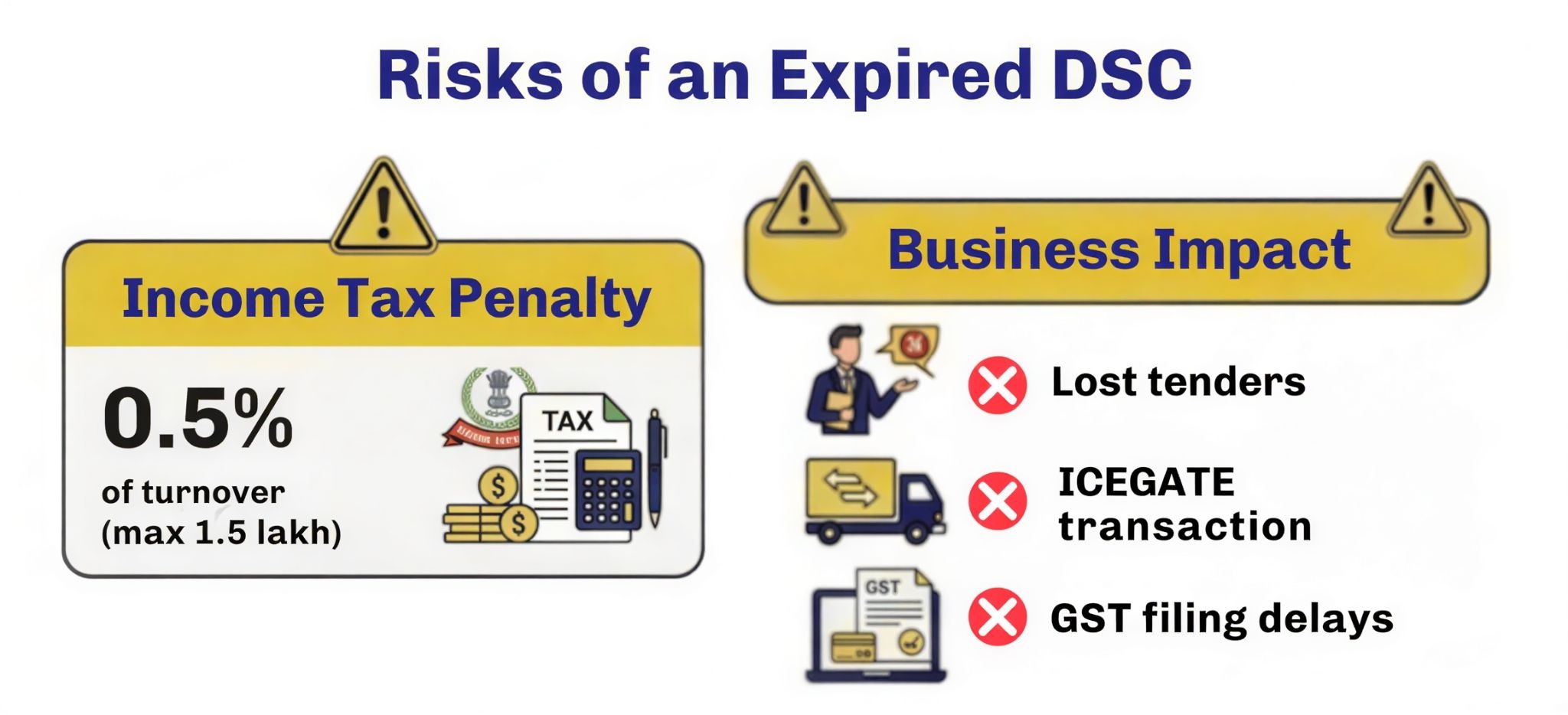
An expired DSC during the "filing season" can lead to significant financial loss and legal jeopardy, as agencies do not accept technical delays as valid reasons for late submission.
- Financial Penalties: For Income Tax, failure to furnish a tax audit report on time can attract a penalty under Section 271B (0.5% of turnover or ₹1.5 lakh, whichever is lower).
- Interest: Late filing leads to interest under Sections 234A, 234B, and 234C for delays in tax payment.
- Operational Shutdowns: In the import-export sector, an expired DSC halts transactions on ICEGATE and DGFT portals. Similarly, missing a government e-tender deadline due to DSC failure can result in the loss of lucrative contracts.
- MCA Risks: Prolonged delays in corporate filings can lead to penalties ranging from ₹50,000 to ₹5 lakh and the potential disqualification of directors.
Procedural Guide: How to Check DSC Validity
Maintaining a proactive stance toward expiry is essential. Checking validity varies by token manufacturer.
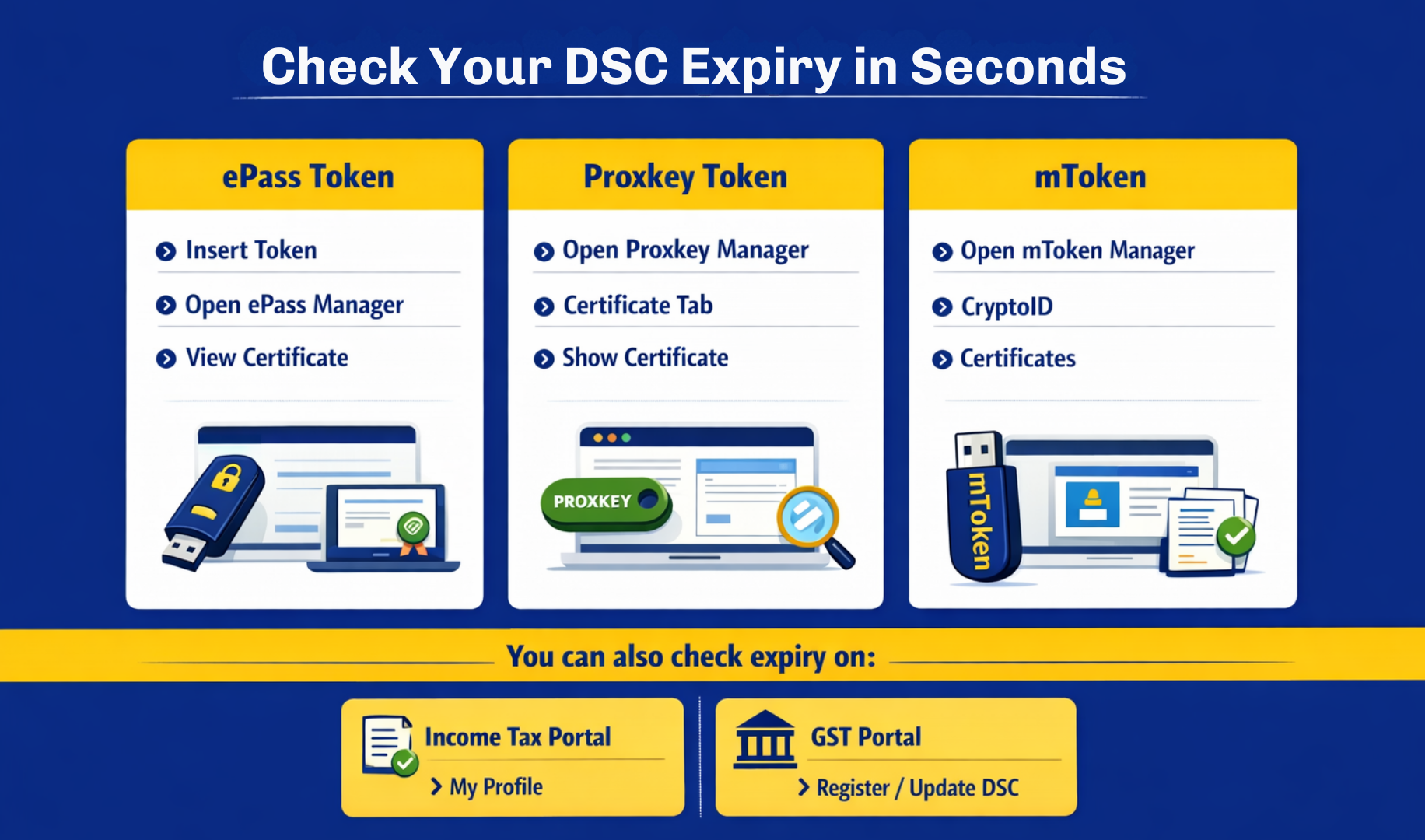
- ePass 2003 Auto: Insert token -> Open ePass Manager -> Login (Default PIN often 12345678) -> Select certificate -> Click 'View Certificate' to see the exact expiration date and time.
- Watchdata / Proxkey: Open Proxkey Token Tool Manager -> Click 'Certificate' tab -> Select certificate -> Click 'Show Certificate'.
- mToken (CryptoID): Open mToken Manager -> Click 'CryptoID' -> Login to 'Certificates' -> Double-click to reveal validity.
- Portal Verification: You can also check status on the Income Tax portal under "My Profile" or the GST portal under "Register/Update DSC".
Troubleshooting Portal-Specific Errors
Even a valid DSC can fail due to system conflicts or data mismatches.
- MCA V3 "Already Registered" Error: This often occurs because the system allows only one DSC per User ID. If a director has multiple IDs, they must merge the V2 ID into the new V3 profile or raise a ticket with the MCA helpdesk to degrade the old ID.
- GST PAN Mismatch: This error occurs when the name or PAN on the DSC does not exactly match the GST website. Names must match the CBDT database exactly (e.g., matching the order of first and last names).
- "No Valid DSC Found": This is often resolved by restarting the emSigner utility as an administrator. Ensure the certificate has the "Non-Repudiation" key usage extension required for GST.
Tax Compliance Roadmap 2025-26
Strategic planning around these dates prevents last-minute crises.
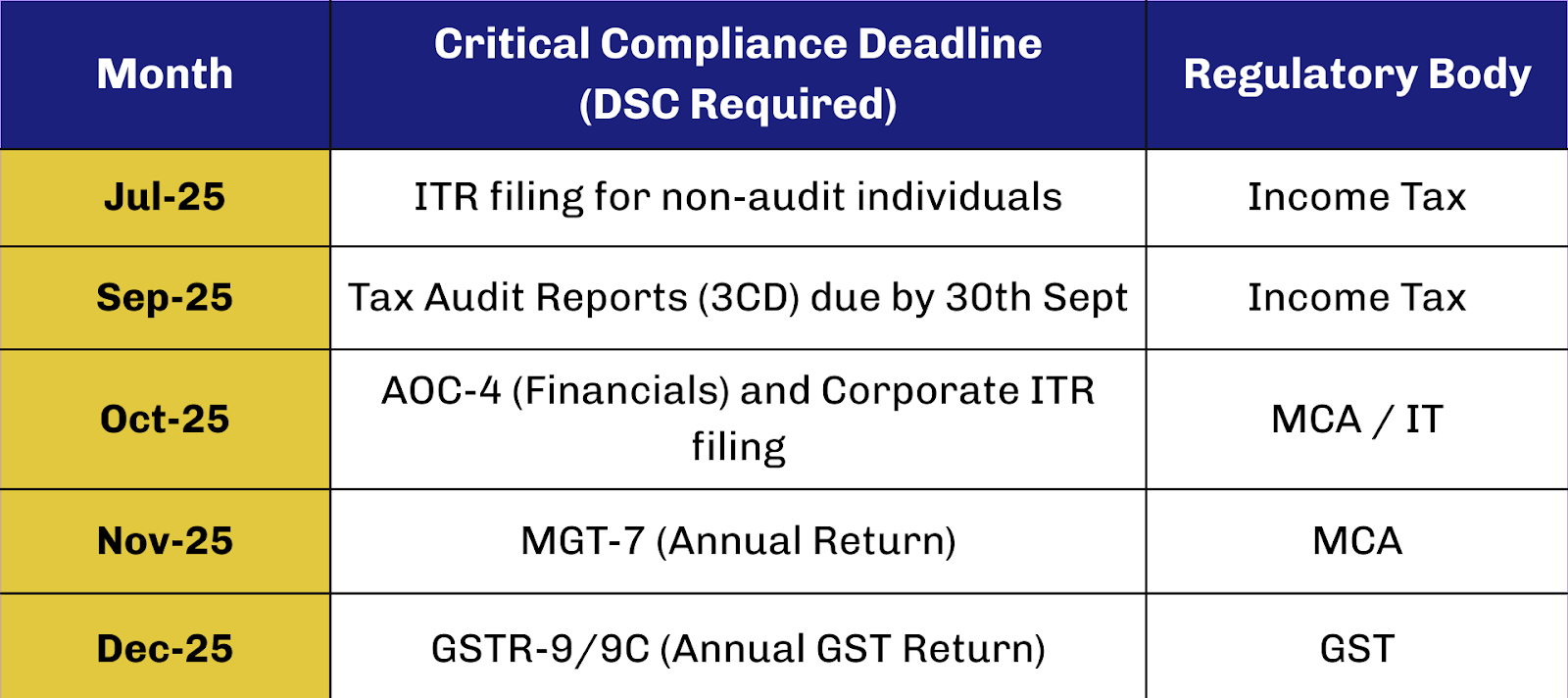
Professional DSC Expiry Management Checklist
1. Pre-Filing Season Audit (March – June)
- Inventory Check: Conduct a physical audit of all client tokens and verify locations in the digital register.
- Validity Verification: Use Token Manager software to record the exact expiration dates of all active DSCs.
- Client Notification: Send early renewal alerts (90 days prior) explaining the IVG 2024 Live Video Verification requirements.
- Portal Association: Confirm each DSC is properly "associated" with client profiles on the IT, GST, and MCA portals.
2. Technical Readiness Checklist
- Utility Configuration: Ensure emSigner and emBridge are updated and running as administrator.
- Port Settings: Verify Port 1585 is open in the system firewall.
- Browser/Java: Test access using Edge (in IE mode) or Chrome with URLs added to the Java exception list.
3. Crisis Management Protocol
- Day-of Expiry: Immediately use the Aadhaar eKYC route for a new certificate; approval can be obtained in 2–3 hours if the client is available for the LVV call.
- Mismatch Resolution: Verify name in the CBDT database via the "Online PAN verification" tool and order a corrected DSC immediately.
Conclusion: Institutionalizing Digital Resilience
Managing your Digital Signature Certificate (DSC) is no longer just a minor task; it is essential for keeping your business running. Here is the breakdown in 10 simple points:
- More Than a Simple Task: DSC management has shifted from a small administrative chore to a vital part of legal compliance.
- Severe Consequences: Failing to manage DSCs can lead to heavy fines, much worse than just a small late fee.
- Risk to Leadership: Poor management can result in directors being disqualified from their roles.
- Company Survival: In extreme cases, the government can "strike off" or shut down a company for non-compliance.
- Tendering Opportunities: You need a valid DSC to bid for government contracts; without it, you lose business.
- Digital Lockout: If your DSC expires, you are effectively locked out of tax and regulatory filing systems.
- Stay Updated: You must keep up with new rules, like the IVG 2024 identity verification guidelines.
- Technical Maintenance: You need to manage software updates, such as emSigner port changes, to ensure the signature works.
- Professional Credibility: For Accountants, keeping client DSCs active is a sign of professional reliability.
- Your Digital Seal: Treat the DSC as your “digital seal of trust”, it is your primary defense in a digital-first world.
FAQs
1. My DSC is still valid for 3 months. Can I "renew" it without a new video?
No. Under the IVG 2024 guidelines, there is no technical "renewal" that extends an old certificate. You must apply for a fresh certificate. This requires a new Live Video Verification (LVV) where you must show your original PAN card and read a code on screen.
2. Can I use the same mobile number for all my clients' DSC applications?
No. The mobile number used in the application must belong to the applicant. Systems now cross-check telecom records. If a professional uses their own number for a client's DSC, the application is likely to be rejected to prevent unauthorized use.
3. I updated my DSC, but the GST portal says "Failed to establish connection." Why?
This is usually a Port Mismatch. Most new emSigner versions have moved from Port 1645 to Port 1585.
Fix: Open your browser and type https://127.0.0.1:1585. If you see a privacy warning, click "Advanced" and "Proceed to 127.0.0.1 (unsafe)." Then restart your emSigner.
4. Is a Class 2 DSC still valid for Income Tax and MCA filings?
No. Class 2 certificates have been discontinued. Only Class 3 DSCs (the highest security level) are accepted across all major Indian portals, including Income Tax, GST, MCA V3, and e-Tendering.
5. Why does my DSC work on the GST portal but fail on the MCA V3 portal?
The MCA V3 portal uses a utility called emBridge, while GST uses emSigner. You must have both installed. Additionally, MCA V3 requires your DSC to be "Associated" with your specific Business User ID. If you have multiple IDs, you may need to merge them.
6. What happens if I lose my DSC USB token?
Since the "private key" is stored only on that specific hardware, it cannot be duplicated. You must immediately inform the Certifying Authority (CA) to revoke the lost certificate and apply for a brand-new one.
7. Can I sign documents on my mobile phone using a DSC?
Typically, no. Most statutory portals (GST/IT/MCA) require the physical USB token to be plugged into a PC/Laptop and use "Signer" utilities that run on Windows or macOS.
8. My name on the DSC has a small spelling difference from my PAN card. Will it work?
No. The name on the DSC must match the CBDT (Income Tax) database exactly. Even a missing middle name or a surplus initial can cause a "PAN Mismatch" error during portal registration.
9. Why am I getting a "Trusted Root" error when I try to sign?
This means your computer doesn't recognize the Certifying Authority (like eMudhra or Capricorn).
Fix: Open your Token Manager software, go to the "Certificates" tab, and click "Install Certificate" or "Register to Windows" to ensure your system trusts the token.
10. Can one person hold two different DSCs?
Yes. You can hold one DSC in your personal capacity (for personal ITR) and another as an "Organization DSC" (as a Director or Partner of a firm). Both can coexist on the same or different tokens.
Contact Us
An expert will call you within 24 hours. No payment required to get started.
Related Post
How to Obtain a Company Registration Number in India
Understanding Corporate Identification Numbers (CINs) and How to Obtain Them in India
. 2 mins.png)
Difference between Udyog Adhaar and Udyam Certificate
Want to get registered for Udyog Aadhar and Udyam Certificate? Here is their registration processes. Also, know about their differences. Explore their features, benefits, and processes to register online for each, helping you to choose the right option as per your need.
. 3 min read.png)
Changing Your Bank Signatory? Here are the Y Documents Required by Most Banks in India
Learn how bank signatory is important for financial workflow. Know why bank signatories are important and discover the documents required to change signature of your signatory.
. 5 min read