
New e-Invoice Rules & e-Way Bill Update: Mandatory Turnover Limit Guide
By Filing Buddy . 04 Aug 26

New e-Invoice Rules : What High-Turnover Businesses Need to Do
The August 1 update brings stricter compliance mandates for businesses crossing the specified e-invoicing turnover limits, requiring automated Invoice Reference Number (IRN) generation on the IRP portal and seamless syncing with e-way bills. High-turnover SMEs must immediately audit their billing systems, update their ERP software, and transition to mandatory electronic reporting for all B2B transactions to avoid severe penalties and blocked input tax credit (ITC).
If your business has been scaling rapidly, managing cash flow, and shipping products across state borders, regulatory updates can sneak up on you fast. Keeping your corporate books aligned with the latest rules shouldn't feel like a second full-time job.
Whether you are tracking compliance changes or optimizing your operational workflows, staying updated with insights from the Filing Buddy Blog ensures your dhandha never gets tripped up by sudden tax audits.
Let's break down the rules, turnover limits, and the exact steps you need to take right now.
New E-Invoice Rules & Turnover Limits
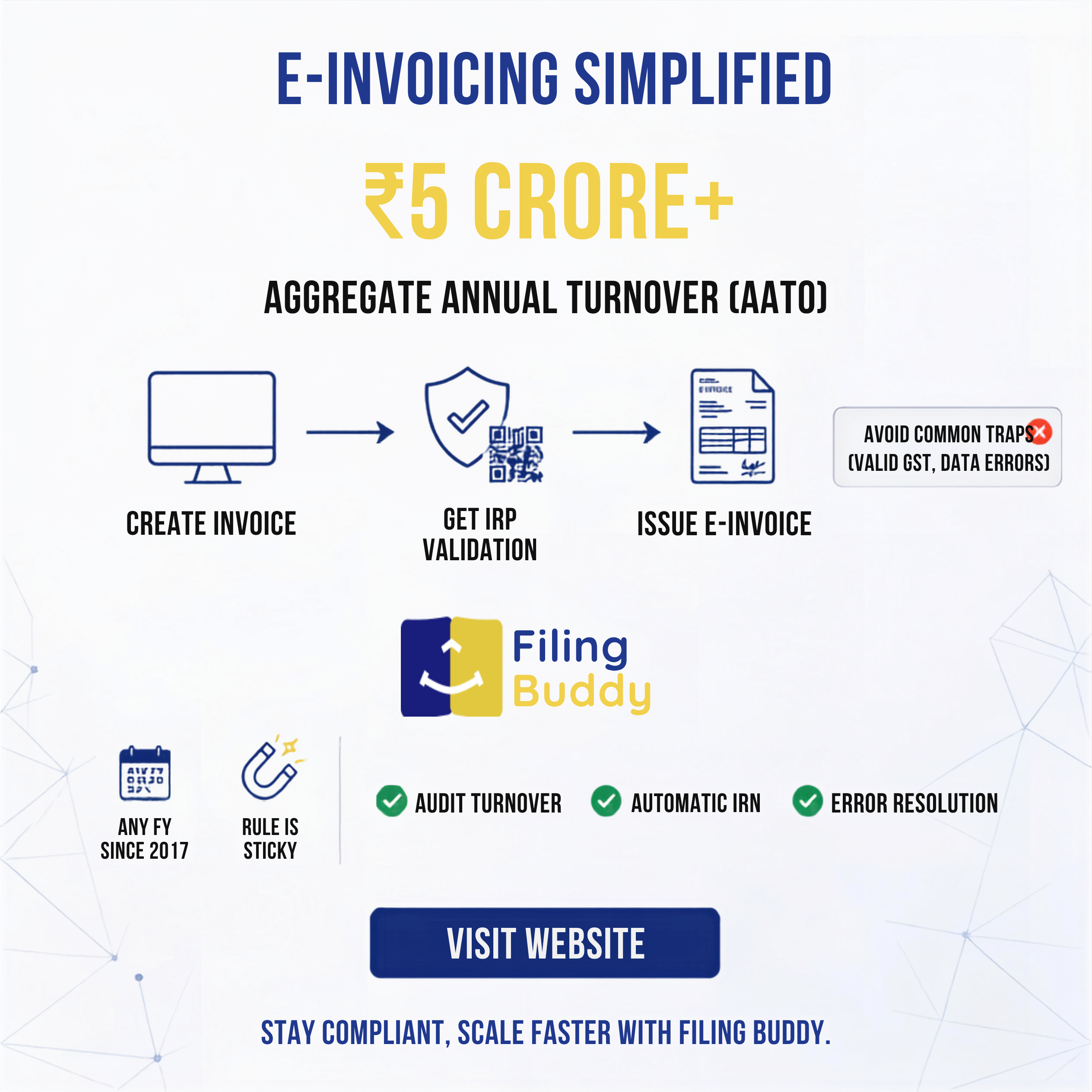
If your aggregate annual turnover (AATO) has crossed the ₹5 crore threshold in any financial year from 2017–18 onwards, e-invoicing is legally mandatory for all your B2B transactions.
The government has progressively tightened the net on electronic reporting. Under the current framework, the e-invoicing mandate applies to any registered entity whose turnover has touched or exceeded ₹5 crore in any financial year since GST was rolled out. You can review detailed threshold history and regulatory analysis via the Xflow E-Invoice Limit Guide.
Critical Rules Founders Often Miss:
- The Rule is Sticky: If you crossed ₹5 crore even once in a past financial year, compliance doesn't switch off just because your revenue dips lower this year. The obligation sticks.
- PAN-Level Calculation: Turnover is calculated at the PAN level across all GSTINs. If you run multiple branches or warehouses across different states under the same PAN, their turnovers are added together.
- Not a Portal, But a Validation Layer: An e-invoice isn't generated on a government website from scratch. You raise the invoice in your own billing system, push it to the Invoice Registration Portal (IRP), and receive a unique Invoice Reference Number (IRN) and digitally signed QR code. Without that IRN, your tax invoice is legally invalid under Rule 48(4).
For a broader perspective on corporate governance and structural setups, you can also review how businesses handle corporate milestones via resources like the Startup India Registration Process Guide.
Businesses crossing the e-invoice threshold must immediately register on the Invoice Registration Portal (IRP), integrate their billing software, and establish a bulletproof routine for validating B2B tax invoices.
If your audits show you are in the mandatory bracket, scrambling at the end of the month will only invite penalties. As outlined in the official portal guide on IRIS IRP 5 Things To Do Next, follow this clear 5-step operational playbook:
Your E-Invoicing Action Plan:
- Audit Your Multi-Year Turnover: Pull your past financial statements back to FY 2017–18 to confirm if your aggregate PAN-level turnover ever crossed ₹5 crore. You can check official notifications directly on the GST Portal.
- Register on the IRP: If you haven’t already, register your entity on the official E-Invoice IRP Portal. Your standard GST credentials will work.
- Upgrade Your Billing Software: Ditch manual Excel copy-pasting. Integrate your ERP or billing system with an authorized GST Suvidha Provider (GSP) so IRNs are fetched automatically.
- Sync e-Way Bills Instantly: For applicable turnover brackets (such as businesses with an AATO over ₹10 crore facing strict 30-day reporting windows), ensure your e-way bill generation links seamlessly with your IRN generation to prevent goods from getting stuck in transit.
- Train Your Accounts Team: Make sure your billing operators understand error codes (like mismatched PIN codes or state codes) so invoices don't fail validation at checkout.
To ensure your corporate compliance extends beyond GST to income tax deadlines, learn how to protect your business using our guide on Post-July ITR Belated Filing Checks.
Tax Invoices vs. e-Invoices vs. e-Way Bills
Understanding the operational differences between standard tax invoices, digitally authenticated e-invoices, and e-way bills prevents costly compliance mismatches during tax audits.
To help your finance team keep things crystal clear, here is how the core compliance documents stack up against each other:
| Document Type | Primary Purpose | When Is It Mandatory? | Key Risk of Non-Compliance |
| Standard Tax Invoice | Commercial billing record sent to customers | All B2B transactions | Considered an invalid document if statutory fields are missing. |
| e-Invoice (IRN-backed) | Real-time government authentication of B2B sales | Taxpayers with AATO above ₹5 crore | Penalty of ₹10,000 per invoice (or tax involved, whichever is higher) + denial of ITC for your customer. |
| e-Way Bill | Legal permit for moving goods worth over ₹50,000 in transit | Movement of goods across state or intra-state limits | Detention of vehicles and heavy penalties under transit checks. |
Failing to maintain harmony across these documents creates a domino effect that breaks your GSTR-1 matching and freezes your input tax credit (ITC). For a complete breakdown of compliance rules and small business guidelines, check the GimBooks E-Invoice Threshold Guide.
For comprehensive strategies on managing tax compliance records, explore the Filing Buddy Blog Hub.
How Filing Buddy Keeps Your "Dhandha" Protected
Avoid common traps like delayed IRN generation, incorrect B2B buyer GSTINs, and mismatched e-way bills that can freeze your GST refunds and invite hefty tax penalties.
When compliance rules shift, founders often run into recurring operational roadblocks. Trying to manually fix portal errors while trying to close clients drains precious startup energy.
Common Traps:
- The Buyer GSTIN Trap: Issuing an e-invoice to a registered corporate client using an unregistered or inactive GSTIN invalidates the entire transaction and blocks their ITC.
- Typing Errors in Address Data: Simple spelling mismatches between your invoice master data and the IRP database trigger state-code validation failures.
- Ignoring the Rolling Timelines: If your turnover exceeds ₹10 crore, remember that the 30-day strict reporting window means you cannot sit on old invoices for months before uploading them to the IRP.
You can read official advisory guidelines on statutory compliance updates on the CBIC GST Portal. Additionally, stay compliant with historical MCA defaults by checking out the MCA CCFS Scheme Guide.
Automate Your Compliance Today
The fastest way to master the new e-invoicing rules is to audit your historical turnover, integrate automated IRP connectors, and partner with compliance professionals to keep your workflows error-free.
Compliance should run smoothly in the background like a well-oiled engine, not crash your cash flow every month.
Your Zero-Stress Execution Checklist:
- Run a Turnover Check: Calculate your multi-year aggregate turnover to see if the ₹5 crore mandate applies to your entity.
- Audit Your Software Stack: Check if your current billing tool talks directly to the IRP, or if you are wasting hours on manual uploads.
- Hand It Over to Filing Buddy: Connect with our team via the Filing Buddy Official Website. We configure your invoicing systems, audit your GST flows, and protect your dhandha from unexpected notices.
Stop letting complex tax portals slow down your growth. Partner with Filing Buddy today and scale your business with total peace of mind.
FAQ
1. What is the current turnover limit for e-invoicing in India?
The mandatory e-invoicing turnover threshold is an aggregate annual turnover (AATO) of ₹5 crore. Any business that has crossed this limit in any financial year from FY 2017–18 onwards must generate e-invoices.
2. Is e-invoicing mandatory if my turnover drops below ₹5 crore this year?
Yes, the rule is sticky. If your business crossed the ₹5 crore threshold in any single financial year since 2017–18, you must continue generating e-invoices even if your current year's turnover falls below that limit.
3. What transactions require an e-invoice under GST?
E-invoicing is mandatory for B2B supplies (business-to-business), exports (with or without payment of tax), SEZ supplies, and deemed exports. It is not required for B2C (business-to-consumer) transactions.
4. What happens if I issue an invoice without generating an IRN?
An invoice issued by a mandatory taxpayer without a valid IRN is legally treated as an invalid tax invoice under Rule 48(4). This can attract penalties of ₹10,000 per invoice and cause your clients to lose their input tax credit.
5. Are small businesses or sole proprietorships exempt from e-invoicing?
Proprietorships are not automatically exempt based on their structure. If a sole proprietorship's aggregate annual turnover crosses the ₹5 crore threshold, e-invoicing applies to them just like a Private Limited Company.
6. Which entities are completely exempt from e-invoicing?
Specified sectors including banks, financial institutions, insurance companies, goods transport agencies (GTAs), passenger transport services, and multiplex cinema admissions are exempt from e-invoicing.
7. Do I need to generate an e-invoice for export transactions?
Yes, export invoices (both goods and services) must be reported to the IRP to generate an IRN. This is critical to ensure smooth processing of tax refunds and seamless customs clearance.
8. What is the penalty for generating an incorrect e-invoice?
Failing to comply with electronic invoicing rules or generating incorrect/non-compliant e-invoices can attract penalties up to ₹25,000 per invoice.
9. How do I generate an Invoice Reference Number (IRN)?
You generate an IRN by uploading your standard tax invoice JSON payload to the government's Invoice Registration Portal (IRP) or through an authorized GSP-integrated billing software.
10. How can Filing Buddy assist with my e-invoicing compliance?
Filing Buddy helps businesses audit their turnover thresholds, integrate ERP billing tools with the IRP, and resolve validation errors. We handle your technical compliance so you can focus entirely on scaling your operations. Explore more resources on our Filing Buddy Business Hub.
Contact Us
An expert will call you within 24 hours. No payment required to get started.
Related Post
How should a start-up complete ITR filing
Business entities must file their ITR annually to comply with the tax laws of their respective countries. It helps the government assess and collect the appropriate amount of income tax from taxpayers and ensures proper accountability of financial activities.
. 3 Mins.png)
5 step checklist for GST compliance in Indian Startups
Learn about how GST works. The basics of GST along with its compliances. Uncover what your business needs to keep in mind concerning GST rules and GST compliance.
. 3 min read.png)
₹20 Lakhs and Beyond: Understanding GST for Freelancers in India
Are you a freelancer or aspiring to be one? In this blog, uncover the basics of freelancing and requirements involving GST. Learn about all the exemptions, obligations, and compliances of GST for freelancers in india.
. 5 min read